
This time, light has once again been awarded the Nobel Prize: this time, we’ve learned how to use light to “flip a switch” in the brain.
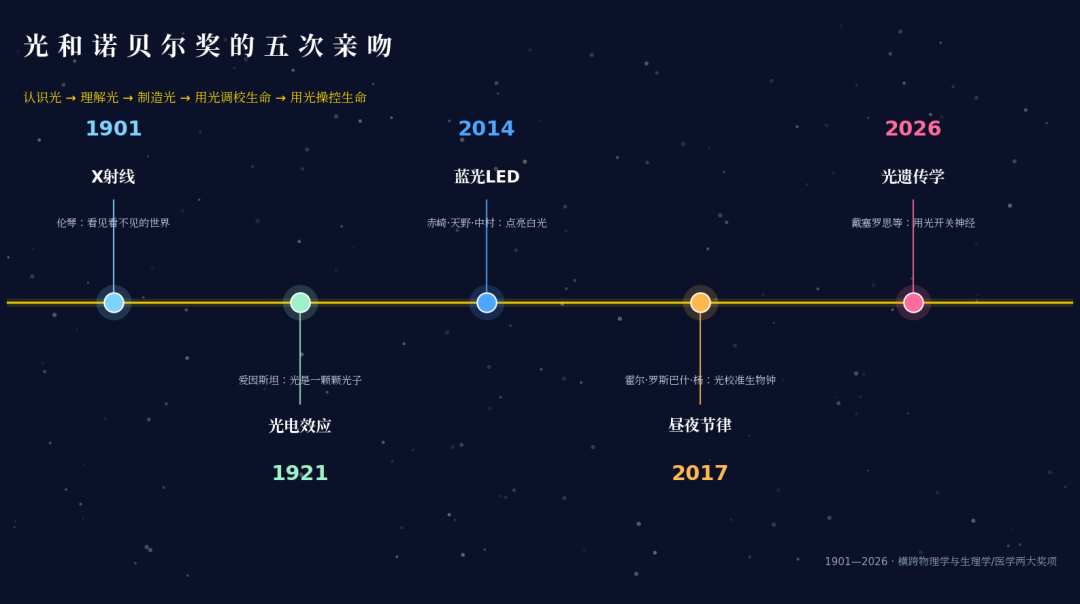
On October 5, local time, the Karolinska Institute in Sweden announced that the 2026 Nobel Prize in Physiology or Medicine would be awarded to optogenetics—the technology of using light to switch brain circuits on and off. Looking back over the past 125 years, light has now been honored with a Nobel Prize for the fifth time—starting from X-rays that can reveal bones, to blue-light LEDs that illuminate countless homes, and now to today’s blue beams that directly stimulate neurons. This forms a clear thread: understanding light → comprehending light → creating light → using light to regulate life → manipulating life with light.
The First Kiss (1901): Seeing the Invisible World
On the night of November 8, 1895, in a laboratory at the University of Würzburg in Germany, physicist Wilhelm Röntgen was working with a cathode-ray tube. To prevent any stray light from leaking out, he tightly wrapped the tube in black cardboard. Yet, as soon as the current was switched on, he noticed that a piece of paper coated with a fluorescent material, about one meter away, began to glow faintly.
How could light travel through the black cardboard?
Over the next six weeks, Röntgen lived and worked entirely in his lab. He discovered that this invisible radiation could penetrate wood, books, and flesh, but was blocked by bone and metal. On December 22, 1895, he asked his wife, Bertha, to place her hand on a photographic plate, capturing humanity’s first medical X-ray—clearly showing the skeletal structure and even her wedding ring. It is said that upon seeing it, Bertha exclaimed, “I have seen my death.”
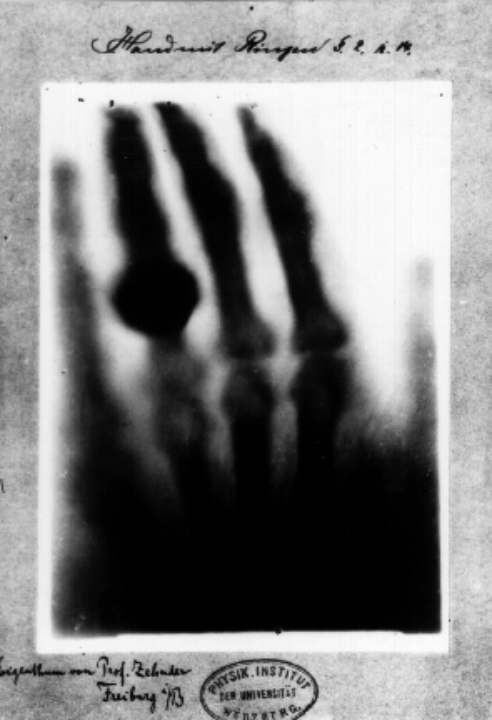
【Illustration 2: Mrs. Röntgen’s Hand】Figure caption: On December 22, 1895, the world’s first medical X-ray—Mrs. Röntgen’s left hand, with clearly visible bones and wedding ring (historical photo, public domain)
Unsure of what this mysterious phenomenon was, Röntgen named it after the mathematical symbol for an unknown quantity: “X.” This very “unknown” opened up a new dimension in human understanding: it turned out that the boundaries of light extend far beyond the narrow band visible to the human eye.
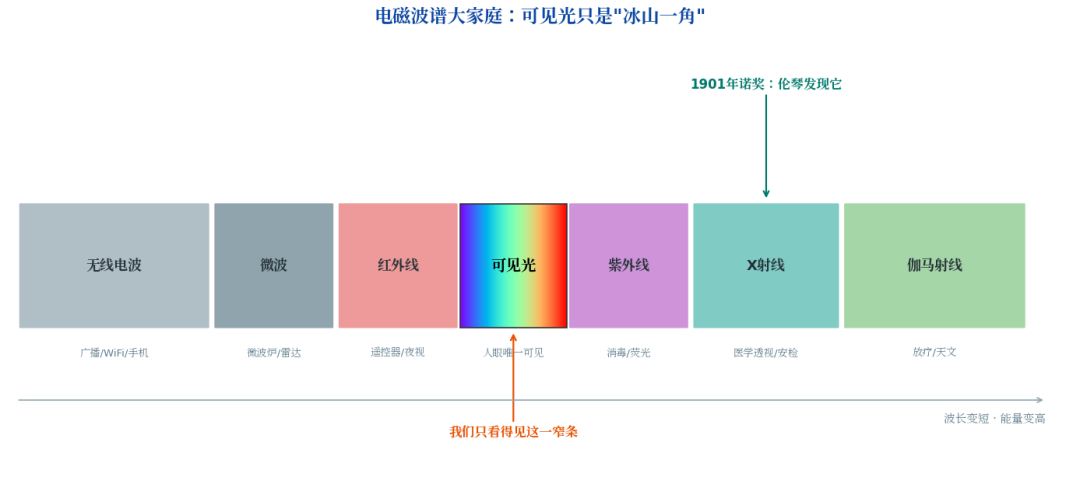
【Illustration 3: The Electromagnetic Spectrum】Figure caption: The electromagnetic spectrum—a vast family, of which visible light is only an extremely narrow segment; X-rays occupy even shorter wavelengths
One detail worth noting: Röntgen did not file any patents for X-rays, and instead donated the prize money from the inaugural 1901 Nobel Prize in Physics to his university. Today, from hospital CT scanners to airport security checkpoints, this “free” discovery saves countless lives every year.
The Second Kiss (1921): Decoding Light’s Quantum Core
Röntgen enabled humanity to see a new kind of light, while Einstein helped us understand its true nature.
The story begins with an “anomalous” experimental observation. Scientists found that when light shines on a metal surface, electrons are ejected—a phenomenon known as the photoelectric effect. But here’s the strange part: no matter how bright red light is, it cannot eject electrons, whereas even dim ultraviolet light can do so; moreover, electrons fly out instantaneously, without any energy accumulation.
According to the century-old theory that “light is a wave,” wave energy should be continuously transmitted. Thus, if light is strong enough and shines long enough, electrons ought to be emitted. Yet experimental evidence contradicted this classical explanation.
In 1905, at age 26, patent office clerk Albert Einstein proposed a groundbreaking hypothesis: light is not a continuous wave, but rather discrete “energy packets”—later called photons. The energy of each photon depends solely on its frequency (color), not its brightness. Red light with insufficient frequency is like a pile of tiny pebbles unable to crack a walnut—no matter how many there are, they’re useless. In contrast, high-frequency ultraviolet photons can knock out an electron with just one particle.
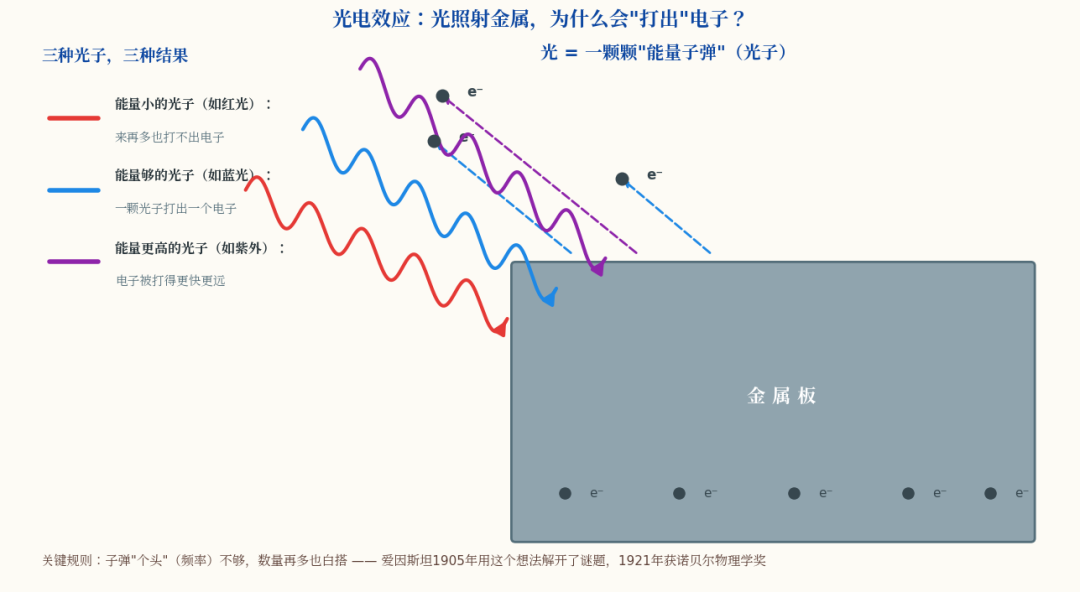
【Illustration 4: The Photoelectric Effect Principle】Figure caption: The “energy packet” model of the photoelectric effect—photon energy depends on frequency (color), not brightness
This hypothesis seemed absurd even to experimental physicist Robert Millikan, who spent ten years trying to disprove it. Instead, his experiments precisely confirmed Einstein’s formula—and Millikan himself went on to win the 1923 Nobel Prize in Physics.
Thus, the 1921 Nobel Prize in Physics was awarded to Einstein. Notably, he received the award for the photoelectric effect, not for relativity. This breakthrough established light’s “wave–particle duality” and laid the foundation for quantum mechanics as a whole. Today, the solar panels we use, smartphone cameras, and fiber-optic communications—all rely on the underlying logic of these tiny “photons.”
The Third Kiss (2014): Creating Blue Light That Illuminates Our World
The first two Nobel Prizes celebrated “understanding light,” while the third recognized “creating light”—and it was the most relevant to all of us.
LEDs (light-emitting diodes) were nothing new: red and green LEDs had already appeared in the 1950s and ’60s. However, producing a blue LED proved elusive for three decades. The reason was simple: without combining red, green, and blue primary colors, white light could not be achieved, and LEDs would never enter the lighting market. At the time, incandescent lamps with low luminous efficacy and mercury-containing fluorescent lamps dominated the global market.
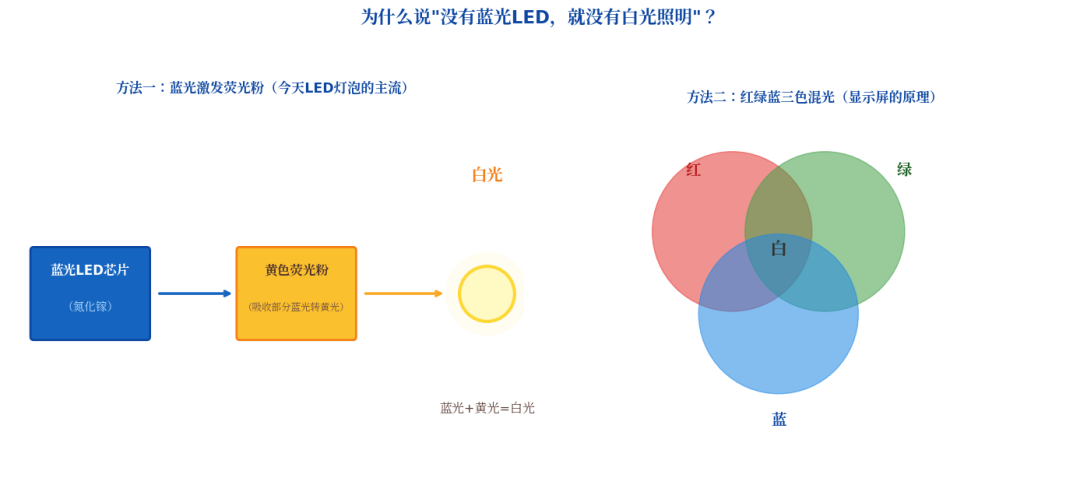
【Illustration 5: How Blue LEDs Become White Light】Figure caption: Without blue light, there is no white light—today’s mainstream approach to LED bulbs combines a blue chip with yellow phosphor
The challenge with blue LEDs lay in materials: they required a semiconductor called gallium nitride, whose crystals were extremely difficult to grow, prone to defects and breakage. Major manufacturers such as RCA abandoned the effort as early as the 1970s. However, Isamu Akasaki and Hiroshi Amano of Nagoya University refused to give up. In 1986, they first deposited an aluminum nitride “buffer layer” on a sapphire substrate, successfully growing high-quality gallium nitride crystals. By 1989, they had also solved the problem of p-type doping, producing the first prototype of a blue LED meeting brightness standards. Meanwhile, in Tokushima, a small Japanese city, engineer Shuji Nakamura at Nichia Corporation—a tiny chemical company with just 200 employees—developed innovative equipment, and in 1993 created the world’s first high-brightness blue LED, bringing it to market ahead of others.
In 2014, the Nobel Prize in Physics was awarded to these three scientists, with the citation praising their invention of highly efficient blue LEDs, which brought bright, energy-saving white illumination. The chair of the Nobel Committee put it bluntly: “Many large companies tried and failed; it was these three individuals who persevered.”
Today, LED lighting saves more than 80% of the energy consumed by traditional incandescent lamps, steadily reducing the global share of electricity used for lighting. This kiss ushered in a new era of everyday life.
The Fourth Kiss (2017): Light Is Telling Us the Time
If the first three kisses belonged to physics, then the fourth shifted the Nobel focus from the laboratory to life itself.
Almost all living organisms on Earth possess a roughly 24-hour biological clock that governs their daily rhythms: waking at sunrise and resting at sunset. But how exactly does light set this clock? The 2017 Nobel laureates Jeffrey Hall, Michael Rosbash, and Michael Young unraveled the mystery using fruit flies.
The story began in 1971: scientists at Caltech discovered a mutant strain of fruit flies, some with faster clocks, some slower, and others completely malfunctioning—all due to a gene called period. In 1984, Hall, Rosbash, and Young independently cloned this gene and pieced together an intricate molecular gear system:
At night, the period gene initiates production of PER protein, which accumulates within the cell;
When PER protein builds up, it enters the nucleus and “shuts down” its own production genes—essentially applying the brakes on itself;
During the day, PER protein gradually degrades, releasing the brakes and allowing the genes to restart, beginning a new cycle;
A key player is another protein called TIM: it is sensitive to light and breaks down when exposed to it—this serves as the molecular switch that resets the biological clock to zero every morning.
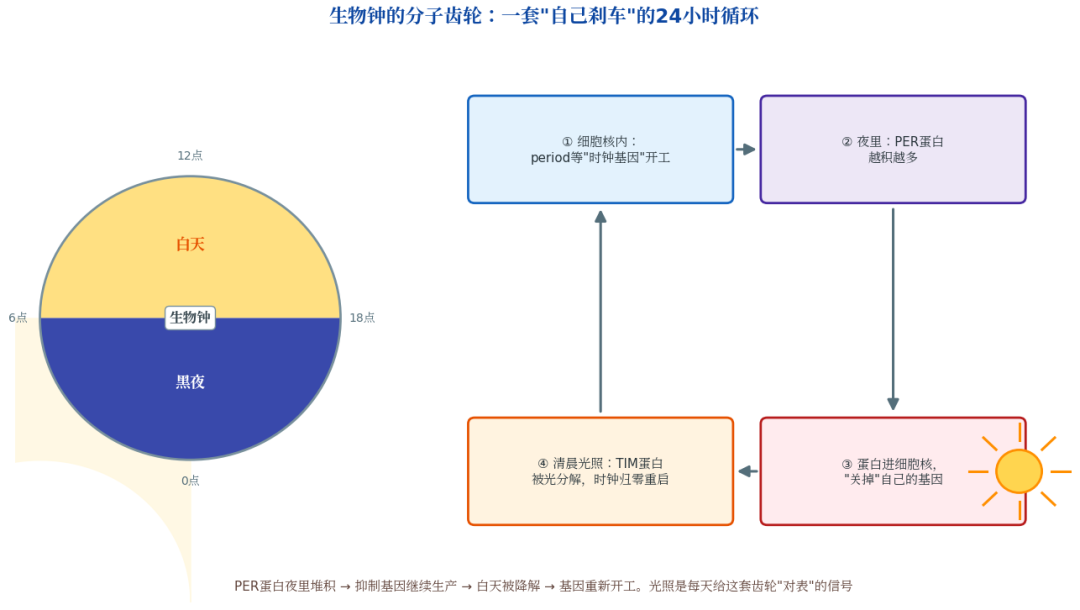
【Illustration 6: The Biological Clock’s Negative Feedback Loop】Figure caption: The molecular gears of the biological clock—PER protein accumulates at night and self‑inhibits, while morning light resets the clock by breaking down TIM protein
But how does light transmit its signal into the brain? In 2002, scientists found the answer: besides the cone and rod cells responsible for vision, our eyes contain a third type of photoreceptor—ipRGCs, containing melanopsin—which do not participate in image formation but instead report the time to the brain’s central biological clock headquarters, and are especially sensitive to blue light around 480 nanometers.
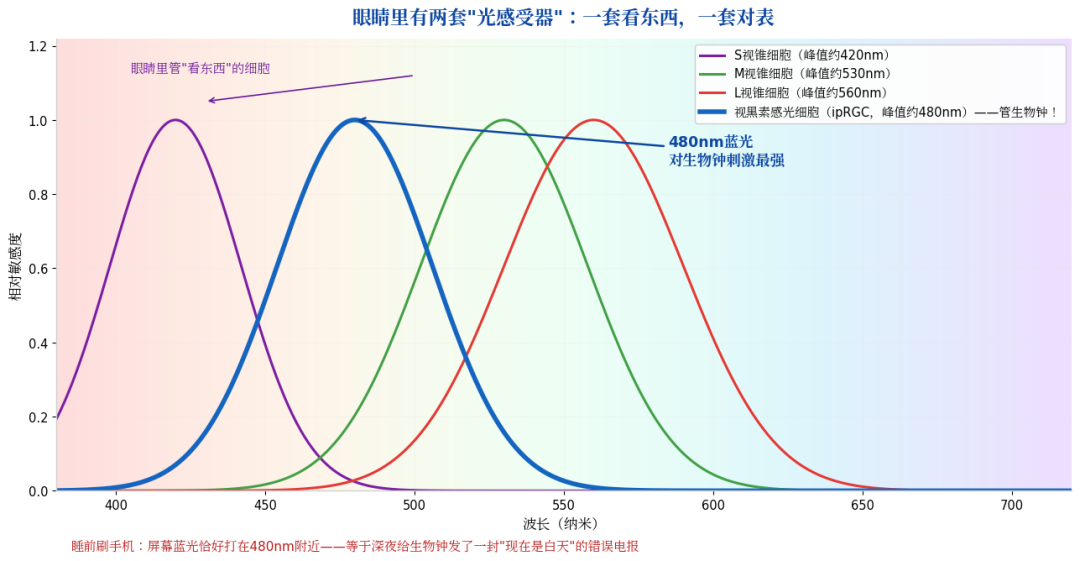
【Illustration 7: Why Blue Light Is So Energizing】Figure caption: There are two sets of light receptors in the eye—cone cells for imaging, and ipRGCs for regulating the biological clock (most sensitive to 480 nm blue light)
This explains a paradox of modern life: why does scrolling on your phone before bed make you feel more awake? Because the screen’s blue light happens to fall near 480 nanometers—effectively sending your biological clock a mistaken “it’s daytime” message late at night. Metabolic disorders, sleep disturbances, and even increased health risks caused by staying up late, shift work, or flying across time zones—all stem from disrupted circadian rhythms. As early as 2007, the International Agency for Research on Cancer classified “shift work that disrupts circadian rhythms” as a Group 2A carcinogen.
For the lighting industry, this Nobel Prize carries profound implications: light is not merely a tool for illuminating spaces, but also a “timekeeping signal” that regulates life—the scientific foundation behind recent concepts like “human-centric lighting” and “healthy lighting.”
The Fifth Kiss (2026): Using a Beam of Light to Flip a Switch in the Brain
Today (October 5, 2026), the Karolinska Institute in Sweden announced that this year’s Nobel Prize in Physiology or Medicine would be awarded to Karl Deisseroth, Peter Hegemann, and Georg Nagel, in recognition of their discoveries related to light-gated ion channels and optogenetics. The three will share a prize of 12 million Swedish krona (approximately 8.02 million yuan).
The story begins with a single-celled algae.
In the 1990s, Hegemann became curious about one question: why does Chlamydomonas reinhardtii, a single-celled alga, respond so rapidly to light? Human visual perception requires a series of chemical reactions lasting at least 10 milliseconds, whereas this alga reacts more than 20 times faster. Together with Nagel, they eventually uncovered the answer: channelrhodopsin—a protein embedded in the cell membrane that acts like a gatekeeper. When blue light shines on it, the ion channel inside opens, allowing charged ions to rush into the cell and generate electrical signals directly. This is a “light-speed” photoelectric conversion, with no intermediate chemical transmission.
Even more remarkable, they discovered that transplanting this protein’s gene into other cells could endow those originally unresponsive to light with a “light-sensitive switch.”
Deisseroth took up the crucial baton: in 2005, he introduced the channelrhodopsin gene into rat nerve cells, successfully triggering neural signals with blue light; by 2007, he further achieved delivering blue light via optical fibers directly into the brains of live mice, precisely activating specific neurons—thus giving birth to optogenetics, the fusion of optics and genetics.
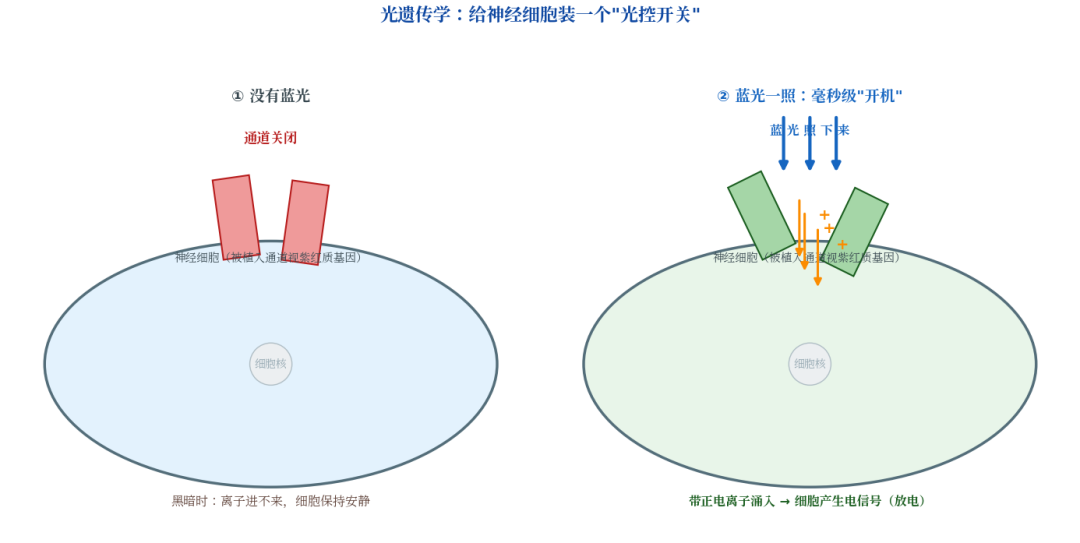
【Illustration 8: The Principles of Optogenetics】Figure caption: Optogenetics—implanting an algae-derived “light-controlled switch” into nerve cells, enabling millisecond-level activation upon exposure to blue light
The revolutionary aspect of this technology lies in the fact that, in the past, studying the brain meant researchers could only “observe”—noticing a certain brain region light up and speculating its connection to a particular behavior, yet lacking proof of causality. Now, they can press a keyboard-like switch to precisely turn on or off specific types of neurons, directly verifying what these cells actually do. How memories form, how fears are encoded, how addictions develop, where abnormal neural circuits lie in Parkinson’s disease or epilepsy—all these mysteries have been unlocked over the past two decades by thousands of laboratories worldwide, using this “key of light.” The Nobel Committee Chair remarked, “Optogenetics offers the possibility of mapping the brain in ways we once only dreamed of.”
It is also moving toward clinical applications: in 2016, a woman in Dallas, USA, who had lost her sight due to retinitis pigmentosa, underwent the world’s first optogenetic therapy trial—transplanting the light-sensing protein gene into remaining retinal cells, replacing dead photoreceptors with artificial light signals. The research team’s ultimate goal is to help the blind “see” again.
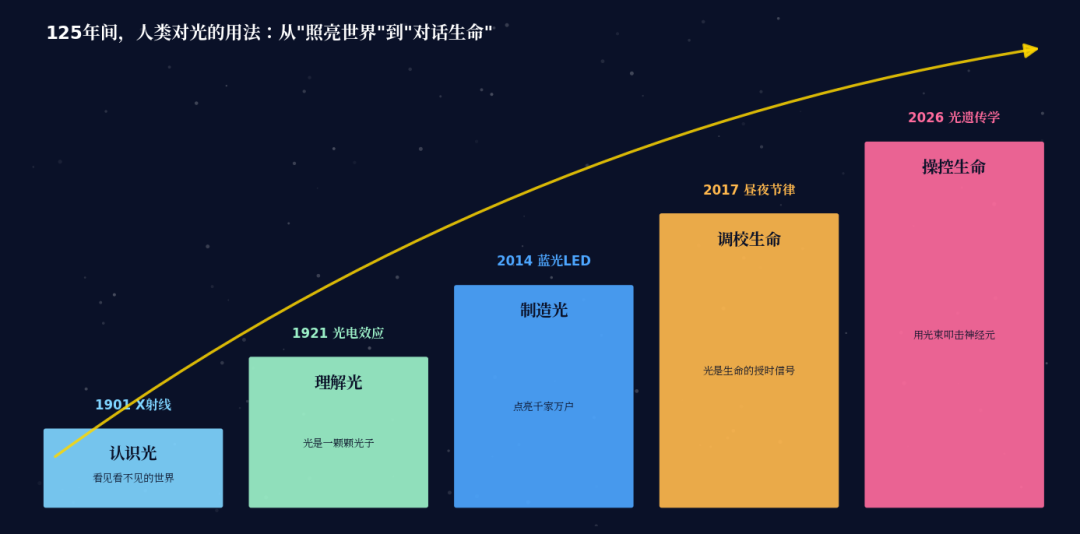
【Illustration 9: From Illumination to Dialogue with Life】Figure caption: Over 125 years, humanity’s use of light has completed five major stages of evolution
Looking back at these five kisses, a clear trajectory emerges:
1901: Understanding light—there is much more to light than what meets the eye;
1921: Comprehending light—light is composed of quantized energy packets;
2014: Creating light—humans mastered efficient, affordable artificial light sources for the first time;
2017: Regulating life—light calibrates our biological clocks through the eyes every day;
2026: Manipulating life—light becomes a precise switch for direct dialogue with neurons.
From “illuminating the world” to “dialoguing with life,” light’s role in human hands has fundamentally changed. For lighting professionals who have spent a lifetime working with light, this marks both the best possible moment and an invitation: as light begins to be prescribed as a “medicine,” those who truly understand it will find themselves increasingly in the spotlight.
Reprint Notice
This article was reprinted from the WeChat official account “Guang Ju Ju Guang Le Le,” authored by “Xiaoyao Shanren Xiaoyao Feng.”
China Light
The official website of the China Association of Lighting Industry and a full-media platform for the lighting sector. We provide authoritative and timely lighting information while striving to be a growth partner for businesses. From brand promotion and channel expansion to consulting, talent training and participation in standards development, we provide comprehensive professional services to help businesses improve quality and efficiency and jointly advance the high-quality development of the lighting industry.
Business Contacts
仇纯 (Ms.): 158 6155 3579
顾君 (Mr.): 137 7157 5253