
Say goodbye to parameter-driven competition! Feng Jian breaks down new strategies and implementation pathways for Healthy lighting (including a guide to avoiding common pitfalls in commercial installations).
On September 16, the “Guzhen Lighting Expo: Bright Minds Online” salon, hosted by Zhongshan Guzhen Light City Expo Co., Ltd. and organized by China Zhi Guang All-Media · Ming Classroom, kicked off online. This session featured Mr. Feng Jian, Vice President of the Henan Provincial Illumination Society and a senior lighting designer, who outlined the theoretical framework and practical project approaches for healthy lighting as the industry transitions from an “energy efficiency revolution” to a “human-centered light environment revolution.”
A Shift in Thinking:
From “Selling Luminous Flux” to “Delivering Verifiable Light”
Mr. Feng Jian pointed out that historically, the industry has focused on selling lamp specifications and competing based on luminous flux, with designs often starting from the premise: “This area is too dark—let’s provide more light,” or “Once we sell the lamp and make it shine, it’s valuable.” However, as requirements like low blue light have become mandatory, the market is shifting toward a human-centered approach: design must deliver tangible, verifiable health benefits to real spaces and people.
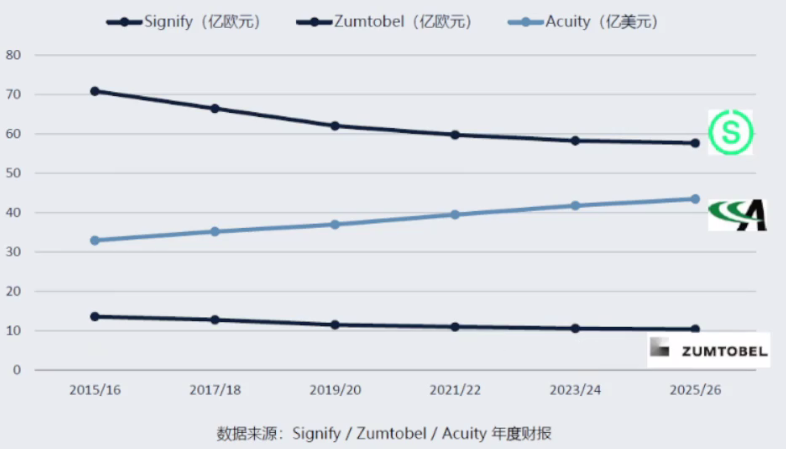
Ten-year revenue trends of the three major players
The Scientific Foundation:
The Four Value Quadrants of Healthy Light
A qualified beam of light must pass the test of four key quadrants: Health, which addresses circadian rhythm lighting and melatonin suppression; Sustainability, covering the full lifecycle, carbon neutrality, and recyclability; Productivity, focusing on concentration and work efficiency; and Emotion, relating to ambiance, social interaction, and emotional memory. Meanwhile, traditional national and industry standards typically only cover lamp-side parameters such as illuminance, luminous efficacy, glare rating, and color rendering index, leaving out the crucial question: “What impact does light actually have on people?”
What kind of light is right for this particular person?
We Must Start Understanding People
The new national standard GB/T 46119-2025 “Dose–Response Relationship of Non-Visual Biological Effects of Light on the Human Eye” fills this gap, with two particularly critical indicators:
m-EDI (Melanopic Equivalent Daylight Illuminance at D65): Measured according to vertical eye position measurements, at 1.2 meters when seated and 1.5 meters when standing—rather than the conventional 75 cm working surface. A handheld spectroradiometer is required, as ordinary illuminometers cannot measure this parameter.
CS (Circadian Stimulus): Ranges from 0 to 1, reflecting the degree of melatonin suppression during nighttime.
For example, in a bedroom, three hours before bedtime, m-EDI should be below 10 lx and CS below 0.1. Exceeding these thresholds can disrupt melatonin secretion and impair sleep—findings derived from extensive surveys of Chinese populations.
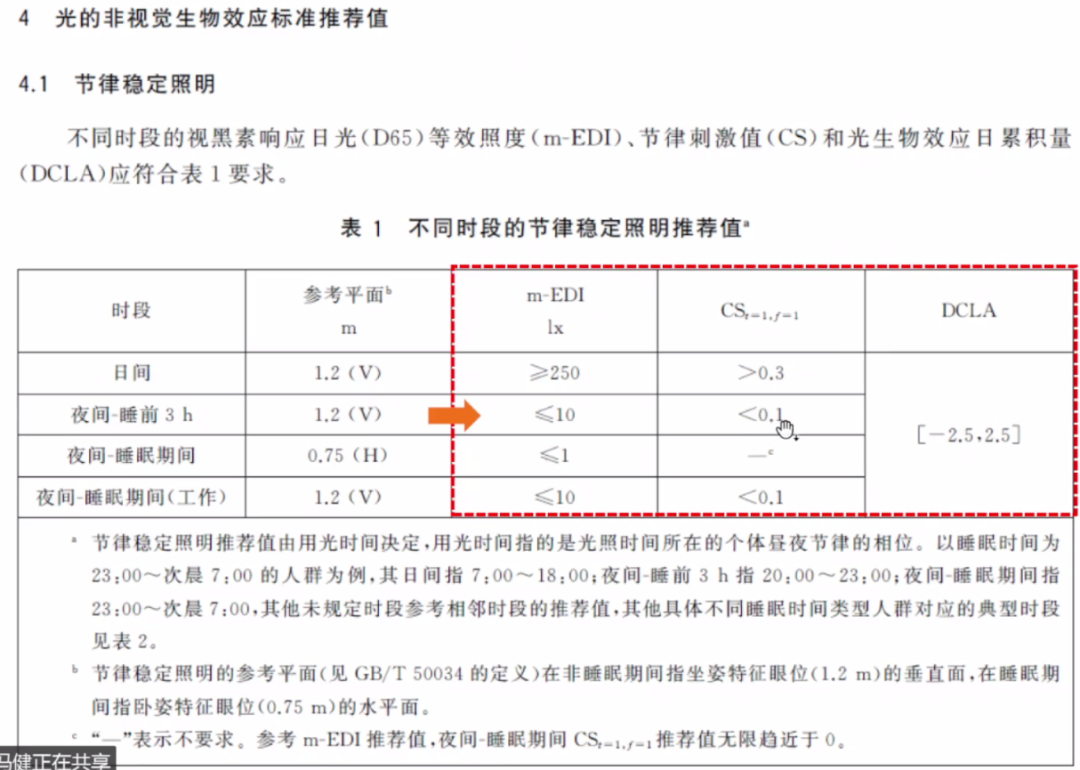
Recommended values from GB/T 46119-2025 “Dose–Response Relationship of Non-Visual Biological Effects of Light on the Human Eye”
Mr. Feng emphasized that healthy lighting must form a closed loop:
Healthy Lighting Chain:
Light Environment Design + Human Physiological Response → Health Benefits → Continuous Optimization.
Smart Lighting Chain:
Device Connectivity + Data Sensing → Intelligent Decision-Making → Execution Feedback.
If any link in the chain is broken, healthy lighting becomes mere marketing jargon, and smart lighting is nothing more than pseudo‑intelligence with Wi‑Fi added.
Home Design:
24-Hour Light Formula
In response to modern lifestyles—insufficient daylight during the day and disruptive blue light from screens at night—Mr. Feng proposed dynamically adjusting the light environment according to daily cycles:
6:30–9:00: Cool white light to help the body wake up quickly.
9:00–17:00: Comfortable illuminance and color rendering to support work efficiency.
17:00–21:00: Warm light around 3000–3500K to create a cozy atmosphere.
21:00–23:00: Lower the color temperature (below 2000K) and control m-EDI to minimize sleep disruption.
Late Night: Extremely low color temperature to ensure elderly individuals can get up without being startled by bright light.
Design Insights
A truly intelligent light environment isn’t just about turning lights on or off or adjusting brightness—it’s about following the human body’s circadian rhythm to craft a “light script.” Traditional solutions often overlook the special lighting needs before bed and during nighttime, which are among the hidden factors affecting modern sleep quality.
For elderly individuals getting up at night, he offered five key recommendations: reduce vertical illuminance at eye level (1.2 meters); avoid direct light shining into the eyes; minimize high-mounted lighting and prefer deep anti-glare fixtures (no exposed downlights); use more low-level, indirect, soft light sources; and ensure continuous lighting along the nighttime pathway to eliminate dark areas and reduce fall risks.
Mr. Feng also reminded everyone that blue light doesn’t need to be demonized—it’s essential during the day, and appropriate levels in office spaces can even enhance focus. Strict controls are only necessary at night to protect sleep.

Key wavelength highlights: 460–490 nm short-wave blue light (the core range with the greatest impact)
He also provided a five-question self-assessment checklist for home lighting (including time-of-day segmentation, pre-sleep m-EDI values, nighttime pathways, transition periods between study and bedtime, and coordination between nighttime screens and end systems), serving as a self-check tool for designers. Both this checklist and the aforementioned new national standard are recommended, not mandatory.
Commercial Space Design:
Four Major Scenarios + Construction Pitfalls to Avoid
Commercial space design draws on the WELL Building Standard, covering offices, healthcare facilities, hotels, and wellness centers. For instance, in office environments, simply meeting 300 lx on the desk isn’t enough; sufficient vertical illuminance at eye level must be maintained throughout the day, with localized boosts above 800 lx during the afternoon slump to combat fatigue. Healthcare and wellness settings prioritize circadian rhythm lighting.
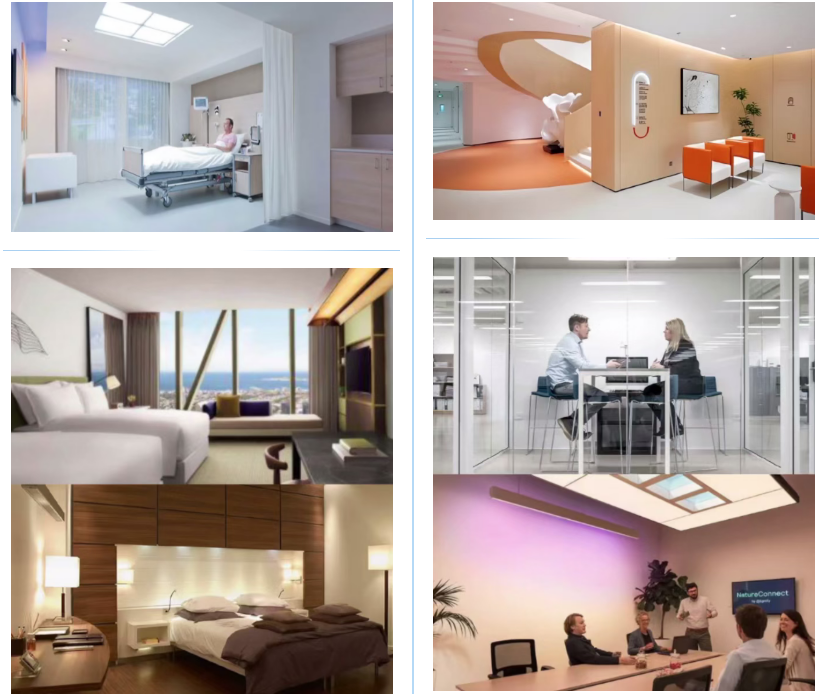
Top left: Benchmark case—Suzhou Sukang Senior Care Hospital’s circadian ward
Top right: InSona Suzhou Sukang Senior Care Hospital (circadian ward)
Bottom left: Tangguo Shanghai’s luxury residence
Bottom right: Signify’s 5A-class office building
Common pitfalls on the construction side include: uncontrolled color tolerance, ignoring environmental reflections when calculating lamps, furniture and soft furnishings obstructing light, and adjusting only brightness without coordinating timing.
Mr. Feng suggested source-control measures—quantifying color tolerance and m-EDI indicators in tender documents, requiring lamps from the same batch, conducting sample sealing and post-delivery inspections, and resolutely rejecting non‑compliant products—to achieve comprehensive oversight across pre‑construction, mid‑construction, and post‑construction phases. He successfully implemented circadian lighting and empirical verification in benchmark projects such as Suzhou Sukang Senior Care Hospital’s circadian ward, luxury residences, and 5A‑class office buildings.
Five Actions Designers Can Implement This Week
Include non‑visual metrics like m-EDI and CS in your proposals to strengthen persuasiveness.
Clearly specify technical requirements such as SPD spectrum, timing, and luminous intensity distribution curve (LDC) in contracts.
Bring a spectrometer to site for on‑site measurements during acceptance testing.
Consider hard and soft finishes in advance to anticipate light loss.
Strengthen on‑site commissioning and project management to ensure consistent implementation of design outcomes.
Interactive Q&A
During the salon’s interactive session, Mr. Feng addressed audience questions:
1. Are the “five‑question self‑assessment” checklist for homes and the commercial‑space acceptance checklist mandatory or recommended?
Mr. Feng: They’re recommended—not mandatory—and GB/T 46119-2025 is likewise a recommended national standard. Incorporating these checklists into your proposals demonstrates a human‑centered approach and enhances persuasiveness.
2. How can we prevent issues like uncontrolled color tolerance, furniture blocking light, or ineffective commissioning during construction?
Mr. Feng: Control starts at the bidding stage—quantify all indicators including color tolerance and m-EDI; require lamps from the same batch to minimize chip‑batch‑induced color variations; strictly seal samples and conduct post‑delivery inspections, resolutely rejecting non‑compliant products. Rigorous oversight across design, supply, and acceptance ensures alignment between drawings and actual implementation.
3. How do we communicate the value of healthy light to clients and persuade them to pay?
Mr. Feng: Integrate m-EDI, CS, flicker, melatonin suppression, and color‑temperature timing controls into your proposals, rather than merely showcasing illuminance and color temperature. Deeply engage in procurement, use a spectroradiometer on site to gather quantifiable data, and present clear evidence of value to ensure consistency between design and execution.
4. What should we do if the manufacturer’s sample test report differs from on‑site measurements?
Mr. Feng: Manufacturer reports measure lamp‑body parameters, while on‑site tests assess what the human eye receives, influenced by installation methods and environmental reflections. If discrepancies arise, first determine whether the issue lies with the lamp or the installation. If problems persist after debugging, collaborate with the manufacturer to resolve lamp compatibility issues.
5. Which steps should novice designers prioritize to put healthy lighting principles into practice?
Mr. Feng: First, thoroughly understand current national lighting standards and master design software such as DIALux evo and Koolux. Use Koolux to simulate m-EDI and melanopic equivalent illuminance, assessing both working‑surface illuminance and vertical eye‑level illumination, while also considering LPD energy‑saving metrics. Listen, observe, and research extensively, gradually implementing these concepts in real projects.
Conclusion
The essence of this salon was to bring healthy lighting back from a marketing slogan to measurable, verifiable, replicable engineering practices. Mr. Feng redefined the criteria for evaluating light using four value quadrants, reminding us through m-EDI and CS indicators in the new national standard that the true value of light lies not in spec sheets but in the human eye within real spaces. With a 24‑hour light formula, a construction‑pitfall checklist, and three real‑world case studies, he demonstrated how “human‑centered” principles can move beyond abstract ideals and take root in every selection, contract, and spectroradiometer measurement.
From “selling luminous flux” to “delivering verifiable light”—this transformation goes beyond technical metrics; it represents a fundamental shift in designers’ mindset: light is no longer just about illuminating a space, but about caring for the people within it. May this sharing serve as a fresh starting point for more professionals to reexamine their drawings and reimagine the light they create.
Note: This article is compiled from the recording of Mr. Feng Jian’s presentation titled “From ‘Selling Luminous Flux’ to ‘Delivering Verifiable Light,’” delivered on September 16, 2026, at Ming Classroom, and published by Ming Classroom.
China Light
The official website of the China Association of Lighting Industry and a full-media platform for the lighting sector. We provide authoritative and timely lighting information while striving to be a growth partner for businesses. From brand promotion and channel expansion to consulting, talent training and participation in standards development, we provide comprehensive professional services to help businesses improve quality and efficiency and jointly advance the high-quality development of the lighting industry.
Business Contacts
仇纯 (Ms.): 158 6155 3579
顾君 (Mr.): 137 7157 5253