
Lighting Chronicle | Philips → Signify: Hand Over the Lighting Business, Keep the Name
Almost everyone in the lighting industry has encountered this scenario: a customer points at a Light bulb / Lamp and asks, "Does Philips still make lamps?"
The answer is: does, but it's not Philips making them.
Today, there are three companies bearing the "Philips" name that are related to lighting:
Royal Philips — the parent company, now a health technology firm that makes CT scanners, patient monitors, razors, and electric toothbrushes;
Signify — the Dutch company that spun off from Philips in 2016 and listed on the stock exchange; the Light bulb / Lamp, tube, and Hue smart lights you buy all carry the Philips brand under a licensing agreement;
Versuni (formerly Philips Domestic Appliances) — the air fryer and coffee machine business, which was sold to Hillhouse Capital in 2021 along with a 15-year brand license.
By the way: The Philips brand has also been licensed to manufacturers of TVs, mobile phones, air conditioners, water purifiers, and other categories, resulting in a fragmented licensing landscape; this article focuses solely on the lighting segment.
There is another asset often mistakenly thought to be "Philips' chip business," but it has long since left Philips and no longer bears its name: Lumileds. It was sold to Apollo in 2017, underwent bankruptcy reorganization in 2022 with its equity wiped out, and has since been twice attempted to be acquired by Chinese buyers—only to be blocked each time by the U.S. Committee on Foreign Investment (CFIUS). That's another story, which will be covered later.
One brand, three financial statements, each operating independently.
This situation forms a striking parallel to Osram, which we discussed in our previous article. Osram's outcome was as follows: after signing an agreement in 2016 and closing the deal in March 2017, it sold its general lighting business to LEDVANCE; in 2020, the entire company was acquired by Austrian sensor manufacturer ams, eventually changing its legal name to ams-OSRAM. Philips' outcome was similar: it also divested its lighting operations, but chose to spin them off via an IPO, allowing the parent company to gradually reduce its stake and exit gracefully. Today, the lighting business remains independent and continues to hold the top global position.
Further reading:
The same industry, two drastically different paths to demise and survival.
This article clarifies Philips Lighting's 135-year history: how it rose to the top, why it chose to divest, what pitfalls it encountered during the process, who owns the "Philips" brand today, and a less-discussed question—when the "global leader" experienced three consecutive years of declining revenue, how did it stay afloat?
I. Origins:
From a Light bulb / Lamp Factory to Global Leader (1891–2014)
In 1891, Dutch engineer Gerard Philips and his father Frederick, a former banker, purchased a small factory in Eindhoven to produce carbon-filament light bulbs. Gerard studied mechanical engineering in Delft, later pursued electrical lighting in Glasgow, and even worked for AEG in Berlin—experiences that convinced him that light bulbs were not a craft, but a science.
The early years were difficult, and the company nearly went bankrupt. The turning point came in 1895 when his younger brother, 16 years his junior, Anton Philips joined the business: Gerard oversaw technology and production, while Anton carried samples door-to-door to handle sales. Within a few years, Philips light bulbs were selling throughout the Netherlands.
What truly set Philips apart from other lamp manufacturers was the establishment of the Physical Laboratory (NatLab) in 1914, led by physicist Gilles Holst. This was one of Europe's earliest industrial research laboratories. Its work extended far beyond improving incandescent lamps—gas discharge, mercury vapor, sodium lamps, phosphors, and compact fluorescent lamps all originated here; even breakthroughs in X-ray tubes laid the groundwork for Philips' later entry into medical devices.
Here's a detail worth noting for those in the lighting industry: in 1924, Philips joined several industry giants including Osram in the Phoebus Cartel—the infamous monopoly alliance that standardized lamp life to 1,000 hours. Although their subsequent fates diverged dramatically, during the 1920s they were partners sitting at the same table.
After the war, Philips maintained its leadership with fluorescent lamps and PL/SL energy-saving lamps, while simultaneously expanding into consumer electronics, semiconductors, and healthcare. By the 2000s, it had become an industrial icon of the Netherlands. Around 2007, its lighting business made successive moves in North America: it acquired LED control systems company Color Kinetics and North American luminaire manufacturer Genlyte ($95.50 per share, according to SEC filings)—the latter bringing Philips some of the most valuable assets in professional North American lighting: channels and brands (such as Lightolier and Day-Brite), setting the stage for Cooper's acquisition more than a decade later.
Lumileds' origins also deserve mention: starting in 1999, it was a joint venture between Philips and HP (bringing high-brightness LEDs from HP labs to mass production); in November 2005, Philips bought out Agilent's entire stake for $949 million (as disclosed in Agilent's SEC filing), gaining full ownership of this upstream chip asset.
By 2015, Philips Lighting reported annual revenues of €7.465 billion, making it the world's largest lighting company. Osram ranked second with approximately €5.5 billion that year.
This explains the claim in the Osram article that it was "the world's second-largest lighting company."
Philips has consistently held the top spot.
II. A Graceful Farewell:
Not a sale, but a separation (2014–2016)
On September 23, 2014, Royal Philips announced a major restructuring: splitting the company into two entities—one focused on health technology, the other on lighting.
The rationale was straightforward. The LED replacement wave had transformed lighting from a "light source business" into an "electronics business," with price wars growing increasingly fierce year after year, and the Chinese supply chain squeezing profit margins in the mid-to-low end market. Meanwhile, medical devices offered higher gross margins, stronger barriers to entry, and steady growth. Valuing both businesses together resulted in a discounted valuation in the capital markets—investors in healthcare didn't want to subsidize lighting cycles, while investors in lighting didn't want their returns diluted by R&D spending in healthcare.
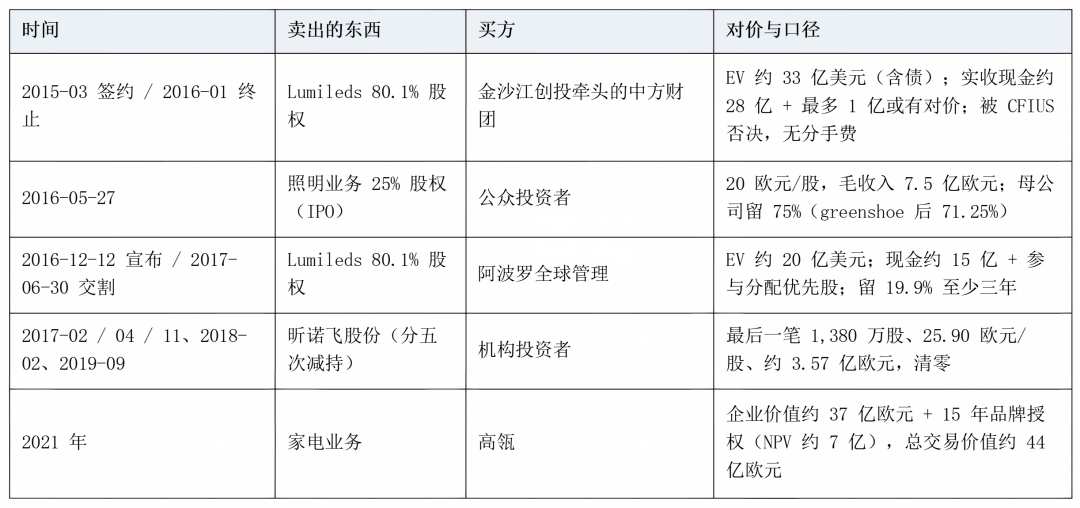
Thus came the May 2016 IPO: priced at €20 per share (midpoint of the €18.5–€22.5 range), set on May 26, and listed on Euronext Amsterdam on May 27 under the ticker LIGHT. The base offering consisted of 37.5 million shares (25% stake), raising approximately €750 million in gross proceeds, corresponding to a market cap of €3 billion and an implied enterprise value of about €4.5 billion (including net debt, pension liabilities, and minority interests). After selling 25%, the parent company retained 75%; after fully exercising the greenshoe option on June 13, the ownership stake was diluted to 71.25%.
In contrast, consider what happened at Osram: In July 2019, Bain Capital and Carlyle Group initially bid €35 per share; Austrian sensor company ams later raised its offer to €38.5; after several rounds of bidding, ams submitted a final offer of €41, announcing it on October 18, 2019, and issuing a formal tender offer on November 7, totaling approximately €4.6 billion in total consideration; the transaction closed on July 9, 2020, leaving ams with a 69% stake.
Within the same timeframe, working in the same industry, one company "spun off" its lighting division, while the other "sold" the entire company.
What's the difference? Simply put, it comes down to balance sheets and shareholder structures. When Philips Lighting spun off, it was profitable and cash-flow healthy—2015 sales reached €7.465 billion, adjusted EBITA was €547 million (7.3% margin), operating profit stood at €331 million, and free cash flow totaled €632 million (per IPO prospectus and 2016 annual report)—making an independent IPO feasible. Osram, however, misjudged the pace of its LED transition and faced simultaneous downturns in automotive and general lighting markets, rendering it unable to stand on its own and forcing it to seek a buyer. Spin-offs require self-sustainability; sales require being unsustainable.
This lesson is worth noting for all Chinese lighting companies currently considering "business spin-offs."
III. Lumileds: $3.3 Billion Rejected, $2 Billion Accepted
Sold once, rejected again for $239 million (2015–2026)
During the spin-off process, Philips also had to address one of its most challenging assets: Lumileds—the company's LED chip and automotive lighting businesses. The fate of this asset would later serve as a textbook example of how "geopolitics shapes asset valuations."
Act I: $3.3 Billion Rejected (2015–2016).
In March 2015, Philips signed an agreement to sell an 80.1% stake in Lumileds to a Chinese consortium: led by Golden Sand River Capital (GO Scale Capital), with participation from Asia-Pacific Resources and Nanchang Industrial Holdings. The transaction valued the stake at approximately $3.3 billion EV (including debt); Philips received about $2.8 billion in cash, plus up to $100 million in contingent consideration (per official Philips press release). However, the deal was blocked in January 2016. The U.S. Committee on Foreign Investment (CFIUS) objected, terminating the transaction without severance pay, and the specific reasons for rejection remain undisclosed. This deal later became widely regarded as a landmark case illustrating obstacles to cross-border M&A in the semiconductor and optoelectronics sectors.
Act II: $2 Billion Sold to Apollo (2016–2017).
Philips was forced to find a new buyer. On December 12, 2016 (SEC filing date; Philips website press release links indicate December 11), it announced the sale of the same 80.1% stake to a fund under Apollo Global Management, valuing the company at approximately $2 billion—Philips received about $1.5 billion in pre-tax cash, and according to the original press release, gained "participating preferred equity", while retaining a 19.9% stake for at least three years. The transaction closed on June 30, 2017.
From $3.3 billion to $2 billion—in just over a year, the valuation dropped by nearly 40%.
Act III: Bankruptcy, Both Shareholders Exited (2022).
Life was tough for Lumileds after Apollo took over. On August 29, 2022, Lumileds filed for pre-packaged Chapter 11 bankruptcy reorganization (confirmed by both Lumileds' official announcement and S&P's rating report), completing the process on October 31 of that year and reducing its debt by approximately $1.4 billion—at the cost of both Apollo and Philips losing their equity stakes (Amsterdam law firm Houthoff's transaction notice indicated that control transferred to creditor financial institutions such as Anchorage and Cerberus). Buyers suffered losses, and even the 19.9% stake retained by sellers ultimately became worthless.
Act IV: Selling in Pieces, Then Continuing to Sell (2024–2026)
In 2024, Lumileds sold its luminaire and accessories business for $238 million to U.S. auto parts supplier First Brands—announced on May 17, 2024, and completed in July (confirmed by two official Lumileds announcements). The car lamp factories located across China, Germany, and Poland were packaged along with the business, leaving behind only the core LED and Micro LED chip operations. By August 2025 (official announcements from Lumileds on August 1 and Sanan Optoelectronics on August 2), Sanan Optoelectronics, in partnership with Malaysia's Inari, announced the acquisition of 100% of Lumileds' equity for $239 million—Chinese buyers returned once again, but the price had dwindled to a fraction of its original value. Then, on April 17, 2026, CFIUS determined that the transaction posed "irreducible national security risks," terminating the deal (Sanan Optoelectronics announcement), with neither payment nor delivery having occurred.
The same asset contacted Chinese buyers three times within ten years: $3.3 billion (rejected) → $2 billion (resold to Apollo, then bankrupt) → $239 million (rejected again). Note that these three figures cannot be directly compared to calculate percentage decline: the first represents the EV of an 80.1% stake, while the third reflects the EV of a 100% stake (zero cash, zero debt), so the bases differ; however, the observation that "offers keep getting lower, yet the door remains firmly closed" holds true even without calculating percentages.
Looking back today, this sequence carries three layers of meaning.
The first layer concerns the seller: geopolitical risks translate into tangible valuation discounts, not merely opportunity costs.
The second layer addresses Chinese buyers: The window for "going overseas to acquire technology" had already half-closed around 2016—Mulin森 could acquire Osram's LEDVANCE because it involved brands and channels; Golden Sand River failed to acquire Lumileds because it involved chips. Buying brands is possible, but buying technology isn't; this dividing line was drawn back then.
第三层是对行业的:飞利浦卖掉芯片后彻底变成了"做灯具和系统"的公司,不再拥有上游;欧司朗则把芯片当命根子留着,最后连公司一起卖给了做传感器的 ams。
Both paths remain viable, but their modes of survival are entirely different.
IV. Renaming to Signify:
The Same Business Model of Brand Licensing Income (2017–2019)
The IPO was only the beginning. Royal Philips aimed to fully exit the lighting business, achieving this through gradual share reductions:
Accelerated secondary offerings in February, April, and November 2017; on November 28, 2017, it sold 17.1 million shares at €32 each, realizing approximately €547 million in cash and reducing its stake from 40.97% to 29.01%—dropping below 30%, at which point Royal Philips lost controlling interest and ceased consolidation. The same announcement explicitly stated: Frans van Houten would step down from Signify's Supervisory Board by year-end (per the bilateral Relationship Agreement);
On February 26, 2018, it sold another 16.22 million shares for approximately €521 million; by year-end 2018, its stake stood at 16.5% (per Philips' 2018 annual report), and on December 31 of that year, Philips' CFO resigned from Signify's Supervisory Board (with the stake reduced to 16.5%, losing significant influence);
2019 年上半年继续减持,2019 年 9 月 19 日,最后 1,380 万股(10.7%)以每股 25.90 欧元卖出,约 3.57 亿欧元,持股清零——荷兰金融市场管理局(AFM)的登记显示为 0.00%。
From the IPO to complete liquidation, it took three years and four months. The process was clean, orderly, and did not trigger a stock price crash. This embodies the full meaning of the phrase "a dignified exit".
There was one key step in between: changing the name. Approved at the shareholders' meeting on May 15, 2018, "Philips Lighting N.V." officially changed its name to Signify N.V. on May 16, with the Chinese name simultaneously activated; the Chinese entity "Philips Lighting (China) Investment Co., Ltd." completed its business registration change in October 2018. This move was based on an agreement—Philips Lighting's response to the media that year was: the renaming complied with the corporate name licensing agreement with Royal Philips, which stipulated that the company name must be changed when Royal Philips ceased to be the controlling shareholder.
However, the product brand remained unchanged. Signify continues to use the Philips trademark on products and packaging under the Trademark License Agreement, with royalty expenses included in cost of sales (the specific rate has not been publicly disclosed; the term structure was disclosed in the IPO prospectus: 10 years, extendable twice by 5 years each upon meeting net sales financial targets). So what you buy today is still a "Philips Light bulb," only the name of the company behind it has changed.
This strategy of selling businesses while retaining trademarkswas templated by Philips. In 2021, it sold its home appliances business (air fryers, coffee machines, electric toothbrushes) to Hillhouse Capital: the enterprise value was approximately €3.7 billion, plus the net present value of a 15-year brand license of about €700 million, resulting in a total transaction value of approximately €4.4 billion according to Philips' official announcement. Two years later, in 2023, that company was renamed Versuni. Businesses can be sold, but brands forever collect rent.
This step happens to be the mirror opposite of Osram's approach.
Osram adopted the model of "changing the company name while leasing the brand": OSRAM brand ownership remained with ams-OSRAM, the general lighting brand was leased to Ledvance under Mulinsen, and the architectural lighting brand was leased to Traxon under Hong Kong's Yuchang (Chinese name "Zhuosheng Lighting").
Philips followed the path of "renaming the company while keeping the parent brand to collect rent": brand ownership stayed with Royal Philips, the lighting company was renamed Signify, and royalty payments continued.
Two different paths lead to the same conclusion: brands outlive businesses and are more profitable than them.
This table lists the assets Philips sold:
V. Signify's Acquisitions and Divestitures (2016–2022)
After the spin-off, Signify's actions were the opposite of Osram's—while Osram kept selling, Signify kept buying.
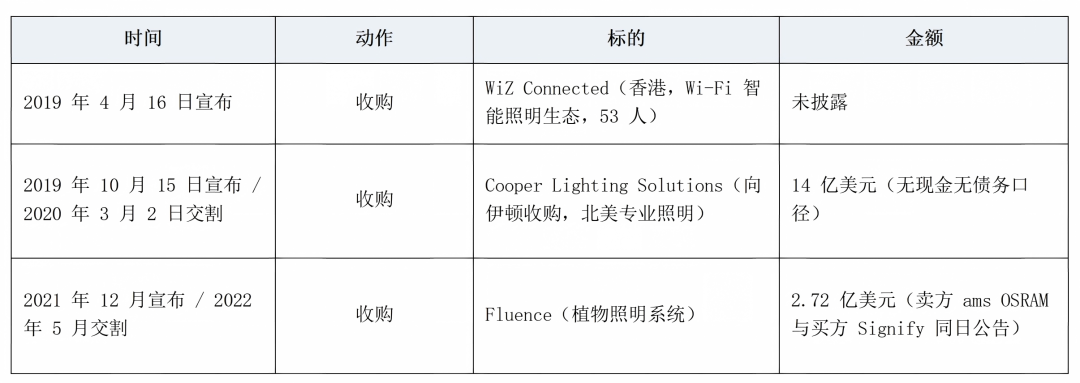
The logic behind these three deals is clear.
Cooper was the largest and most critical acquisition. For $1.4 billion, it acquired a North American professional lighting company with 2018 sales of $1.7 billion and 84% LED penetration, instantly propelling Signify into the top two positions in North American professional lighting—a position originally established through the 2007 Genlyte deal; Cooper effectively reinforced Signify's core foothold in North America. The synergy guidance provided at the time was over $60 million annually.
WiZ filled the gap in smart home lighting. Philips already had Hue (using Zigbee, positioned at the high end), while WiZ used Wi-Fi and targeted the low end, covering both price segments—this dual-brand strategy is rare in consumer lighting.
Fluence was the most interesting deal because it involved acquiring assets previously sold by Osram. Fluence was originally an American horticultural lighting company acquired by Osram in 2018; Osram announced in December 2021 that it would sell Fluence to Signify, with closing in May 2022.
上一篇里欧司朗"卖卖卖"清单上的一项,在这一篇里成了昕诺飞"买买买"清单上的一项。 全球照明行业的资产,就是这么在几家手里转的。
VI. What Remains Today
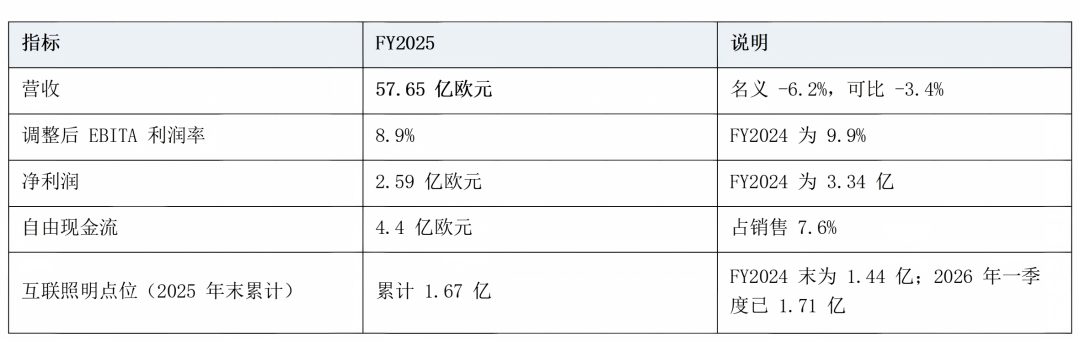
Let's start with the latest complete fiscal year (FY2025, results released January 30, 2026):
Segment breakdown (FY2025 segment data, in millions of euros):
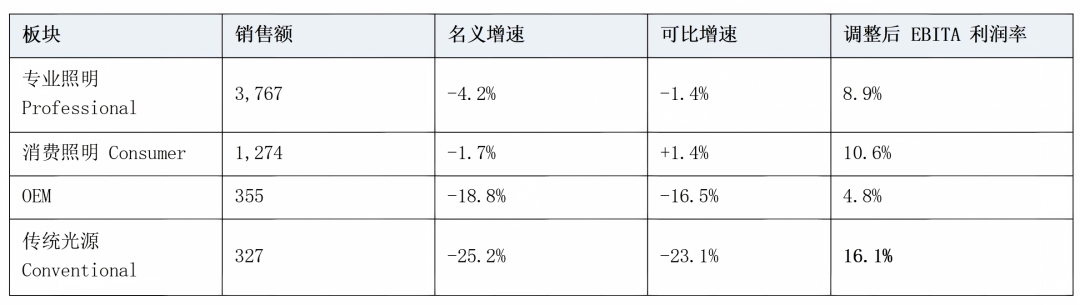
The four segments totaled €5,723 million, plus "Other" at approximately €40 million, for total revenue of €5.765 billion. Two counterintuitive points: traditional light sources (-25.2%) and OEM (-18.8%) experienced the sharpest declines, yet traditional light sources posted the highest profit margin (16.1%)—this is a typical profile of a "harvesting" business: no further investment, only cash collection. OEM, by contrast, is shrinking with a meager 4.8% margin, squeezed from both ends.
Its strongest asset is its brand portfolio: Philips (main brand, licensed), Philips Hue (consumer smart lighting), Interact (urban and architectural interconnected lighting systems), Color Kinetics (architectural and landscape LED lighting systems), Dynalite (controls), WiZ (smart home), Cooper Lighting Solutions and Genlyte (North American professional), Vari-Lite / Strand / Selecon / Showline (entertainment lighting).
What does €5.765 billion mean? In 2015, before the spin-off, revenue stood at €7.465 billion. Ten years later, it lost €1.7 billion, a decline of about 23%. Three forces converged here: strategic divestments(no further investment in traditional light sources or certain OEM segments), weakening demand(slowing demand in European professional markets and U.S. projects), unit price deflation(improved LED efficiency led to annual price drops, allowing the same lighting needs to be met at lower costs).
Among these three forces, the first was a deliberate choice, while the latter two reflected broader industry trends. The title of "global leader" was earned in an ever-shrinking pool.
Whose lamp do you hold in your hand today?
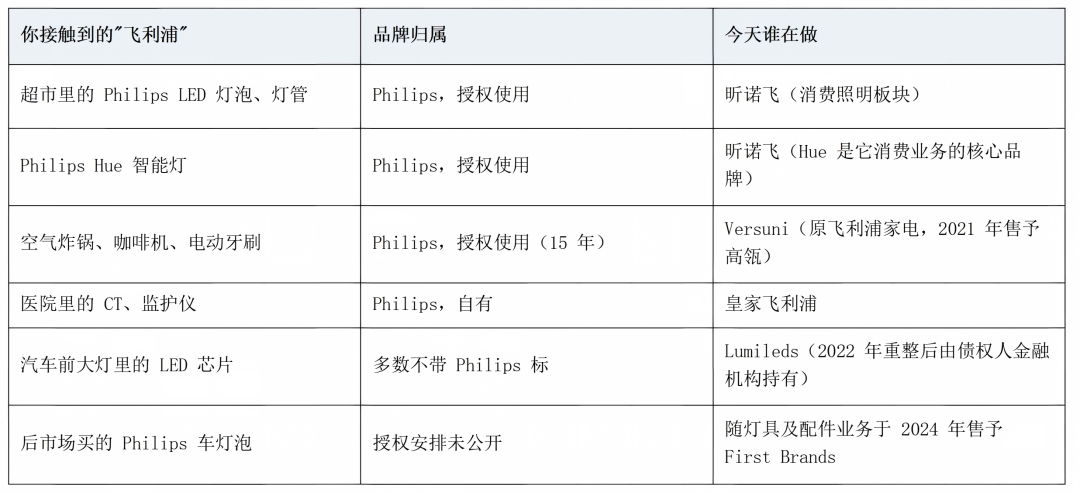
This table encapsulates the message of the entire series: a brand has survived 135 years, through four generations of creators.
VII. Weathering the Winter: Three CEOs,
A strategic review and a quarterly report still in decline
Since 2023, Signify's financial reports have shown a steady downward trend (all figures based on company announcements):
2023: €6.704 billion, nominal -10.8%, comparable -8.3%
2024: €6.143 billion, comparable -6.6%
2025: €5.765 billion, nominal -6.2%, comparable -3.4%
Nearly €1 billion in revenue lost over three years; 2025 marked the lowest point since the spin-off.
Management has also been turbulent. Following the Annual General Meeting on April 25, 2025, Eric Rondolat, who had led the company for 13 years, stepped down; CFO Željko Kosanović served as interim successor; on May 28, the company announced a new appointment—the former CEO of Dutch energy company Eneco, As Tempelman, who assumed office on September 1. Within five months, there were three changes in the CEO position.
Simultaneously launched was a comprehensive package: a €180 million cost-cutting plan affecting around 900 jobs, suspension of the share buyback announced for 2025, and no revenue guidance for 2026—only two bottom lines were set: adjusted EBITA margin of 7.5%–8.5% and free cash flow equal to 6.5%–7.5% of sales. By the end of Q3 2026, headcount (FTE) had fallen from 28,064 a year earlier to 24,961 people, a year-over-year reduction of over 3,000—explained by factory layoffs due to production cuts combined with planned workforce reductions (official Q3 report language).
Then came Capital Markets Day on June 23, 2026—Tempelman's first full strategy presentation nine months after taking office, and Signify's first such event in five and a half years. Many in the industry were waiting to see bold moves (asset sales, channel cuts), but there were no major announcements, only a rather modest categorization system (based on official press releases and presentation materials):
Business segments were divided into "Build" and "Harvest" piles.
Build: interconnected lighting, consumer lighting, select professional lighting sub-segments, and a more focused geographic footprint—direct operations contracted from 55 countries to 35 (to be completed in about three years, exiting markets to be handed over to channel partners while continuing product sales). This portion accounts for 72% of revenue, approximately €4.2 billion.
Harvest: non-interconnected LED light sources, traditional lighting, and more commoditized manufacturing operations. This portion makes up 28%, about €1.6 billion, aiming to extract cash and profits; traditional lighting explicitly retains "all end-game options" (including sale), and OEM likewise keeps "all options open."
The 2029 mid-term targets were deliberately conservative: comparable sales growth of 0–1%, adjusted EBITA margin around 10%, free cash flow at 7%–8% of sales; dividend payout ratio adjusted to 40%–50% of recurring Net profit, with no resumption of buybacks. Note the first figure—0–1%. Even the world's largest lighting company sets mid-term guidance of no growth.
Another detail from Capital Markets Day is worth noting for Chinese peers: Cooper was singled out as a case study, positioned as "clear second place in North American professional lighting," with a strategy called "maximizing operating leverage"; meanwhile, Genlyte, also in North America, was grouped under "turnaround." Two brands in the same region—one escalates, the other is rescued—this is how "categorized management" plays out in practice.
The latest Q3 2026 report (October 23) shows this strategy beginning to take effect, though revenue remains weak:
Sales reached €1.367 billion, nominal -2.9%, comparable -3.4%
Adjusted EBITA was €145 million, with a margin of 10.6% (compared to 9.7% last year); excluding one-time factors, underlying profit margin stood at 8.5%
Net profit was €88 million (€76 million last year)
Free cash flow was €118 million (€71 million last year)
Revenue fell, profits rose, driven by three factors: strict pricing (no price wars), cost reductions (Q3 achieved €37 million in gross savings), and a one-time refund of $28 million in U.S. tariffs(IEEPA tariff reimbursement, net amount after supplier settlements and customer discounts, a one-off contribution of about 2.1 percentage points to profit margin). Without this refund, the improvement in profit margins wouldn't look so impressive—this is precisely why the company split its full-year guidance into two tiers: "high-end view including tax refunds, low-end view excluding tax refunds."
Management expects the fourth-quarter market environment to remain challenging: European professional markets stay sluggish, and U.S. project demand softens.
This is the current state of being "world's number one": not collapsing, but slowly bleeding over the long term; not lacking strategies, but having used all available measures to protect profits.
VIII. Three Takeaways
First, the dividing line between spin-offs and outright sales lies in cash flow, not scale.
Philips Lighting could go public independently in 2016 because it was still profitable and had positive free cash flow; Osram was acquired in 2020 because transformation investments and simultaneous downturns in two markets had eroded its balance sheet. For any business considering a spin-off, ask first: can it generate positive operating cash flow on its own after leaving the parent company? If not, forget about spin-offs—it's just shedding burdens.
Second, brand licensing is the most stable business in this industry, but it belongs exclusively to the "parent company."
Osram leased its brand to Ledvance and Zhuosheng Lighting, while Philips leased its brand to Signify and bundled a 15-year lease of its home appliance brand with a sale to Hillhouse Capital—both companies sold their businesses but retained their trademarks and continue collecting rent. The implication for buyers is straightforward: when you acquire a century-old brand, you're often only buying usage rights and paying annual fees. Mulinsen's acquisition of LEDVANCE follows exactly this structure.
Third, price deflation can strip away the halo of being "number one," but don't blame everything on deflation.
From €7.465 billion to €5.765 billion, Signify's decline resulted from active divestments (traditional light sources, certain OEM segments), weakening demand (European professionals, U.S. projects), and unit price deflation. These three factors are inseparable on paper but distinct in managerial action—the company's strategy was precisely to "exit low-margin pools and defend high-margin pools."
In this industry, "being number one in scale" is no longer a safety cushion; "profit margin" is what truly matters. With Q3 revenue down 3.4% and a profit margin of 10.6% (even after stripping out the 2.1-point boost from a one-off tax refund, underlying margin still stands at 8.5%), this combination is worth studying for every Chinese company still chasing scale.
China Light
The official website of the China Association of Lighting Industry and a full-media platform for the lighting sector. We provide authoritative and timely lighting information while striving to be a growth partner for businesses. From brand promotion and channel expansion to consulting, talent training and participation in standards development, we provide comprehensive professional services to help businesses improve quality and efficiency and jointly advance the high-quality development of the lighting industry.
Business Contacts
仇纯 (Ms.): 158 6155 3579
顾君 (Mr.): 137 7157 5253