
Unpaid wages totaling RMB 675,500 to migrant workers! A lighting engineering company has been placed on the list of discredited entities subject to punitive measures.
Lighting projects are a key growth area in the LED lighting Industry, and the successful completion of numerous projects relies heavily on the on-site work of frontline migrant workers. However, amid industry-wide issues such as project financing and lengthy payment cycles, some lighting companies face significant financial pressure, leading to frequent cases of wage arrears to migrant workers. Once verified, these companies and their responsible executives may face severe credit sanctions.
On October 9, the Human Resources and Social Security Bureau of Jiyang District, Sanya City, Hainan Province, issued a “Decision Letter on Inclusion in the List of Discredited Entities Subject to Joint Punishment for Arrears in Migrant Worker Wages,” placing a lighting company on the discredited list due to unpaid wages.
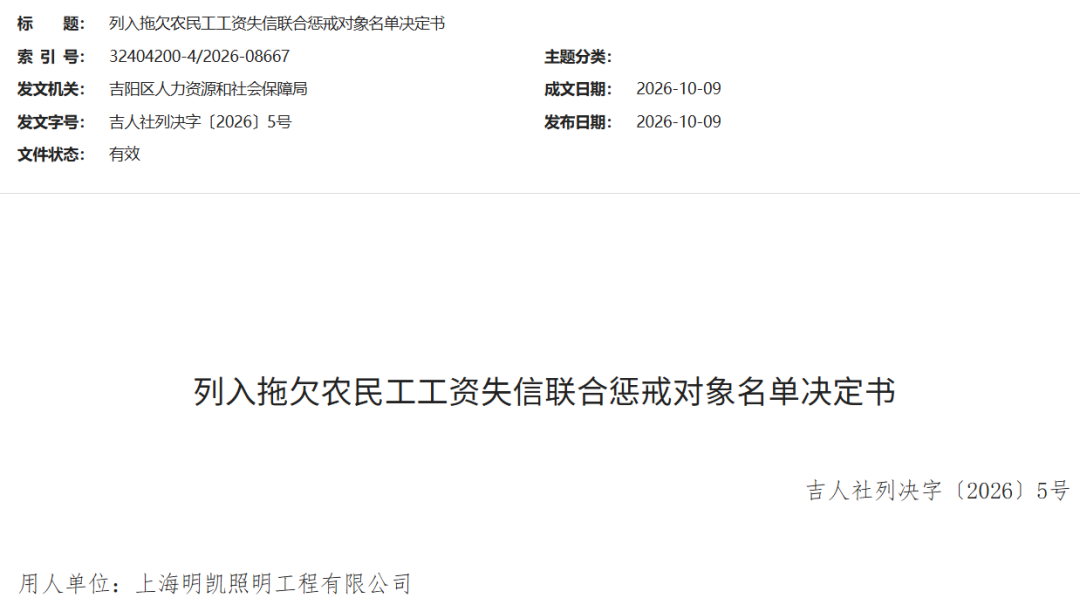
The Decision Letter states that, following verification by the human resources and social security authorities, Shanghai Mingkai Lighting Engineering Co., Ltd. failed to pay wages totaling RMB 675,500 to two migrant workers, including Pan*, during the construction of commercial projects on plots 06 and 07 in WanHua, Jiyang District, Sanya City,, constituting a serious violation with severe negative social repercussions.
On September 17, 2026, the bureau legally served the company with a “Prior Notice of Inclusion in the List of Discredited Entities Subject to Joint Punishment for Arrears in Migrant Worker Wages.” The company did not submit any written objections within the prescribed time limit.
In accordance with Article 48 of the Regulations on Guaranteeing Payment of Migrant Worker Wages and Article 5 of the Interim Measures for the Administration of the List of Discredited Entities Subject to Joint Punishment for Arrears in Migrant Worker Wages, the bureau has decided: to include Shanghai Mingkai Lighting Engineering Co., Ltd., along with its legal representative Chen* and project manager Huang*Feng, on the list of entities subject to joint punishment for wage arrears.
According to the Decision Letter, once listed as a discredited entity, the company and its responsible parties will face multi‑dimensional restrictions: relevant government departments will impose lawful and regulatory limitations in areas such as government funding support, government procurement, tendering, financing and loans, market access, tax incentives, performance evaluations, and transportation services. The period of inclusion runs from October 9, 2026, to October 8, 2029.
Records show that Shanghai Mingkai Lighting Engineering Co., Ltd. was established in 2006 and is an engineering firm integrating construction services with lighting product offerings. It specializes in night‑time building illumination, landscape lighting, plaza and road lighting, commercial district lighting, bridge lighting, and exterior façade and sculpture lighting.
Frequent wage arrears among migrant workers—discredit sanctions are more than just a public notice
In recent years, the construction sector has remained a hotspot for wage arrears, with similar cases being far from uncommon; lighting and illumination projects are no exception.
Night‑time illumination and outdoor lighting projects fall under the broader category of construction works, which typically involve upfront financing, long payment cycles, and multi‑tiered subcontracting and re‑subcontracting. When project owners delay payments, financial pressures cascade down the Industry / Supply chain, with frontline migrant workers often bearing the brunt of this risk.
Moreover, although labor costs are factored into project budgets, if companies prioritize spending recovered funds on materials, advance financing, or other operational needs, payroll accounts and monthly wage‑disbursement systems may not be properly enforced, allowing wage arrears to accumulate.
Many lighting projects are assigned through general contractors to specialized lighting firms, which then subcontract to foremen who organize migrant workers to carry out the actual construction. Under this multi‑layered subcontracting model, employment relationships become unclear, making it easy for blame to be shifted when project payments stall, while migrant workers face significant challenges in asserting their rights and gathering evidence, resulting in prolonged wage delays.
For engineering firms, being placed on the list of entities subject to joint punishment for wage arrears carries consequences far beyond mere public scrutiny. Restrictions on participation in tenders can effectively cut off new project opportunities, weakening future customer acquisition capabilities, while limitations on financing and loans impact both capital availability and contract fulfillment. Additionally, both corporate leaders and project managers share responsibility, delivering a substantial blow to business operations.
Under national regulations, payment of migrant worker wages is a non‑negotiable obligation; employers cannot refuse to pay simply because the client has not yet settled outstanding amounts. In recent years, human resources and social security authorities have intensified efforts to investigate and address wage arrears in the construction sector. Once deliberate wage withholding is confirmed—meeting statutory criteria or causing adverse social impacts—both the company and its legal representatives and project managers will be added to the list of discredited entities, rather than solely penalizing the corporate entity.
Furthermore, according to current regulations, if an organization has rectified its illegal practice of wage arrears, has remained on the list of discredited entities for at least six months, and submits a written commitment to improve its credit standing, it may apply to the human resources and social security bureau for early removal from the list. Upon receipt of such an application, the bureau will conduct a review within fifteen working days and decide whether to grant early removal.
Payment of migrant worker wages represents an inviolable bottom line. Ensuring that migrant workers receive their full wages on time is not only a strict legal requirement but also a fundamental pillar of trust essential for the long-term sustainability of engineering enterprises. As they undertake projects, lighting companies should strengthen measures such as real-name registration for workers, dedicated payroll accounts, and systematic wage‑disbursement protocols to proactively mitigate the risk of wage arrears at the source.
China Light
The official website of the China Association of Lighting Industry and a full-media platform for the lighting sector. We provide authoritative and timely lighting information while striving to be a growth partner for businesses. From brand promotion and channel expansion to consulting, talent training and participation in standards development, we provide comprehensive professional services to help businesses improve quality and efficiency and jointly advance the high-quality development of the lighting industry.
Business Contacts
仇纯 (Ms.): 158 6155 3579
顾君 (Mr.): 137 7157 5253