
Recent breakthroughs in red, green, blue, and near-infrared technologies—could perovskite LEDs be the real deal this time?
Introduction
From May to October this year, the perovskite lighting field witnessed an unusually dense series of breakthroughs—
On May 7, a pure red-light device achieved an external quantum efficiency (EQE) of 30.2% (Nature Communications);
On July 1, blue light reached 22.0%, as reported in Nature;
On August 16, lead-free tin-based near-infrared devices from the Ningbo Institute of Materials, Chinese Academy of Sciences, attained 17.5% (InfoMat);
On August 27, another lead-free approach published in Science delivered 21.2% with a T50 lifetime of 920.5 hours;
On September 25, green light developed by Fujian Normal University achieved a wall-plug efficiency (WPE) of 28.7% (Nano Letters);
On October 13 and 14, deep-red light at 21.7% and near-infrared at 37.1% were successively announced.
These achievements span multiple journals. Progress is now shifting from “single-point efficiency” toward synergistic optimization of efficiency, stability, and spectrum.
Why now? And what does this mean for the lighting and display industries? This article breaks it down.
I. Why Blue Light Remains the Most Challenging Perovskite Problem
To appreciate the significance of these advances, we first need to understand the current state of perovskite LEDs (PeLEDs).
Metal-halide perovskite semiconductors offer high color purity, easily tunable spectra, and low-cost solution processing, making them strong contenders for next-generation high-definition displays.
While red and green perovskite LEDs have seen rapid performance gains in recent years, blue light—one of the three primary colors—has lagged significantly. In particular, short-wavelength blue light in the 455–470 nm range has become a critical bottleneck hindering the practical implementation of full-color displays.
What Makes It So Difficult?
There are three key challenges: First, the bandgap is wider, requiring higher drive voltages and making carrier injection and recombination more difficult; second, ion migration is severe—under electric fields, ions within the perovskite lattice can migrate and cause phase separation, leading to spectral drift and device degradation; third, overall electroluminescent performance remains subpar, with previous blue-light devices consistently falling short of red and green counterparts in both efficiency and lifespan.
In short: red and green lights have already taken off, while blue light is still climbing the hill. Without all three primary colors, full-color displays remain just an empty promise.
II. How This Breakthrough Was Achieved: Adding a Structural Scaffold to Perovskites
The blue-light research was published online in Nature on July 1, 2026 (Vol. 655, No. 8123, pp. 617–623), marking the most significant advancement in blue-light technology this year. Domestically, there has been extensive media coverage: the National Natural Science Foundation released a summary of findings on September 29, and the Fujian Institute of Structure of Matter reposted the results on October 16.
The joint team’s solution can be viewed as building a structural scaffold within the perovskite crystal: using two isomeric molecules to construct a three-dimensional network of multiple hydrogen bonds inside the perovskite and at its interface with functional layers.
The specific roles are as follows: O-benzylhydroxylamine hydrochloride (OBCl), acting as a hydrogen-bond donor, is deposited between the hole-transport layer and the perovskite layer, forming hydrogen bonds at the interface to strengthen contact and induce nucleation along specific crystal planes; meanwhile, the isomeric molecule NBCl is incorporated into the perovskite matrix, where its hydrogen-bond donors and acceptors form bonds with both the perovskite and the underlying OBCl layer, guiding vertical crystal growth and enhancing film mobility.
The effects are cascading: the structure becomes stabilized, crystal orientation is controlled, and carrier transport is balanced. At the same time, the three-dimensional hydrogen-bond network significantly suppresses ion migration and phase separation under electric fields, ensuring spectral stability even at high operating voltages—precisely the area where blue-light devices were previously most vulnerable.
Behind the 22.0% Efficiency: Two More Crucial Numbers
Beyond efficiency, this breakthrough carries at least two additional figures worth noting in the industry:
First, the peak wavelength. At 468 nm (pure blue) and 463 nm (deep blue), the devices cover the short-wavelength range most sought after by the display industry—not merely “capable of emitting light,” but rather “emitting light of the right color.”
Second, the operational lifetime. Research indicates that this strategy boosts device lifetimes by several orders of magnitude. However, it’s important to clarify: the baseline for blue-perovskite lifetimes was extremely low, so even a tenfold improvement still leaves absolute values far below commercial thresholds for displays and lighting products—“an order-of-magnitude improvement” demonstrates the effectiveness of the approach, but does not mean immediate deployment.
III. Deep Red at 21.7%: Additive Timing Engineering and a “Cold Shower” of 26.39 Hours
Unlike blue light, the deep-red route relies on “additive engineering”: a joint team from the University of Science and Technology of China and the Chinese Academy of Sciences places two additives at different stages of thin-film fabrication—4-vinylbenzylammonium iodide (VBAI) enters the precursor, while octylphosphonic acid (OPA) is added as an anti-solvent—coordinating timing to improve crystallization and reduce defects in mixed-halide perovskites, ultimately achieving an EQE of 21.7% at 734 nm (Authors Yi Shao and Jie Yang; Journal of Materials Science, online October 13, 2026, DOI: 10.1007/s10853-026-13948-6).
One controls “what the material grows into,” while the other ensures “it doesn’t change afterward.”
But the real “cold shower” lies in the device’s lifetime: its T50 operational life stands at 26.39 hours—clearly an improvement over comparable devices, yet still several orders of magnitude short of any commercial application threshold.
The significance of deep red extends beyond mere efficiency—it validates the effectiveness of staged process control: progress in perovskite LEDs is moving from single-material formulations toward deeper integration of device engineering and process management.
IV. Near-Infrared at 37.1%: The Hidden Chemistry Within Additives
This achievement deserves special attention because it addresses an awkward question: why do the same additive formulas yield vastly different efficiencies across laboratories?
A joint team from Purdue University and Emory University (Corresponding author Letian Dou, who holds positions at both institutions; collaborators include the University of Michigan and Princeton University) discovered that the long-used additive 5-aminovaleric acid (5AVA) undergoes two competing reactions during precursor heating: one generates beneficial zwitterionic species (5IMAP), while the other produces harmful lactams (2PP). Previously, no one had realized that everyone had been working with the average value of this “mixture.”
The decisive factor determining which pathway prevails is the duration of precursor heating—20 minutes represents the optimal point.
Avoiding uncontrollable solution-phase reactions, the team directly synthesizes pure 5IMAP and incorporates it—resulting in a photoluminescence quantum yield (PLQY) of 97.2%, with near-infrared devices achieving an EQE peaking at 37.1% and averaging 32.8% (Nature 658(8136): 629–635, DOI: 10.1038/s41586-026-11120-3).
One answer to “why now?” lies in the growing payoff from such meticulous investigations into microscopic chemistry.
V. Green Light at 28.7%: Weakly Confined Nanocrystals Boost Wall-Plug Efficiency
Green-light development also shows notable progress: on September 25, a team led by Chen Daqin at Fujian Normal University published work in Nano Letters (Nano Letters 26(39): 13580–13589, DOI: 10.1021/acs.nanolett.6c03763), using “weakly confined perovskite nanocrystal” films to raise the wall-plug efficiency (WPE, or “wall-plug efficiency”—translated by university press as “plug-in efficiency”) of green-light devices to 28.7%, with a low turn-on voltage of just 1.8 V, a half-width at half-maximum of only 17.6 nm, and a maximum luminance of 75,060 cd/m².
Regarding longevity: extrapolated data suggests that at an initial brightness of 100 cd/m², the T50 exceeds 10,000 hours (paper estimates around 10,230 h). Here, it’s crucial to emphasize the word “extrapolated”—this figure does not come from continuously running the device for 10,000 hours.
Special Note: WPE and EQE are distinct metrics—WPE measures the overall efficiency of converting electrical input into light output (including losses due to voltage and light extraction), whereas EQE refers specifically to the device’s external quantum efficiency.
In this article, blue, deep red, and near-infrared use EQE, while green uses WPE; direct cross-comparison between these metrics is not appropriate.
VI. Arranging Six Points Along One Spectrum: A Single Chart for Efficiency and Lifetime
Each individual point represents “the highest laboratory-level performance”; only when viewed together does the picture become meaningful. Pay special attention to the last column—the six dates span half a year.
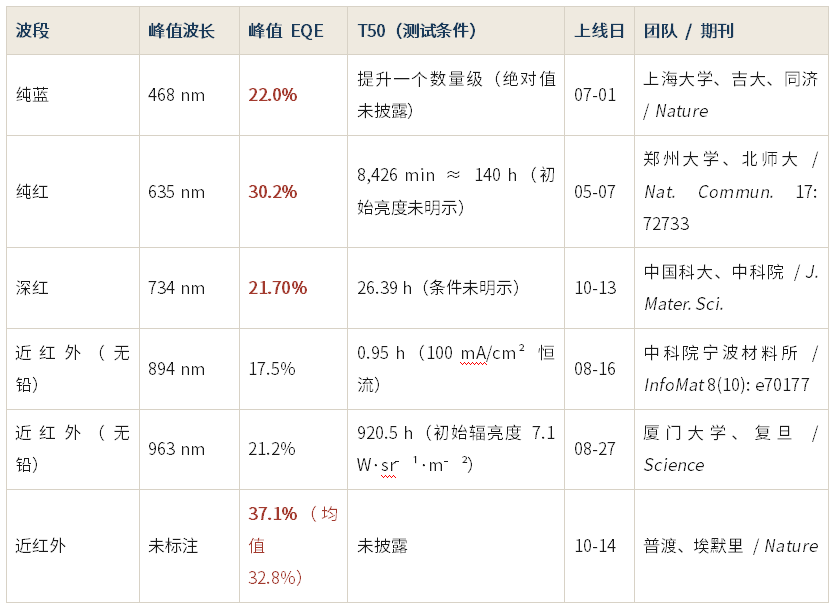
Note: All figures represent peak efficiencies measured in laboratory settings; device sizes and testing conditions vary widely, so the lifetime column cannot be compared horizontally—only trends can be assessed vertically.
Green light is excluded from this table: it reports a WPE of 28.7% (online September 25, 2026, Nano Letters 26(39): 13580–13589), which differs in scope from the EQE listed above.
First, efficiency is no longer the bottleneck. From 468 to 963 nm, all six points exceed 17.5%, with two surpassing 30%. Just three years ago, blue light was still struggling in the single digits.
Second, and perhaps the most deceptive aspect of this chart: the lifetime column. With 0.95 hours and 920.5 hours side by side, they appear three orders of magnitude apart—but these numbers simply cannot be compared horizontally. The Xiamen University figure was measured under an initial radiance of 7.1 W·sr⁻¹·m⁻², while the Ningbo measurement used a constant current of 100 mA/cm²; the deep-red figure provides no clear conditions, and the Zhengzhou figure lists an initial brightness without specifying the corresponding time period. Meanwhile, the green-light estimate remains purely extrapolated.
The lack of uniformity in lifetime measurements is the most critical methodological issue in this field. For the same batch of devices, changing the initial brightness can alter the T50 by one or two orders of magnitude.
Therefore, upon seeing the word “record,” the first question should be: Under what conditions was this measured?
VII. Don’t Rush to Declare Mass Production
Even with laboratory efficiencies reaching new heights, there’s still a long way to go before scaling up to factory production. Several facts require clarification:
First, the 22.0%, 21.7%, and 37.1% figures all pertain to small-area devices; once scaled up, efficiencies typically decline.
Second, the inherent stability of perovskite materials—susceptible to humidity, heat, and light-induced decay—remains a core engineering challenge. The “order-of-magnitude increase” in blue-light lifetimes and the 26.39-hour figure for deep red are relative to their previous levels, not equivalent to meeting commercial lifespan thresholds.
Third, peak values are not averages—the 4-percentage-point gap between 37.1% and 32.8% reflects the weight of the term “peak”; it may make headlines, but it cannot yet enter production lines.
Fourth, environmental compliance regarding lead content remains an unavoidable prerequisite for industrialization.
Fifth, display and lighting standards for color gamut, color points, and lifespan are far stricter than academic papers suggest.
A more prudent assessment would be: this marks an important step along a key technological path, but “mass commercialization of perovskite LEDs” still requires further observation.
VIII. What Does This Mean for Displays and Lighting, Respectively?
For the Display Industry
The blue-light efficiency bottleneck has been significantly alleviated, bringing full-color perovskite displays one step closer to feasibility—its advantages of high color purity and low-cost solution processing continue to make it highly attractive for high-end displays, AR/VR micro-displays, and other applications.
For the Lighting Industry
Perovskite LEDs will not replace mature white-light LEDs or laser sources in the near term, but two directions merit attention:
First, high-gamut backlights and healthy lighting spectrum design—perovskite’s superior color purity could inspire novel spectral solutions;
Second, as Micro LED and other emerging display technologies spill over into lighting applications, perovskite might serve as one color scheme option competing in this space.
These assessments remain speculative and should be confirmed by actual industry progress.
Final Thoughts
This wave of intensive breakthroughs demonstrates that perovskite LED progress has moved beyond “single-point efficiency” into a stage of synergistic optimization encompassing efficiency, stability, and spectrum.
The related research outcomes essentially provide three replicable knobs, each adjusting spatial, temporal, and chemical factors: interface hydrogen bonding (blue light), additive timing (deep red), and reaction pathways (near-infrared).
Going forward, what truly warrants tracking isn’t another record, but three key issues: whether device lifetimes can cross commercial thresholds, whether large-area uniformity can be resolved, and whether lead substitution and eco-friendly processes can be implemented.
The knobs have been identified; now it’s time to install them into the machinery.
References
[1] Wang Y. et al., Isomeric multi-hydrogen-bonding enables blue perovskite LEDs, Nature 655(8123): 617–623 (2026), online July 1, 2026. DOI: 10.1038/s41586-026-10723-0
[2] National Natural Science Foundation of China, “Chinese Scholars Make Progress in Blue-Light LED Materials and Device Design,” September 29, 2026. https://www.nsfc.gov.cn/p1/3381/2825/143057.html(中科院福建物质结构研究所 reprinted October 16, 2026)
[3] Shao Y., Yang J., Efficient and stable deep-red mixed-halide perovskite LEDs via dual-additive engineering, Journal of Materials Science (2026), online October 13, 2026 (Online First, volume pending). DOI: 10.1007/s10853-026-13948-6
[4] Baek S.-D., Yang Y.-T. et al., Hidden reaction pathways inform additive engineering for perovskite LEDs, Nature 658(8136): 629–635 (2026), online October 14, 2026. DOI: 10.1038/s41586-026-11120-3
[5] Wang Z., Wu X. et al., Weakly Confined Perovskite Nanocrystal Films for Energy-Efficient Electroluminescence Devices, Nano Letters 26(39): 13580–13589 (2026), online September 25, 2026, with publication scheduled for October. DOI: 10.1021/acs.nanolett.6c03763
[6] Zhang J. et al., High-performance red light-emitting diodes from quasi-two-dimensional perovskite nanocrystals, Nature Communications 17: 72733 (2026), online May 7, 2026. DOI: 10.1038/s41467-026-72733-w
[7] Shen P., Ding S. et al., Efficient near-infrared light-emitting diodes via enlarging grains of tin-based perovskites, InfoMat 8(10): e70177 (2026), online August 16, 2026 (included in the October issue). DOI: 10.1002/inf2.70177
[8] Bai W. et al., High-efficiency, long-lived lead-free perovskite light-emitting diodes, Science 393(6814): 882–887 (2026), online August 27, 2026. DOI: 10.1126/science.aeg8955
China Light
The official website of the China Association of Lighting Industry and a full-media platform for the lighting sector. We provide authoritative and timely lighting information while striving to be a growth partner for businesses. From brand promotion and channel expansion to consulting, talent training and participation in standards development, we provide comprehensive professional services to help businesses improve quality and efficiency and jointly advance the high-quality development of the lighting industry.
Business Contacts
仇纯 (Ms.): 158 6155 3579
顾君 (Mr.): 137 7157 5253