
The street lights donated by 330,000 are actually three-no products? The quality control bottom line of public welfare projects cannot be relaxed
On June 29, a rural public welfare donation incident exposed by Guangdong Radio and Television Station quickly attracted attention in the lighting industry and public opinion arena.
Reports indicate that residents of Yangchun City, Guangdong Province, have reported frequent issues with a batch of street lights donated by local charitable enterprises.
According to the Yangchun City Volunteer Federation, this batch of 350 solar Street lights is part of the "Rural Warmth Support Public Welfare Donation Project" materials, aimed at assisting rural infrastructure construction and improving the nighttime travel environment in rural areas. Some villagers have been injured due to street light issues.
Upon verification, this batch of street lights has no brand trademark, no manufacturer address, and no product quality certificate; it belongs to "three-no" products and does not comply with national product quality safety standards.
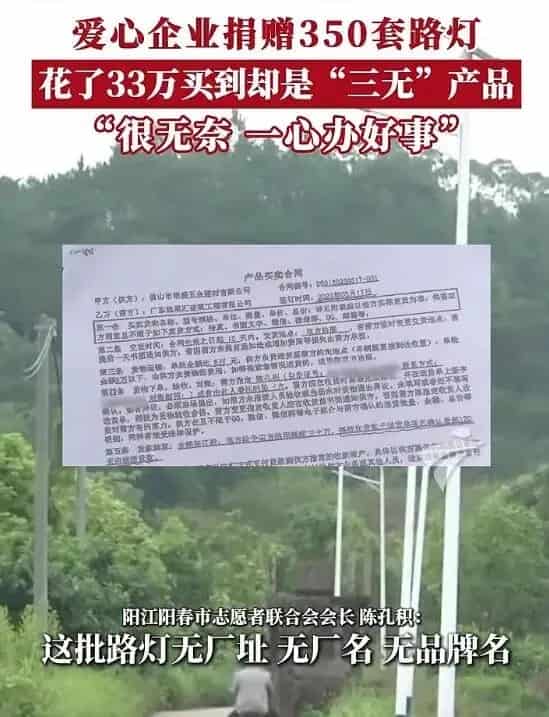
Source: Guangdong Radio and Television Station
The donating enterprise stated that these street lights were purchased through legitimate channels from a distribution company in Foshan, costing over 330,000 yuan, expressing helplessness about the situation.
The Yangchun City Market Supervision Department has confirmed the product violation and stated that it will continue to follow up on this incident; details related to the event are still under further investigation.
目前事件正在调查中,但也有媒体报道了该事件的一些进展,供货的经销公司接受采访时,否认问题批次为其供货,南海区的市场监督管理所现场突击,暂未发现三无产品;而爱心企业则坚称"走的正规途径,33万买来全是三无,我也是受害者"。甚至有媒体披露了涉及的相关负责人员。至此,这起事件已从产品质量问题,演变为一场涉及多方问题的复杂事件。
A public welfare donation that should have been a win-win situation, why did it ultimately fail due to product quality? This incident is not an isolated case; it precisely highlights the long-standing pain points in public welfare donation scenarios.
就乡村太阳能照明市场而言,在乡村振兴的大背景下,太阳能路灯捐赠因落地快、可视化强、社会意义明确,成为各类公益帮扶项目的热门选择。但恰恰是这类项目,往往成为劣质灯具的 “泄洪口”。
On one hand, most public welfare project liaisons are not lighting professionals and lack the ability to judge safety standards and performance parameters of luminaires, leading procurement decisions to lean towards low prices; on the other hand, some manufacturers/dealers exploit the characteristic of public welfare projects that emphasize "landing ceremonies" over "post-implementation acceptance," packaging unqualified "three-no" luminaires as "high cost-performance public welfare models," which then sink through distribution channels layer by layer before finally entering rural areas.
不能因为是捐赠,就不好意思严格验收。事实上,严格验收保护的是捐赠方、受赠方和最终使用者三方利益。验收越规范,就越能让各方得到公平和客观评价,也能让公共设施安全更可持续。从采购到投入使用,每个环节都应当留下可核验的质量文件和责任边界,否则一旦出现伤人、损坏或舆情,善意项目会转化为多主体争议。
330,000 ÷ 350 units ≈ 943 yuan/unit. This falls in the lower-mid price range for rural solar street lights with poles of 6-8 meters, but compliant products can still be produced. The "Three Certifications" verification must be the baseline: brand trademark, manufacturer address, and certificate of conformity. Each item must correspond to standard specifications; if any is missing, the delivery receipt cannot be signed.
was originally a support project aimed at gathering goodwill and spreading warmth, but ultimately turned into a safety hazard due to inferior products, also causing the public to question similar public welfare projects. Building a reputation for public welfare requires years of accumulation, yet destroying it only takes a batch of substandard street lights or one failed inspection.
The incident is still under further investigation and handling. Rectification of the faulty street lights, determination of liability for the involved parties, and subsequent placement of the injured villagers all await final answers from official sources. However, this incident has sounded a warning bell for all public welfare projects and market regulation. Lighting enterprises should take this as a lesson: public welfare is also an extension of commercial reputation. Regardless of the purpose, delivering products that meet national standards is the bottom line; rural markets equally require quality standards.