Export trends of China's lighting products in the first four months of 2025: Total value decreased by 7%, and the decline in exports to the US widened to 12%
Source: 中国之光网|| Views: 4347
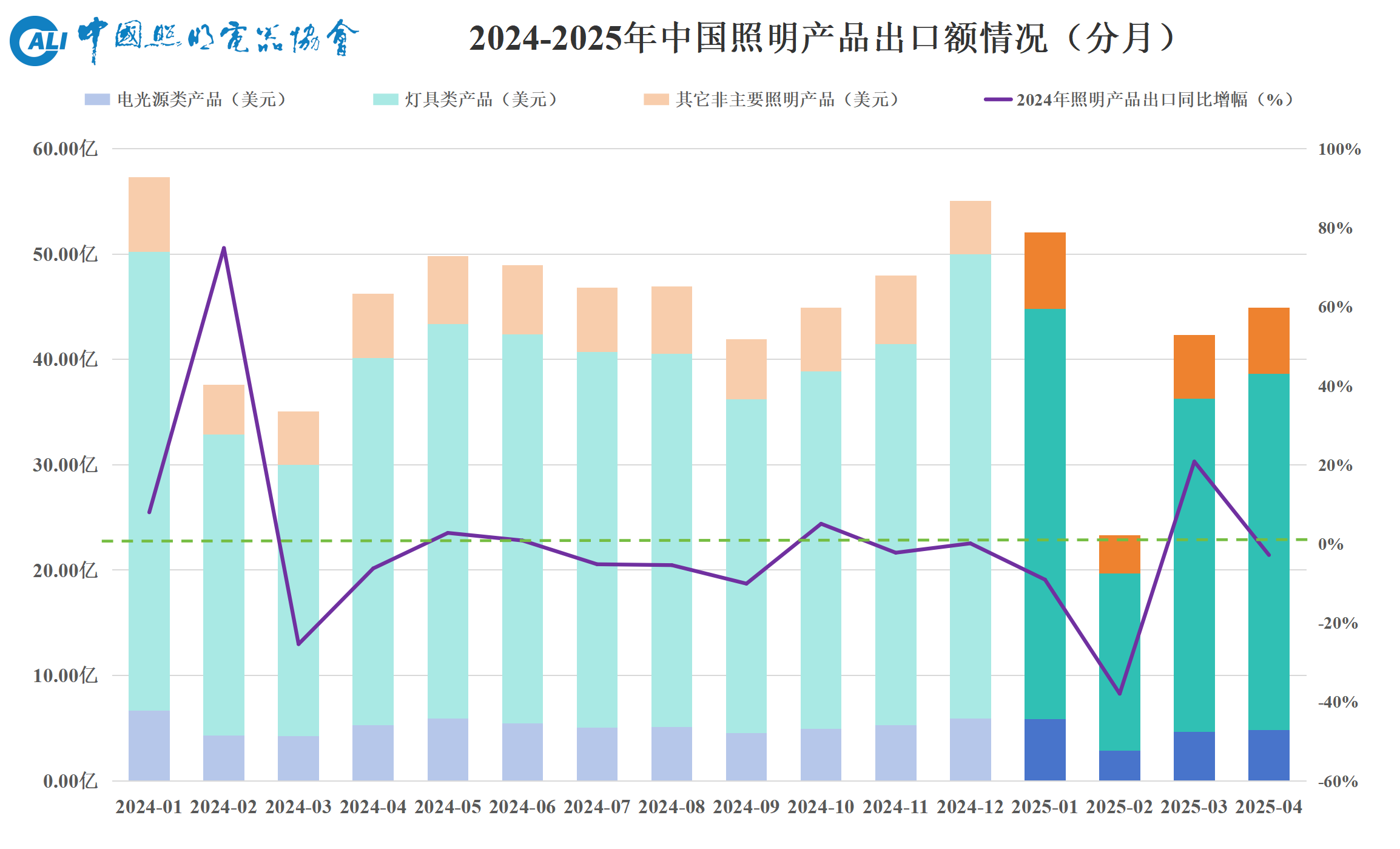
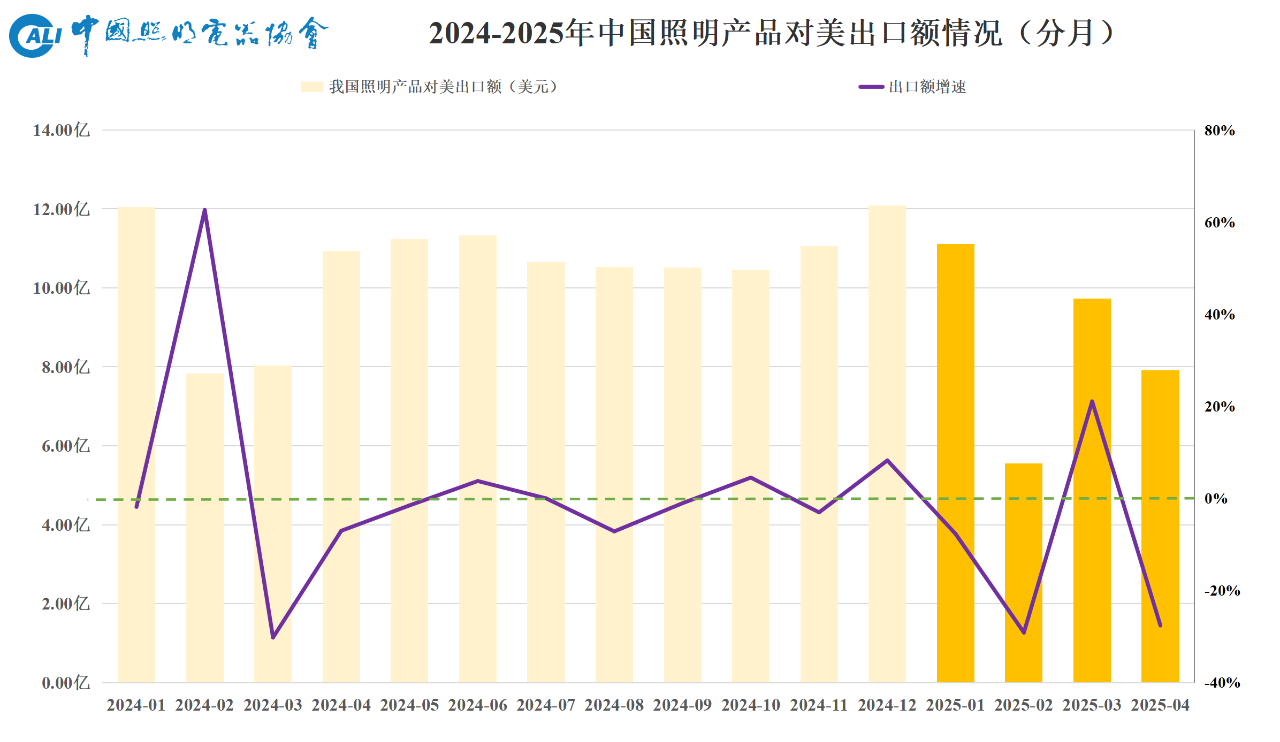
According to customs data, in the first four months of 2025, the total export value of China's lighting products was approximately USD 16.3 billion, Year-on-year (YoY)decrease of about 7%, narrowing by 1 percentage point compared to the first quarter, accounting for about 2.3% of the total export value of mechanical and electrical products. Among them, the export value to the US was approximately USD 3.4 billion, Year-on-year (YoY) decrease of 12%. In April, China's lighting product exports amounted to approximately USD 4.5 billion, Year-on-year (YoY) decrease of about 3%. Among them, the export value to the US in that month was approximately USD 800 million, down 28% from April last year.
China's lighting product exports to the US in the first four months
The United States is the largest export market for China's lighting products. In the first four months, affected by unfavorable factors such as the escalation of US tariffs on Chinese products, the export value of Chinese lighting products to the US was approximately USD 3.4 billion, Year-on-year (YoY) decrease of about 12%, widening by 7 percentage points compared to the first three months; accounting for about 21% of China's total exports, down 1 percentage point from the same period last year. Looking at monthly data, since the beginning of 2025, except for March when exports to the US increased due to reasons such as rush exports, delayed shipments after the Spring Festival, and a low base in the same period last year, China's exports to the US have generally been in a downward range in the first four months.
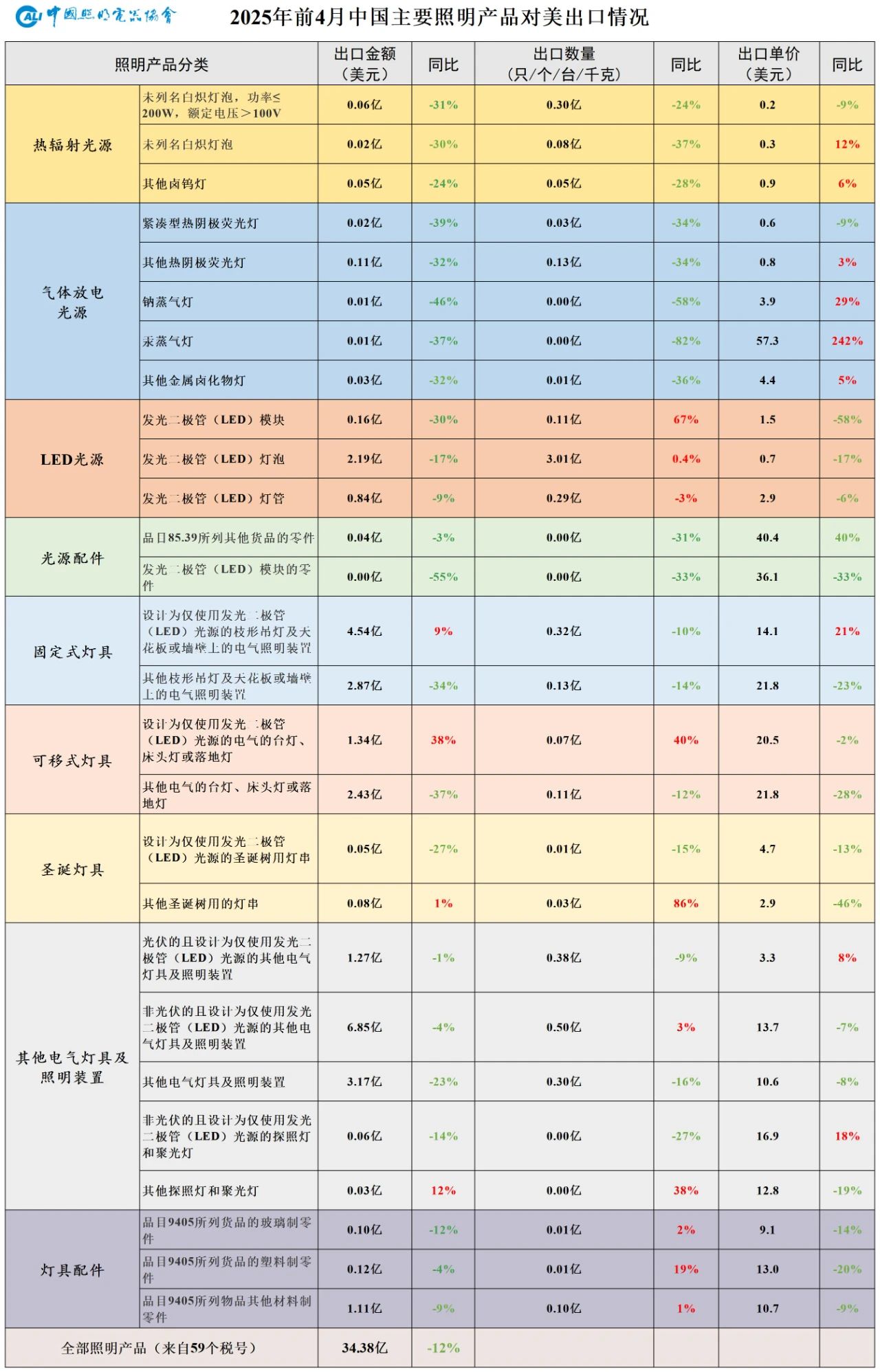
By product category The export value of Luminaire products to the US was approximately USD 2.5 billion, a year-on-year (YoY) decrease of about 12%; accounting for 73% of total exports to the US, basically flat compared to the same period last year. Electric light source products saw the largest decline, with an export value of approximately USD 390 million, a year-on-year (YoY) decrease of about 16%; accounting for 11% of total exports to the US, down by 1 percentage point from the same period last year. The export value of non-major lighting products was approximately USD 500 million, a year-on-year (YoY) decrease of 4%; accounting for 16% of total exports to the US, up by 1 percentage point from the same period last year. Although China's lighting product exports to the US are under significant pressure, butthe unit prices of some lighting products exported to the US have risen to varying degrees. Among them, the average export price of chandeliers and other electrical lighting devices for ceilings or walls designed to use only Light-emitting diode (LED) light sourcesincreased by 21% year-on-year (YoY),other electric lamps and lighting devices that are photovoltaic and designed to use only Light-emitting diode (LED) light sourcesincreased by 8% year-on-year (YoY),and searchlights and spotlights that are non-photovoltaic and designed to use only Light-emitting diode (LED) light sourcesincreased by 18% year-on-year (YoY). This reflects, from one perspective, the rigid demand for Chinese lighting products in the US.
From the perspective ofmajor export production regions
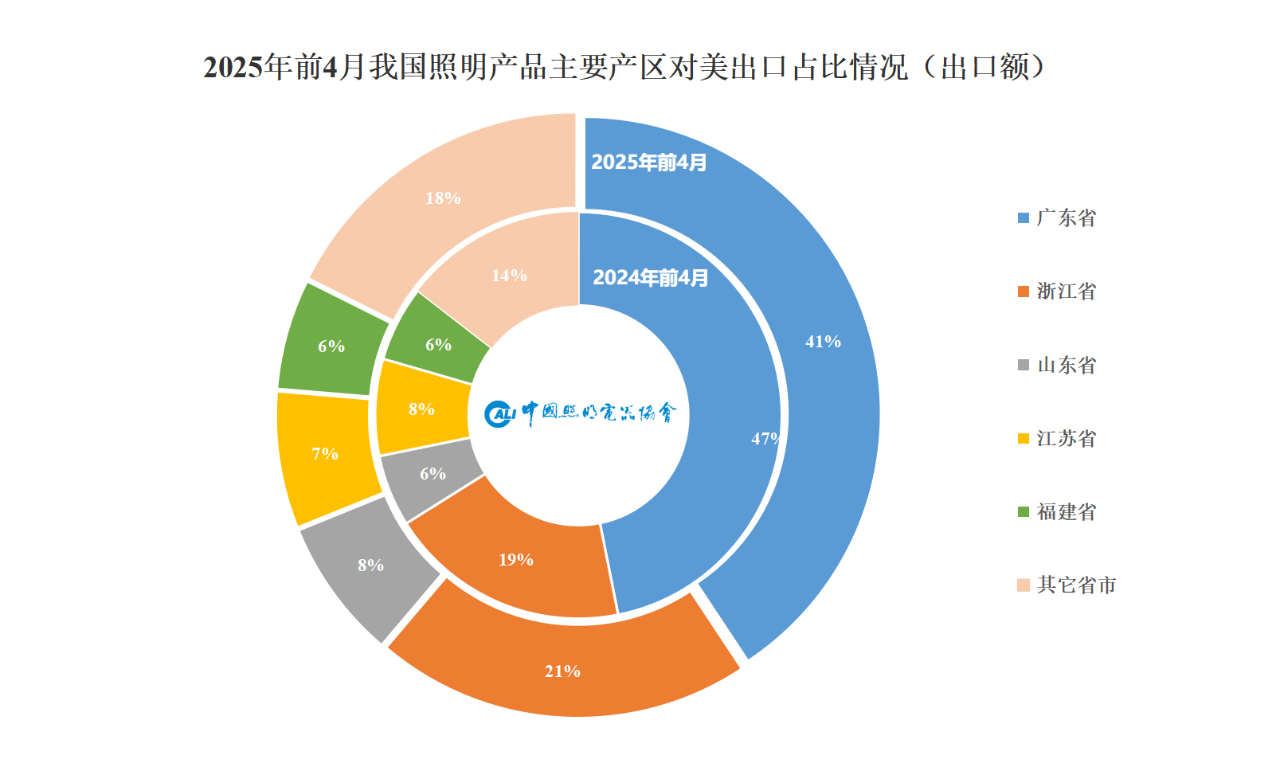
From January to April, Guangdong's export value to the US was approximately USD 1.4 billion, a year-on-year (YoY) decrease of 23%; the Yangtze River Delta region (Jiangsu, Zhejiang, Shanghai, Anhui, Jiangxi) had an export value to the US of approximately USD 1.1 billion, a year-on-year (YoY) decrease of 9%;Fujian's export value to the US was approximately USD 200 million, a year-on-year (YoY) decrease of 29%.
From the perspective of overall export products:
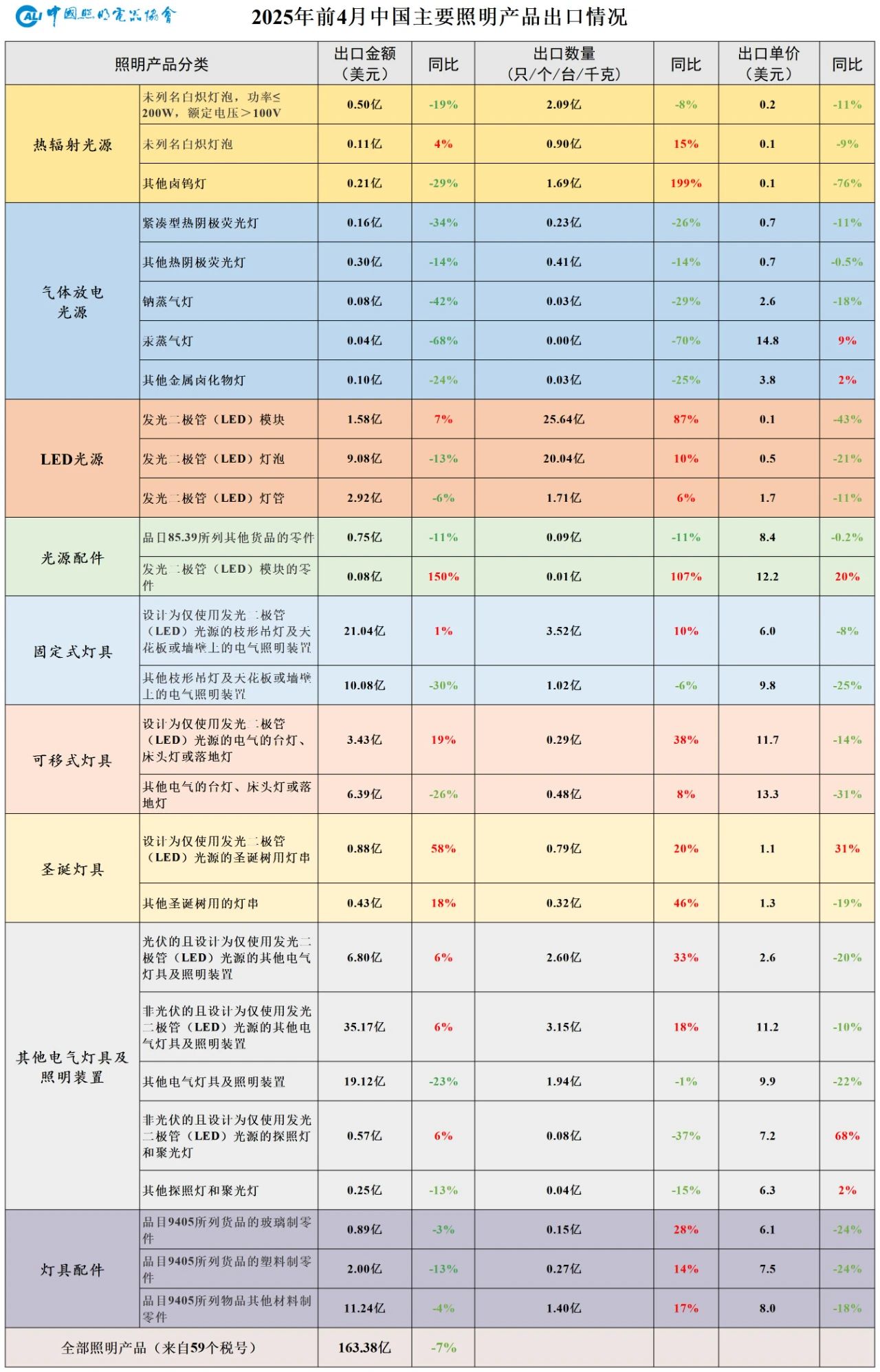
From January to April, the cumulative export value of luminaire products was approximately USD 12.2 billion, a year-on-year (YoY) decrease of about 8%, narrowing by 1.5 percentage points compared to the first quarter; accounting for about 75% of the total export value of all lighting products, flat compared to the same period last year. Among them, exports of other electrical luminaires and lighting devices, luminaire accessories, etc., declined, with an export value down about 15% year-on-year (YoY), accounting for about 31% of luminaire exports. In addition, the export value of fixed luminaires, portable luminaires, and other products slipped. A small number of luminaire products, such as Christmas luminaires, photovoltaic other electric lamps and lighting devices designed to use only light-emitting diode (LED) light sources, and non-photovoltaic other electric lamps and lighting devices designed to use only light-emitting diode (LED) light sources, achieved dual growth in both export value and volume. The export value increased by 42%, 6%, and 6% year-on-year (YoY), respectively, and the export volume increased by 27%, 33%, and 18% year-on-year (YoY), respectively. In the first four months, China's export volume of electric light source products was approximately 8.9 billion units, a year-on-year (YoY) increase of 9%. Among them, the total export volume of electric light sources for general lighting was approximately 5.3 billion units, a year-on-year (YoY) increase of 39%. The export volume of LED electric light source products (LED light bulbs, LED tubes, LED modules) was approximately 4.7 billion units, up by about 41% year-on-year (YoY); accounting for 90% of China's export volume of electric light sources for general lighting, an increase of 2 percentage points compared to the same period last year. The export volume of LED module products was approximately 2.6 billion units, a year-on-year (YoY) increase of about 87%. The export volume of traditional electric light source products such as thermal radiation sources and gas discharge light sources increased by 20% year-on-year (YoY), accounting for about 10% of the total export volume of electric light sources for general lighting. Although the export volume of electric light source products shows a growth trend, the export value remains under pressure. From January to April, the export value of electric light sources was approximately USD 1.8 billion, a year-on-year (YoY) decrease of about 11%, accounting for about 11% of the total export value of all lighting products, a decrease of 1 percentage point compared to the same period in 2024.
From the perspective of export destinations:
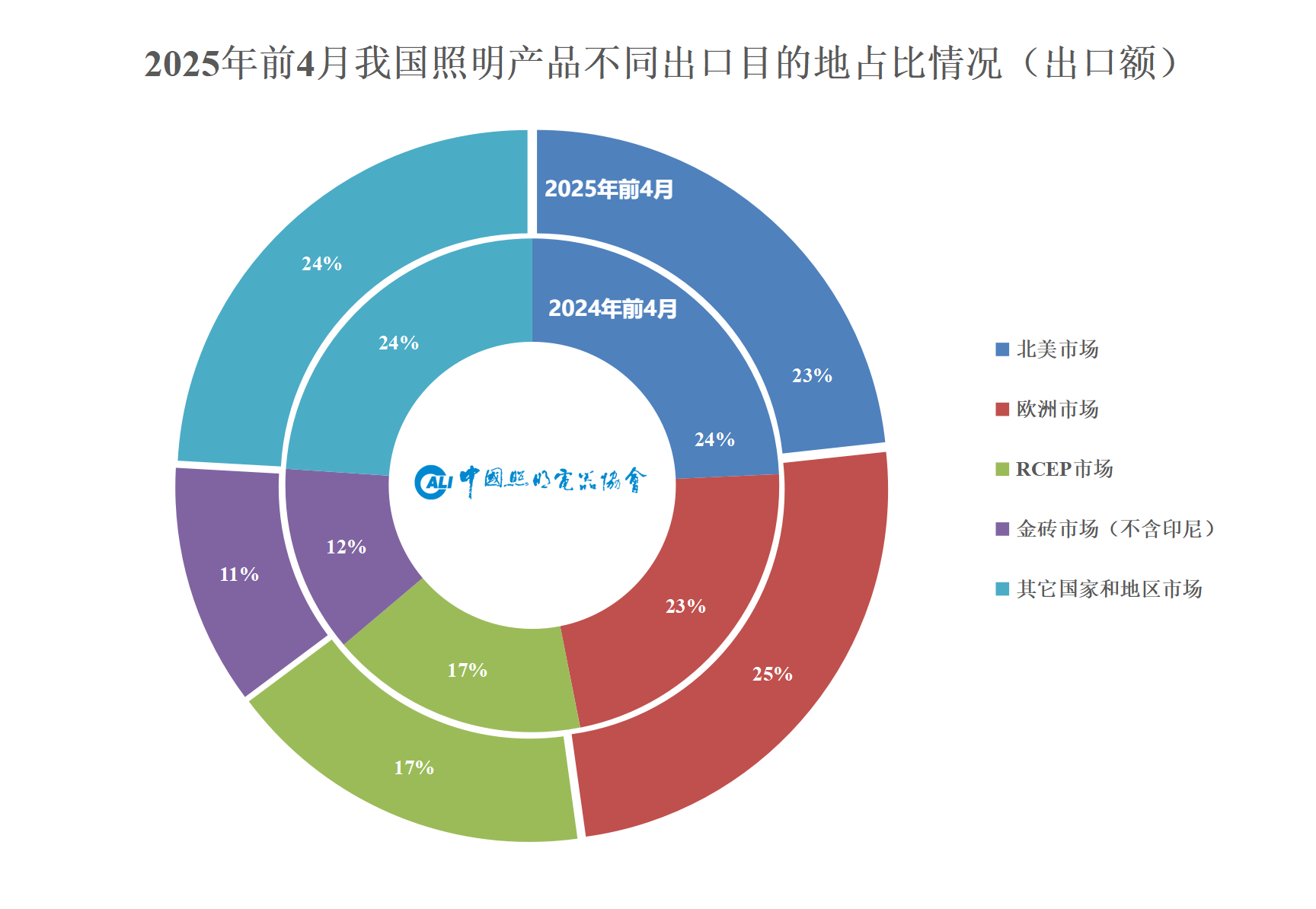
In the first four months of 2025, China's export value to the North American market was approximately USD 3.8 billion, a Year-on-year (YoY) decrease of 11%, widening by 5 percentage points compared to the first three months; the export value to the European market was approximately USD 4.0 billion, with a Year-on-year (YoY) increase of 1%, rising by 3 percentage points compared to the first three months. China's export value of lighting products to countries along the "Belt and Road" was approximately USD 7.9 billion, a Year-on-year (YoY) decrease of 5%, narrowing by 4 percentage points compared to the first three months.
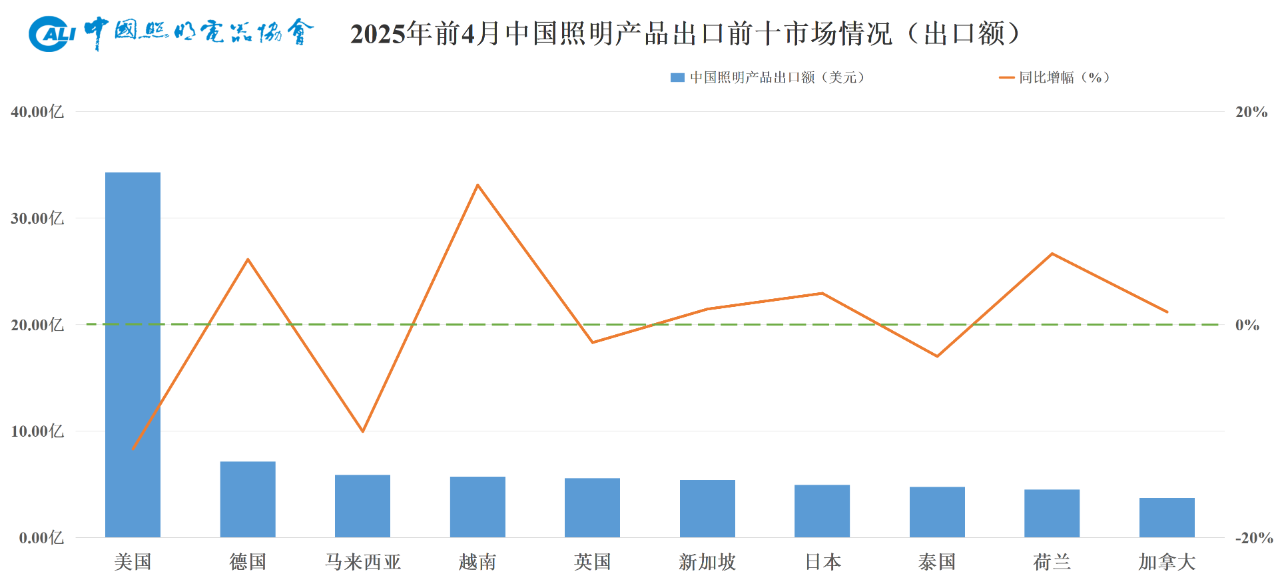
From the perspective of individual export destinations, the top ten markets for China's lighting product exports from January to April were: the United States, Germany, Malaysia, Vietnam, the United Kingdom, Singapore, Japan, Thailand, the Netherlands, and Canada, with an export value of approximately USD 8.2 billion, a Year-on-year (YoY) decrease of 4%, accounting for about 50% of China's total lighting exports. In terms of export growth rates, the Year-on-year (YoY) growth rates of exports to markets such as the United States, Malaysia, the United Kingdom, and Thailand were all in a downward range, with declines between 2% and 12%; the Year-on-year (YoY) growth rates of exports to markets such as Germany, Vietnam, Singapore, and Japan were in an upward range, with increases between 1% and 13%.
The European Union and ASEAN are China's second and third largest export markets for lighting products, with export values of USD 3.0 billion and USD 2.9 billion respectively, representing Year-on-year (YoY) growth of approximately 3% and 1% respectively.
Export situation of major lighting products
Since April, the U.S. government's indiscriminate imposition of tariff policies has not only severely affected the U.S. market but also disrupted the normal order of global foreign trade. On May 12, China and the United States issued a joint statement reaching the latest tariff agreement, which slightly alleviated the foreign trade situation for China's lighting industry to the U.S. However, overall, the pressure on exports to the U.S. remains significant throughout the year. It is understood that some enterprises exporting to the U.S. are rushing production and shipments, utilizing the 90-day tariff relief period to complete production for the first half of the year, but they still face unfavorable factors such as order gaps in the second half due to uncertainties in tariff negotiations. To help enterprises expand foreign trade markets and activate the development potential of domestic trade markets, the China Association of Lighting Industry will continue to provide various services to the industry, by organizing enterprises to participate in international exhibitions such as Light + Building and the Russian Lighting Exhibition to go global, and building industry exchange and cooperation platforms such as the China Lighting Industry Conference, actively promoting the construction of a dual-circulation development pattern for the industry domestically and internationally. Enterprises interested in related activities can contact CALI.
China Light
The official website of the China Association of Lighting Industry and a full-media platform for the lighting sector. We provide authoritative and timely lighting information while striving to be a growth partner for businesses. From brand promotion and channel expansion to consulting, talent training and participation in standards development, we provide comprehensive professional services to help businesses improve quality and efficiency and jointly advance the high-quality development of the lighting industry.