
Major News! Over a dozen national lighting standards are being accelerated in development and revision
Standardization plays a crucial role in the lighting industry. Recently, there have been updates on multiple national standard projects in the lighting field, and China's standardization technical institutions are intensively advancing the development and revision of over a dozen national standard projects.
With the rapid development of emerging technologies such as the Internet of Things, artificial intelligence, and healthy lighting, as well as the deepening research and application in fields like vision and color, the lighting industry is facing unprecedented changes. From the widespread application of smart lighting systems to the rise of healthy lighting, and the increasing importance of photobiological safety and light source quality, the industry's demand for standardization is becoming more urgent. This development and revision work of national standards, focusing on key areas such as smart lighting, chromaticity, and photobiological safety, covers the hottest topics and frontier technologies currently concerned by the lighting industry, aligns with the needs of lighting basics and application development, helps promote the coordinated development of technological innovation, standard development and industrial application, contributes to optimizing the standard system, and aims to enhance international consistency by regulating technical requirements. This not only provides new development opportunities for enterprises, but also injects strong momentum into the high-quality development of the entire industry.
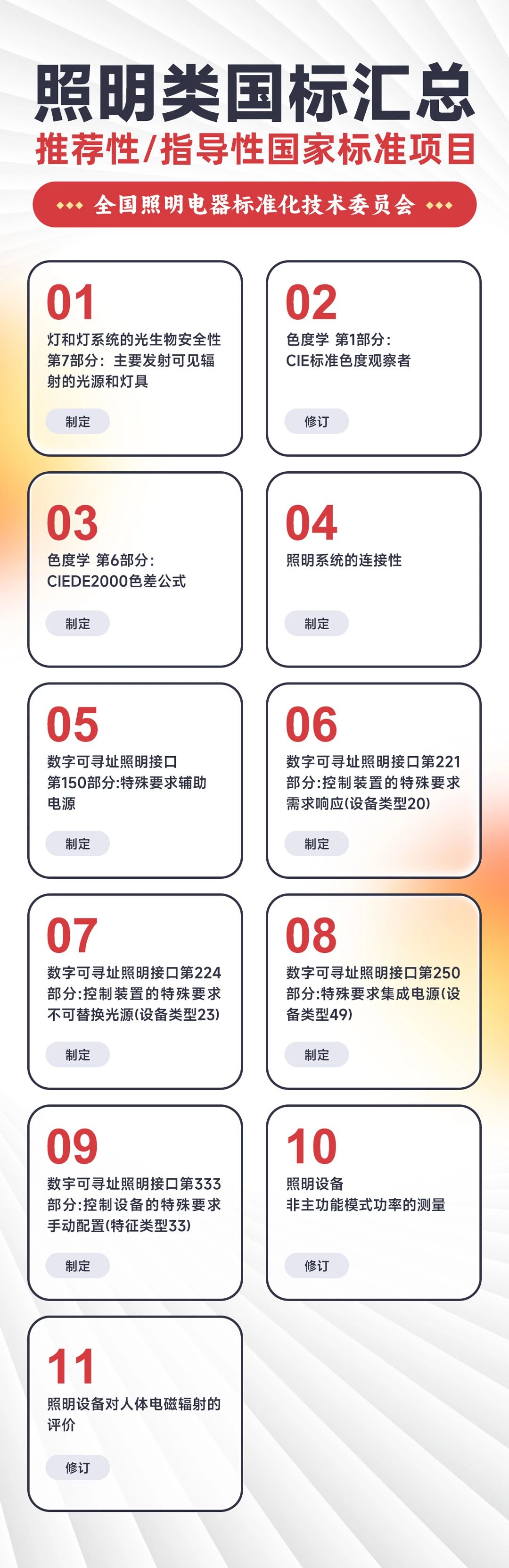
National Standard Project on Chromaticity
Precisely define "color competitiveness"
Under the jurisdiction of SAC/TC 224 (SAC/TC224), with specific implementation by the Lighting Basic Sub-Technical Committee (SAC/TC224/SC4), two recommended national standards have now formed draft versions for public comment: "Colorimetry - Part 1: CIE Standard Colorimetric Observers" drafted led by Zhejiang University, and "Colorimetry - Part 6: CIEDE2000 Color-Difference Formula" drafted led by Beijing University of Technology. For details on the projects, please see below:
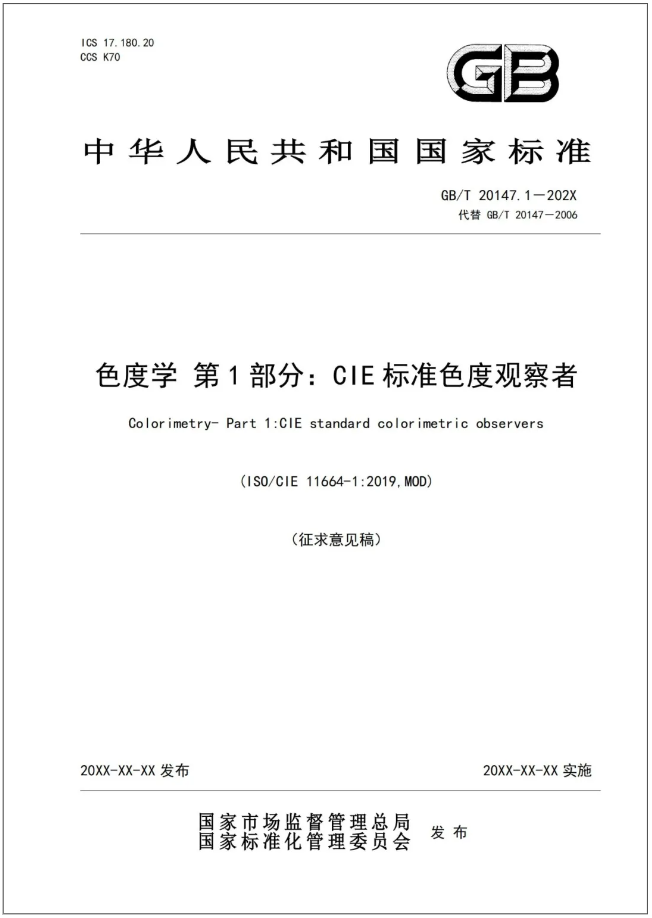
Colorimetry - Part 1: CIE Standard Colorimetric Observers
Plan Number: 20242615-T-607 Revision
The standard to be revised, GB/T 20147-2006, is identical to the original international standard ISO/CIE 10527:1991 and has been in effect for nearly 16 years without any revisions, while the corresponding international standard has been revised twice. Furthermore, based on the provisions for the core elements of the colorimetry system, GB/T 20147 is proposed to be divided into 6 parts, this standard constitutes Part 1 of the colorimetry standards and serves as the basis and foundation for developing other related standards. Therefore, the purpose of this revision is to maintain the advanced nature of the standard and its consistency with international and domestic standards, and to lay the foundation for improving the domestic colorimetry standard system, thereby further regulating colorimetry research and evaluation.
Part 1 specifies the CIE 1931 standard colorimetric observer and the CIE 1964 standard colorimetric observer, which are fundamental contents of colorimetry and basic common standards in the lighting field. This revision effectively promotes the development of the lighting industry and its standardization system, while improving the consistency between international and domestic standards.
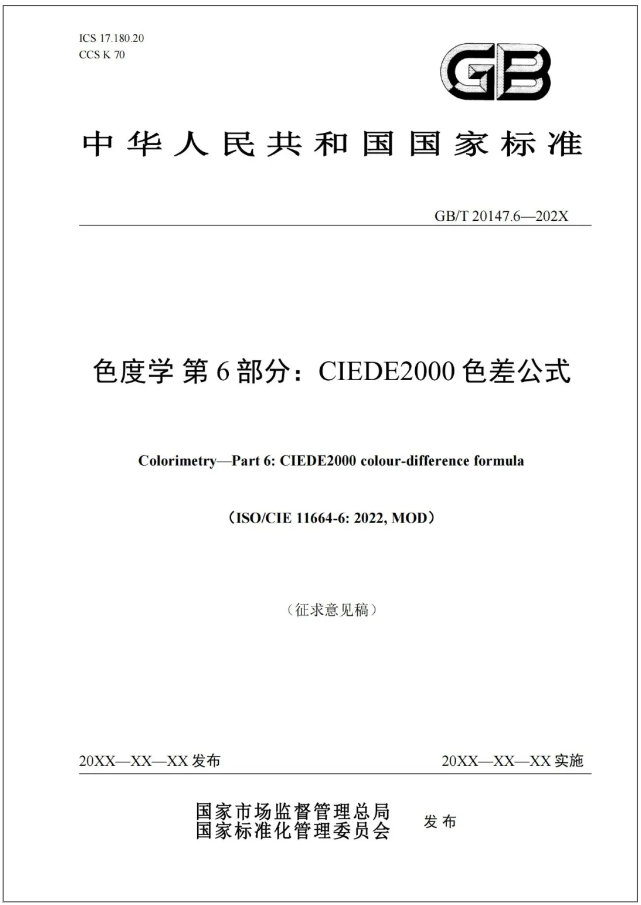
Colorimetry – Part 6: CIEDE2000 colour-difference formula
Plan No.: 20242711-T-607 Development
This standard is Part 6 of the GB/T 20147 series of standards on colorimetry. The CIEDE2000 colour-difference calculation formula described herein can be used to more accurately simulate human perception of colour changes and is applicable to describing the colour difference between two colour stimuli of reflective or transmissive objects. The purpose of this document is to extend the CIE 1976 L*a*b* colour space to obtain the CIEDE2000 colour-difference formula, which mainly corrects for perceptual changes in colour difference caused by lightness, chroma, hue and the interaction between chroma and hue.
The development of this standard aims to provide a more accurate and comprehensive method for evaluating colour differences, meeting the requirements for colour consistency and quality in various fields. This is of significant importance for various colour-related industries and applications, as well as for promoting the development of colour management standards.
National standard project on photobiological safety
Healthy lighting becomes a basic necessity
Jointly under the jurisdiction of SAC/TC 224 and the National Technical Committee on Safety of Optical Radiation and Laser Equipment (SAC/TC 284), the recommended national standard "Photobiological safety of lamps and lamp systems – Part 7: Light sources and luminaires mainly emitting visible radiation", led by National Electric Light Source Quality Supervision and Inspection Center (Beijing), has now formed a draft for comments. For details on the project, see below:
Photobiological safety of lamps and lamp systems – Part 7: Light sources and luminaires mainly emitting visible radiation
Plan number: 20240600-T-607
In recent years, with in-depth research by researchers worldwide on photobiology and photochemistry, topics such as healthy circadian lighting, photobiological safety, non-visual effects, light therapy, and natural light intrusion have been hot spots of widespread social concern. Given that most electric light sources and luminaires have spectra, light distributions, and luminous intensities that trigger natural avoidance responses—for example, people usually do not look directly at bright light sources, thus avoiding blue light hazard—there are still some light sources and luminaires whose emitted optical radiation may adversely affect health. This document is Part 7 of GB/T 30117 "Photobiological safety of lamps and lamp systems"; GB/T 30117 has already published 5 parts.
"Photobiological safety of lamps and lamp systems - Part 7: Light sources and luminaires primarily emitting visible radiation" aims to specify photobiological safety requirements for products related to light sources and luminaires that primarily emit visible radiation, specifying the photobiological safety assessment of electric light sources and luminaires under normal use conditions, as well as some basic product requirements. It applies to electric light sources and luminaires that primarily emit radiation in the visible light spectrum range (380 nm to 780 nm), used for space and object illumination, or as signals.
Smart lighting national standard project
Electromagnetic compatibility national standard project
Bridging the "last mile" of the smart ecosystem
According to the "Notice of the Standardization Administration of China on Issuing the Plan for the First Batch of Recommended National Standards in 2025 and the Plan for Foreign Language Versions of Related Standards" (Guobiao Wei Fa [2025] No. 3), seven Smart lighting national standard projects and one electromagnetic compatibility national standard project, under the jurisdiction and specific implementation of SAC/TC 224, have been included in this formulation and revision work plan. We are now soliciting participating drafting units. For details on the relevant projects, please see the following content:
Connectivity of Lighting Systems
Plan Number: 20250171-Z-607 Formulation
With the rapid development of IoT technology, Smart lighting systems have gradually become an important component of smart cities, smart homes, and other fields. Lighting equipment from different manufacturers may adopt different communication protocols and connection methods. This guiding technical document intends to provide information and guidance on the operation of lighting systems and their interconnection with other systems, and outlines various connectivity Solution used in lighting systems, including topology, communication protocols, and related embedded functions, aiming to provide lighting enterprises with a relatively comprehensive guiding technical document.
Series of Standards for Digital Addressable Lighting Interface
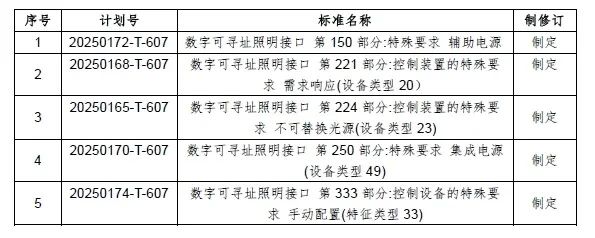
The above five standards are national standard projects adopting the Digital Addressable Lighting Interface series. Digital addressable interface technology is a dedicated wired communication protocol for the lighting industry, enabling precise control and management of lighting equipment. The formulation and revision of these standards help technical personnel in manufacturing enterprises better understand relevant technical clauses. By aligning with internationally unified technical requirements, they further promote international trade cooperation and enhance corporate competitiveness and innovation capabilities.
Measurement of power in non-main function mode of lighting equipment
Plan Number: 20250169-T-607 Revision
(Replacing GB/T 39018-2020)
GB/T 39018 applies to smart lighting equipment supplied by a power source voltage not exceeding 1500V DC or 1000V AC at 50/60Hz. It specifies the measurement method for power consumption of lighting equipment in non-main function mode, providing corresponding test method guidance for product performance standards of control devices and luminaires. This revision aims to provide methodological support for enterprises to better test and calculate non-main function power consumption during product design and development, improve the overall energy efficiency of products, meet market and user demands for high-efficiency energy-saving products, and promote the development of green lighting.
National standard (mandatory / recommended) project on electromagnetic compatibility
According to the "Notice of the Standardization Administration of China on Issuing the Plan for the First Batch of Recommended National Standards in 2025 and the Plan for Foreign Language Versions of Related Standards" (Guobiao Wei Fa [2025] No. 3), a National standard (mandatory / recommended) project on electromagnetic compatibility, under the jurisdiction and specific implementation of SAC/TC 224, has been included in this formulation and revision work plan. We are now soliciting participating drafting units. For details on the project, please see below:
Evaluation of electromagnetic radiation from lighting equipment on the human body
Plan number: 20250166-T-607 Revision
(Replacing GB/T 31275-2020)
GB/T 31275 provides appropriate evaluation methods, standardized working conditions, and measurement distances for determining the electromagnetic fields in the space surrounding lighting equipment. This standard can be used to assess the hazards of electromagnetic radiation from lighting equipment to human tissues, standardize the measurement methods and evaluation indicators for electromagnetic radiation of lighting equipment, and ensure that the electromagnetic radiation levels of lighting equipment are within a safe range. This revision is based on updates to the corresponding international standards; domestic standards should be adjusted accordingly to enhance the adaptability and competitiveness of China's lighting equipment in the international market.
The aforementioned standard projects are being actively promoted. To ensure the applicability, effectiveness, and advancement of the standards and to improve the quality of standard development, some standards are publicly soliciting drafting units from society, while others have formed draft standards for comments and are now openly seeking public feedback.
The state supports Chinese standardization technical institutions, enterprises, and others to actively participate in international standardization activities, promoting the compatibility of Chinese standards with the international standard system. The significance and value of participating in standard development need no elaboration. The future of the lighting industry requires guidance from standards and even more active participation from various entities. For more details, please contact us for consultation.
China Light
The official website of the China Association of Lighting Industry and a full-media platform for the lighting sector. We provide authoritative and timely lighting information while striving to be a growth partner for businesses. From brand promotion and channel expansion to consulting, talent training and participation in standards development, we provide comprehensive professional services to help businesses improve quality and efficiency and jointly advance the high-quality development of the lighting industry.
Business Contacts
仇纯 (Ms.): 158 6155 3579
顾君 (Mr.): 137 7157 5253