
Essentials: Analysis of the US Lighting Export Market
The United States is the world's largest developed country, with strong competitiveness in the technology sector, while China is the world's largest developing country, possessing the strongest manufacturing capabilities globally. The cooperative and win-win relationship between the two nations is the cornerstone for the healthy development of the global economic and social value chain. For a long time, the US has been China's largest trading partner; however, since 2017, the US government has adopted and protectionist policies, leading to intensified trade friction between China and the US and a deterioration in economic and trade relations. Currently, ASEAN has maintained its position as China's largest trading partner for four consecutive years. According to data from the General Administration of Customs, in 2023, China's exports to the US amounted to $500.291 billion, a Year-on-year (YoY) decrease of 13.1%. Among them, lighting product exports totaled $12.8 billion, a Year-on-year (YoY) decrease of 16%. This article will briefly analyze the changes in the US lighting export market by combining recent changes in export conditions to the US.
Dependence on Chinese lighting products is declining
1
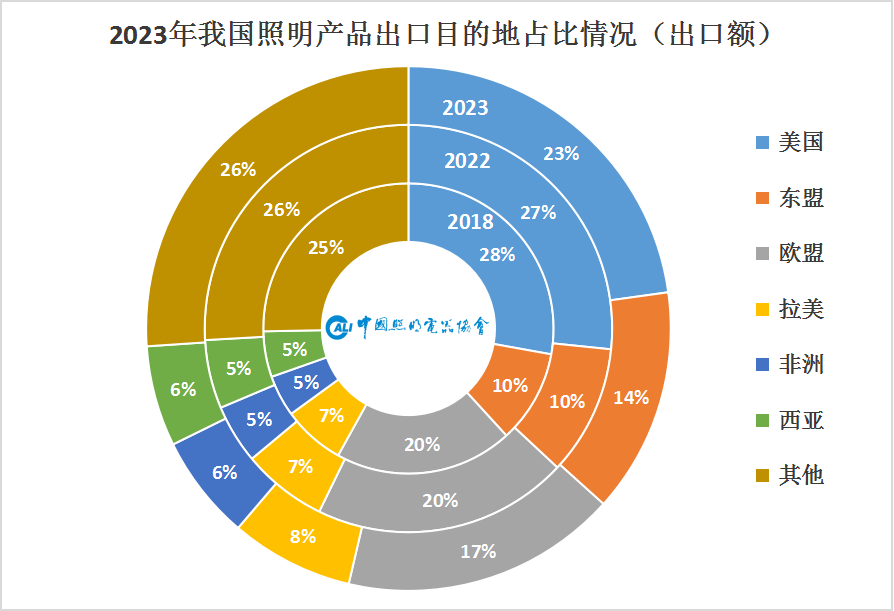
Looking at the changes in the export structure of China's lighting products to major global markets, the export share to the US has been declining year-on-year since 2021. In 2023, the export share dropped to 23%, a decrease of 5% compared to 2018. As China's export share continues to decline year-on-year, the import share from Mexico, Vietnam, Canada, South Korea, India, and other countries by the US has increased significantly; the increase in their shares is basically equivalent to the share lost by China. Influenced by factors such as additional tariffs imposed by the US on Chinese goods, trade policies, and intensified competition from other countries, demand for Chinese lighting products in the US market has weakened. With the upgrade of China's manufacturing sector and improvements in technical levels, domestic enterprises are striving to expand into emerging markets such as ASEAN to achieve market diversification and risk dispersion. How to maintain China's lighting product share in the US market and enhance the US market's dependence on Chinese lighting products remains a significant challenge in the future.
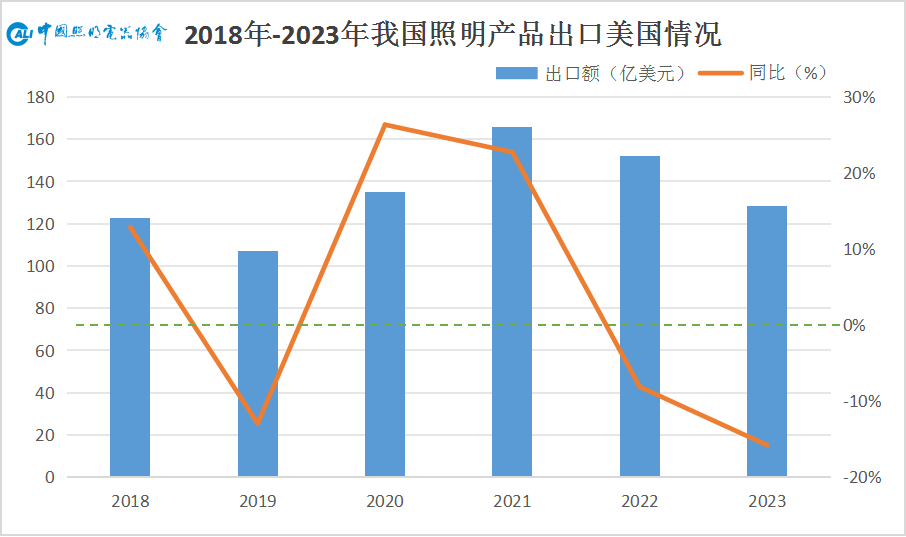
Since 2018, exports of Chinese lighting products to the US have shown a fluctuating trend. Specifically, the export value of lighting products in 2019 declined significantly, with a drop of about 13%. After a brief recovery in 2020 and 2021 due to the global COVID-19 pandemic, exports began to decline again from 2022, with a decrease of approximately 16% in 2023, further widening the decline compared to the previous year. In 2023, the total export value of Chinese lighting products to the US was approximately $12.8 billion, an increase of 4 percentage points compared to 2018. In the first quarter of 2024, exports of Chinese lighting products to the US amounted to $2.8 billion, a year-on-year decrease of about 2%.
The current change in exports of Chinese lighting products to the US is directly related to the shrinking proportion of China's export share in the total foreign trade volume of the US. Affected by US tariff policies on China and the gradual fading of China's manufacturing dividend, many manufacturing enterprises that relied heavily on the US as their main export market were forced to transfer production capacity overseas, directly impacting China's export trade with the US. In 2023, the total imports from China accounted for about 14% of the US's total trade volume, a year-on-year decrease of nearly 3 percentage points; this represents a decrease of about 7 percentage points compared to 2018. China has become the country with the largest decline in import share over the past six years for the US, and the direct dependency of trade between the US and China shows a clear downward trend.
With the active promotion of economic and trade relations relaxation by the governments of China and the US, as well as potential policy changes brought about by the upcoming US election, we look forward to the potential opportunities for warming up bilateral trade relations. The export of Chinese lighting products to the US may welcome new opportunities.
Changes in the situation of exports of lighting products to the US
2
(I) Luminaire Products
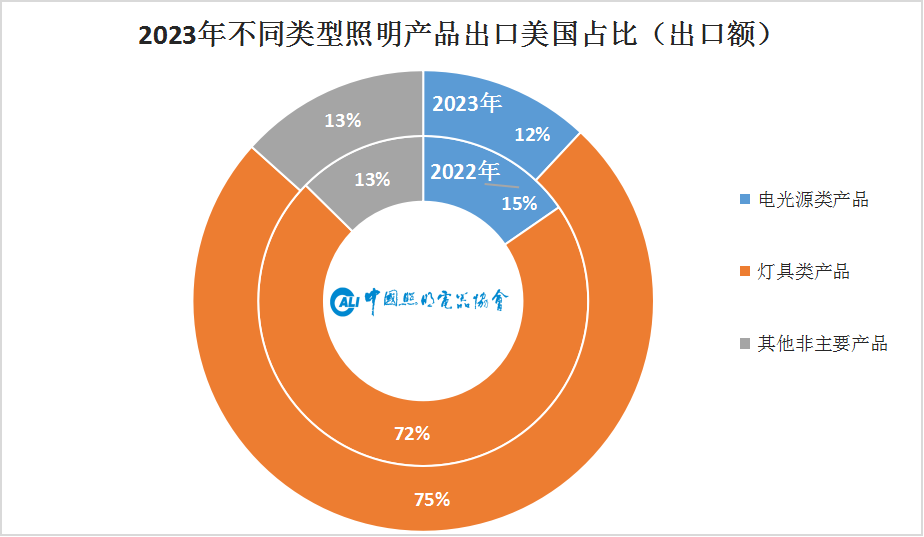
In 2023, China's exports of luminaire products to the United States amounted to approximately USD 9.6 billion, a year-on-year (YoY) decrease of 13%, accounting for 75% of total lighting product exports, with the share rising by 3 percentage points. Among them, portable luminaires saw the smallest decline, down 8% YoY; Christmas lights experienced the largest drop, down 38% YoY. Exports of fixed luminaires, other electrical luminaires and lighting apparatus, non-electrical luminaires and lighting apparatus, and luminaire accessories all declined by varying degrees, ranging from 11% to 35% YoY. In the first quarter of 2024, China exported USD 2 billion worth of luminaire products to the United States, a 1% YoY decrease. Among these, exports of fixed luminaires and portable luminaires rose slightly, increasing 5% and 8% YoY respectively; Christmas light products continued last year's downward trend, falling 38% YoY.
(II) Electric Light Source Products
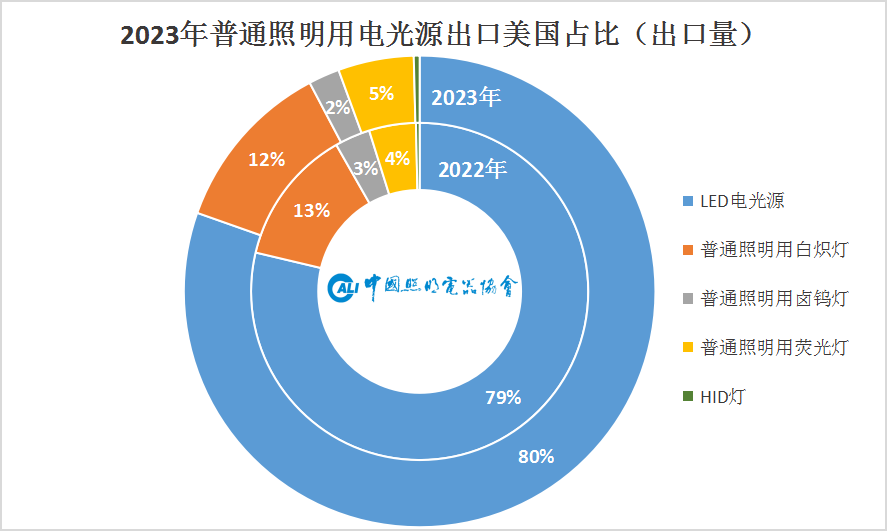
In 2023, China exported approximately 1.4 billion units of general-purpose electric light sources for illumination to the United States, a year-on-year (YoY) decrease of 6%. Among them, the total export volume of LED electric light source products was 1.1 billion units, down 4% compared to 2022, accounting for 80% of the total export volume of all electric light sources, with a 1 percentage point increase YoY. The export volumes of incandescent lamps for general illumination and tungsten halogen lamps for general illumination declined to varying degrees, decreasing by 15% and 41% respectively. Affected by the implementation process of the , exports of fluorescent lamps and HID lamps for general illumination increased slightly, with export volumes growing by 8% and 7% respectively. In the first quarter of 2024, China exported approximately 300 million units of electric light source products to the United States, a 13% decrease year-on-year. The total export volume of LED electric light source products to the United States increased slightly by 6% YoY. Due to the relatively small base of LED module product exports from the previous year and tariff impacts, among other factors such as avoiding tax rates through the export of parts, the export volume of this product to the United States surged by 890% YoY.
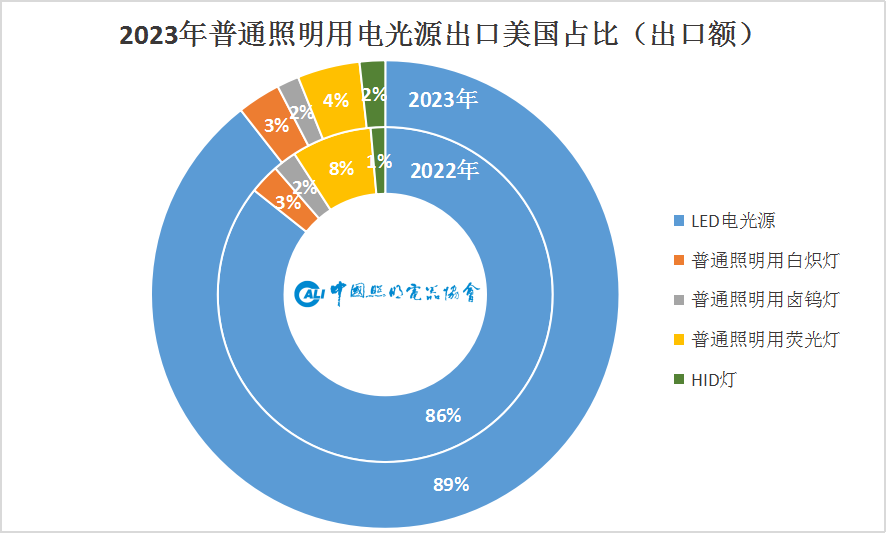
出口额方面,2023年我国普通照明用电光源出口美国约14亿美元,同比下降20%。其中,LED电光源产品出口超12亿美元,同比下降17%,占电光源出口总额的89%,较上年扩大了3个百分点。普通照明用白炽灯、卤钨灯和荧光灯产品出口额均有不同幅度下降,同比下降在18%至56%之间。2024年第一季度,我国电光源产品对美国出口约3亿美元,同比下降9%。LED电光源产品整体较去年同期下降7%,但发光二极管(LED)模块产品出口额同比大幅上涨了563%。
Changes in U.S. Companies and Lighting Markets
3
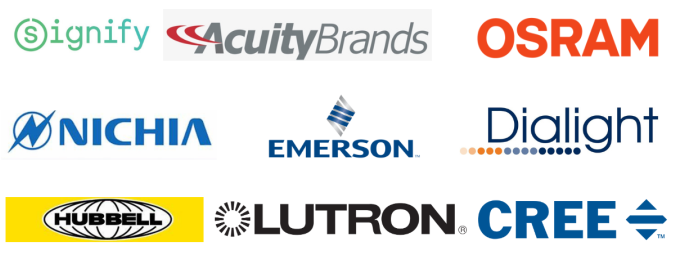
The U.S. lighting market is transitioning from a fragmented stage with no dominant enterprises and fierce competition to a transitional stage led by 1-5 dominant enterprises. In the U.S. LED lighting market, Emerson Electric Co., Signify, (OSRAM), Nichia Corporation, Acuity Brands Inc., and others hold significant market shares. In December 2023, Acuity Brands announced that it reached an acquisition agreement to acquire the Arize® series horticultural lighting product business under Current Lighting; in the same month, the well-known American company (Hubbell) announced that it would sell its home lighting business to the American private equity firm Kingswood Capital Management, LP. This move reflects the company's strategic shift away from its lighting business segment; in May 2024, Cooper Lighting Solutions announced that it would close its factory located in Vicksburg, Mississippi, USA, which will enable Cooper to expand its product supply range and enhance customer experience. Leading enterprises are continuously strengthening their market dominance through strategic acquisitions, business transformation, and product development.
Precautions for Exports to the United States
4
(I) Safety Certification
FCC Certification is issued by the Federal Communications Commission. FCC certification ensures that electronic devices, wireless products, and communication equipment comply with U.S. electromagnetic compatibility (EMC) and radio frequency (RF) specifications to prevent interference with other devices or the environment during use, ensuring safety and reliability. Obtaining FCC certification is one of the legal requirements for selling electronic and communication products in the U.S. market. Lighting luminaires in the U.S. must comply with FCC Part 18 requirements and complete Declaration of Conformity (DoC) certification.
UL Certification is a widely recognized mark indicating that a product has passed rigorous testing and evaluation, meeting specific safety and performance standards.
ETL Certification aims to ensure product safety and reliability while complying with relevant regulations and performance standards. The ETL mark typically helps product manufacturers demonstrate that their products have undergone independent testing and review, thereby increasing consumer trust in product quality and safety. ETL certification is used to verify various lighting products, including LED luminaires, fluorescent lamps, light bulbs, etc.
(II) Energy Efficiency Labeling
DOE Certification is a mandatory certification nationwide in the U.S., issued by the U.S. Department of Energy based on U.S. energy efficiency regulations. Its main purpose is to save energy and reduce emissions, help users save electricity, thereby reducing energy consumption demand and mitigating the greenhouse effect, among other effects.
ENERGY STAR is a voluntary certification for an energy-saving program mainly targeting consumer electronics products. LED lighting products are primarily intended for residential lighting products and light bulbs. Products that pass testing can be listed on the ENERGY STAR website; consumers who purchase ENERGY STAR certified products enjoy U.S. government consumer subsidies.
DLC (DesignLights Consortium) Certification is a voluntary certification designed to address LED luminaires not covered by ENERGY STAR. The DLC project focuses on commercial and industrial lighting. Products passing DLC certification can be listed on the DLC website; purchasing products with DLC certification may also entitle you to subsidies from local utility providers in the U.S.

(III) Intellectual Property
除产品认证及能效标识外,还应注意知识产权问题,特别是美国“337调查”。该调查是指美国国际委员会(USITC)根据美国1930年《关税法》(Tariff Act)第337条(19U.S.C1337)及相关修正案,对不公平进口行为进行调查,并采取制裁措施的一项准司法程序。该调查其主要目的在于禁止一切不平等竞争行为或向美国出口产品中的任何不公平贸易行为,中国一直是美国337调查的主要涉及对象之一,据不完全统计,我国企业涉案量常年占比约30%。以2018年3月,美国Ultravision Technologies公司指控对美出口、在美进口或在美销售的LED灯驱动及其组件(Certain Light Engines and Components Thereof)侵犯其专利权一案为例。艾比森、雷曼光电、洲明科技、利亚德等11家中国企业被诉。由于我国企业应对策略得当,该案申请人于2018年11月向ITC提出了案撤诉动议。2019年2月,ITC发布终裁公告,终止该案调查,标志着我国企业在该337调查案应对中取得了胜利。2021年6月,Ultravision知识产权官司终于一审宣判:中国LED企业胜诉,美国德州地区法院认定艾比森等被告未构成专利侵权,且原告专利无效。
因此,我国照明企业在进入美国市场之前,可以通过商标、专利等知识产权信息检索,分析是否存在侵权并及时规避风险,或可以通过申请、购买、许可等方式,获得美国相关的知识产权,合法进入美国市场。
虽然过去一年世界经济复苏乏力,全球贸易整体表现比较低迷,但从出口数据中也不难看出中美经贸正在遇冷。此前联合国贸发会议发布的《全球贸易最新动态》报告显示,中国和美国之间的贸易相互依存度下降。中美关系的正向发展首先取决于两国在发展战略、发展方向以及在全球定位方面能够朝着形成共识、避免敌对、维系正常的大国关系这一方向发展,特别是在当前复杂的全球发展格局当中,双方应朝着把中美关系纳入建设性轨道去推进,为经贸合作塑造更好的合作氛围和合作格局。
China Light
The official website of the China Association of Lighting Industry and a full-media platform for the lighting sector. We provide authoritative and timely lighting information while striving to be a growth partner for businesses. From brand promotion and channel expansion to consulting, talent training and participation in standards development, we provide comprehensive professional services to help businesses improve quality and efficiency and jointly advance the high-quality development of the lighting industry.
Business Contacts
仇纯 (Ms.): 158 6155 3579
顾君 (Mr.): 137 7157 5253