
Smart lighting and energy saving
As the new year begins, the changes facing the lighting industry are becoming increasingly evident. Even senior leadership emphasizes that, at a macro level, global economic growth momentum is insufficient, with increasing instability, uncertainty, and unpredictable factors. How to tap into growth potential is a practical challenge for lighting companies. This year, the country continues to intensify efforts to achieve its dual carbon goals and reduce energy consumption. For the lighting market, we need to carefully consider:
1. The new construction market continues to shift toward the existing building market
I remember a few years ago, I accompanied a group of real estate executives on a study tour to Europe, where we visited a German architectural design firm. The person who received us was a Chinese designer who had studied in Germany and stayed there after graduation. When asked how many new projects they designed in a year, the answer was in single digits. Later, the domestic real estate executives privately remarked that if he were in China, the number of projects he would receive should be tens or even hundreds of times higher. Last year, as real estate development stagnated, the number of new project designs that many domestic design firms could secure dropped sharply. Instead, renovation projects for some existing buildings came to light. In addition, urban renewal has gradually become a trend, not demolishing existing buildings but replanning and reusing them, providing new market opportunities for lighting companies.
2. The approach of simply replacing luminaires with LED in lighting energy saving has hit a bottleneck
Building energy efficiency retrofitting is not new either. Many energy saving companies tried to enter the market through EMC schemes a few years ago. Having reviewed many energy saving retrofit proposals, I found that in the lighting subsystem, it was often just a simple replacement of luminaires using traditional light sources with LED luminaires. It is undeniable that such replacements brought some energy saving effects at the time, but they did not tap into the energy saving potential of smart lighting. When the coverage rate of LED luminaires reached a certain level, energy saving companies using this approach would encounter a bottleneck.
Now is the time for us to re-examine energy saving in smart lighting. As Lin Yan, Vice President of Sansi Xiongji, said in his New Year outlook, the most impressive thing in 2023 was the positive changes taking place in smart lighting, especially in the commercial lighting sector. Since smart lighting can bring convenience in management and operation and maintenance, and significantly reduce energy consumption and lighting usage costs, more and more users have accepted or even actively sought smart lighting solutions.
So, what kind of energy saving effects can smart lighting systems actually bring? In fact, there is already a large amount of research reports providing evidence. In the research report "Energy Savings from Networked Lighting Control (NLC) Systems with and without LLLC" published by the DesignLights Consortium in the United States, 194 buildings of various types were monitored over the years. These buildings all used smart lighting control systems, and the average energy saving effect in the lighting part could reach 49%, with the most significant energy saving effect seen in warehouse-type buildings, reaching 68%. In office-type buildings, the energy saving effect could also reach 64%. This is not the energy saving effect brought about by replacing LED luminaires, but the energy saving effect brought about solely by using smart lighting control systems.
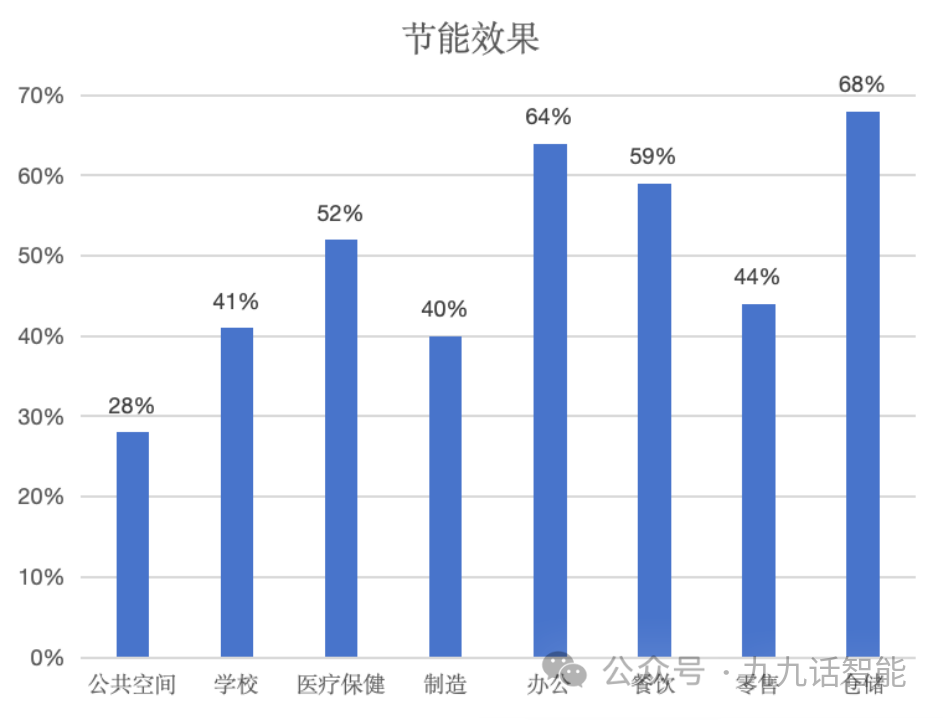
It can be seen from this that smart lighting control systems can make a real contribution to energy saving. How to use smart lighting control systems to achieve energy saving?
1. Develop a comprehensive plan and focus on scenario-based applications. First, do not pursue [[13. 节能、寿命与评价|Energy saving]] for its own sake. Lighting affects our health and reflects the aesthetic design of spaces. We must start with human needs and behaviors to create a well-rounded plan. Second, different scenarios have different requirements; offices, warehouses, public spaces, classrooms, etc., all have distinct needs for [[10. 智能照明与控制|Smart lighting]]. Furthermore, there are numerous wired and wireless lighting control communication protocols, along with supporting control hardware ecosystems. It is essential to select an appropriate control system based on project requirements, scale, and supporting systems. Finally, prioritize top-level management software and interface protocols for integration with other systems to prepare for future upgrades and expansion. Where possible, integrate with shading systems, HVAC, and building automation systems to achieve greater [[13. 节能、寿命与评价|energy saving]] effects, especially since HVAC accounts for the largest share of energy consumption in buildings.
2. Use appropriate control strategies. There are many options for control methods/strategies corresponding to [[10. 智能照明与控制|Smart lighting]] functional requirements, for example:
The following are strategies for Smart lighting control systems in terms of Energy saving provided by the U.S. Department of Energy, for your reference and application:
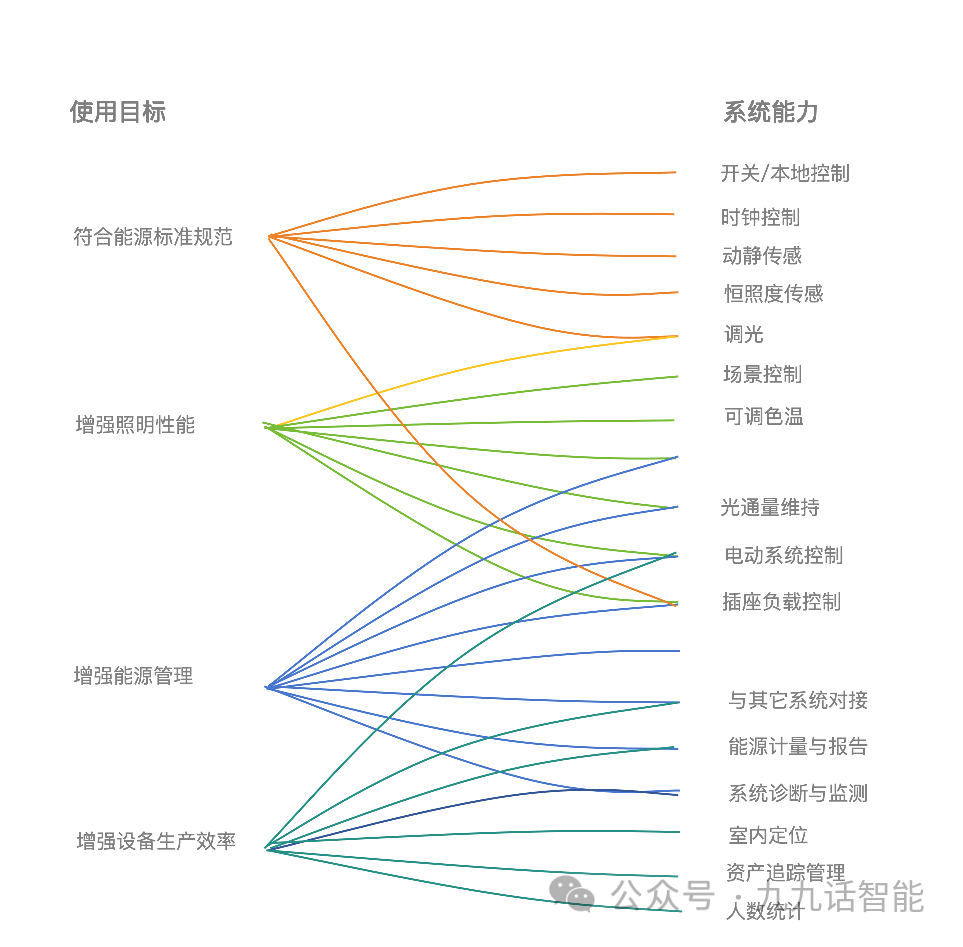
3. Focus on data collection and application, ensure effective data monitoring, and protect data security
How much energy can actually be consumed/saved? Estimation alone is not enough. It is recommended to use smart devices with metering capabilities, such as smart meters, smart circuit breakers. If granularity down to each device is required, drivers, sockets, switches, etc., with metering chips can be used. With proper data collection, effective analysis can be performed on the management system to readjust energy-saving strategies for spaces and behaviors with high energy consumption, unlocking further potential for energy saving. At the same time, pay attention to data security.
4. Provide calculations of return on investment to persuade users
The initial deployment cost of a smart lighting control system is definitely higher than that of ordinary LED luminaires. How to persuade customers to use a smart lighting control system? It is essential to state the benefits that the overall solution brings to the customer. At the same time, it can be analyzed from the perspective of Total Cost of Ownership (TCO), calculating initial installation costs, operating costs, maintenance costs, etc. For example, when promoting smart T8 tubes for garage retrofits, we used the following table for return on investment analysis. In representative projects, the payback period can be as short as 7 months, saving hundreds of thousands of yuan in electricity bills per month, helping customers make clear judgments.
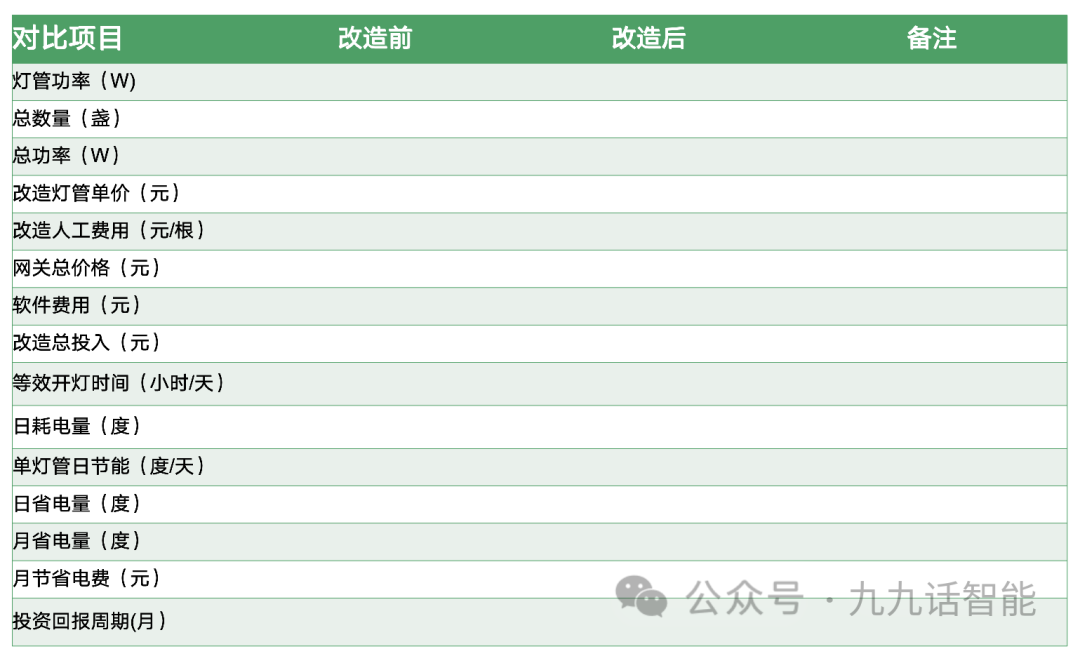
5. Pay attention to hidden service costs
When selling traditional LED luminaires, agents typically only need to cover basic logistics and installation costs. In contrast, providing smart lighting control systems involves hidden service costs, including pre-sales solutions, commissioning during sales, and after-sales maintenance. If these costs are not accounted for, it can easily lead to profit loss or even financial deficits. Dealers new to smart lighting control systems often overlook these calculations and quote low prices directly. As a result, they not only fail to make a profit but also cause the control systems to remain unused, failing to achieve true energy saving effects. Finally, we emphasize that energy saving is just one important link in achieving dual carbon goals. To reduce carbon emissions, the entire product lifecycle must be considered, including raw materials, manufacturing, packaging, transportation, usage, and waste recycling. Of course, if energy saving is not done well, achieving grander goals is out of the question. Smart lighting energy saving provides more market demand and business opportunities for lighting companies. Let us stay grounded, improve our products and solutions, and achieve growth.
Source: Jiujiu Talks Smart Lighting
China Light
The official website of the China Association of Lighting Industry and a full-media platform for the lighting sector. We provide authoritative and timely lighting information while striving to be a growth partner for businesses. From brand promotion and channel expansion to consulting, talent training and participation in standards development, we provide comprehensive professional services to help businesses improve quality and efficiency and jointly advance the high-quality development of the lighting industry.
Business Contacts
仇纯 (Ms.): 158 6155 3579
顾君 (Mr.): 137 7157 5253