
Special Report: State of the Cannabis Lighting Market 2023 – An In-Depth Look at Lighting Trends for Commercial Growers
This yearCannabis Business Times’s “State of the Cannabis Lighting Market” report is CBT’s eighth annual in-depth study of lighting trends among commercial growers. Since the first release of this exclusive industry research in 2016, the lighting market and the cannabis industry have undergone significant changes. Driven by enthusiastic growers, product manufacturers, and researchers, advances in lighting technology have been tested by both new and old challenges.
As new markets and competitors enter the scene, growers face price compression, rising energy costs, and shifting consumption patterns while pursuing higher profitability. Once considered unproven and unaffordable, energy-saving light-emitting diodes (LEDs) have become indispensable cost-saving components for many commercial growers to control their growing environments.
This 2023 “State of the Cannabis Lighting Market” report was conducted by third-party research firm Readex Research on behalf of Cannabis Business Times, with support from Fluence. The results reported here provide insights into cannabis lighting trends and grower operations practices. As the cannabis lighting market matures, this important CBT study enables valuable comparisons.
LEDs bring different lighting choices
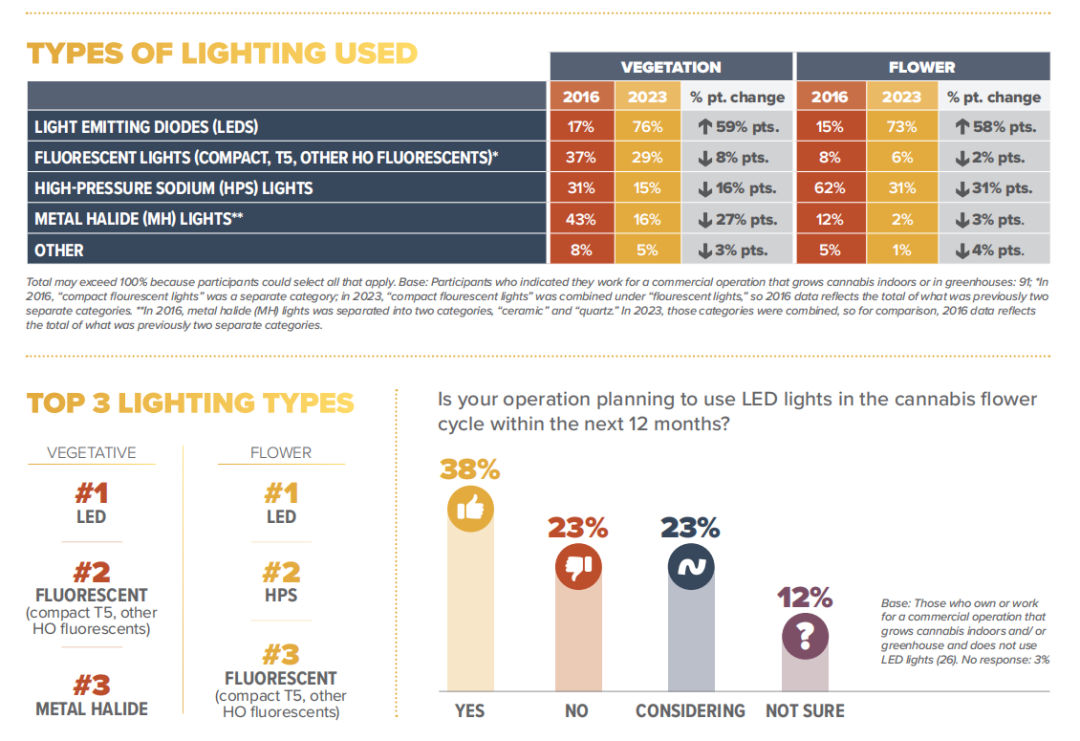
Last year, for the first time in the history of this report, more than 70% of research participants came from commercial indoor and greenhouse cultivation, using supplemental lighting reports with "light-emitting diodes" (LEDs) at every growth stage to fill respondent gaps. This represents a 55 percentage point increase compared to the 2016 average. While LEDs continue to dominate commercial lighting choices, study results show that in 2023, some Veg and Flowering growers sought other solutions.
Vegetation: In 2023, 76% of research participants reported using "light-emitting diodes" (LEDs) for plant growth, an increase of 59 percentage points from 2016. Nearly one-third (29%) of participants reported using "fluorescent lamps (compact, T5, other HO fluorescent lamps)", but the usage rate of this technology among participants decreased by 8 percentage points compared to 2016. The proportion of participants using high-pressure sodium lamps (HPS) was 15%, a decrease of 16 percentage points from 2016.
In 2016, "metal halide (MH) lamps" were the preferred choice for vegetable lighting, with 43% of growers using them that year. In 2023, only 16% of commercial growing participants used metal halide during the vegetative stage, a decrease of 27 percentage points from 2016.
Flowering: The vast majority (73%) of research participants in 2023 stated that they use LEDs in flowering, an increase of 2 percentage points from last year and 58 percentage points from 2016.
Nearly one-third (31%) of commercial grower participants reported using HPS lamps this year, reflecting a decline of approximately 50% since the first year of this study (2016), when 62% of study participants growing commercial crops indoors or in greenhouses, with or without supplemental lighting, reported using HPS lamps in their cultivation.
Future plans indicate that growers who do not use LED lighting or supplemental lighting will undergo more transitions: 38% of participants stated that they plan to use LEDs in the next cannabis flowering cycle, and another 23% are considering using LEDs.
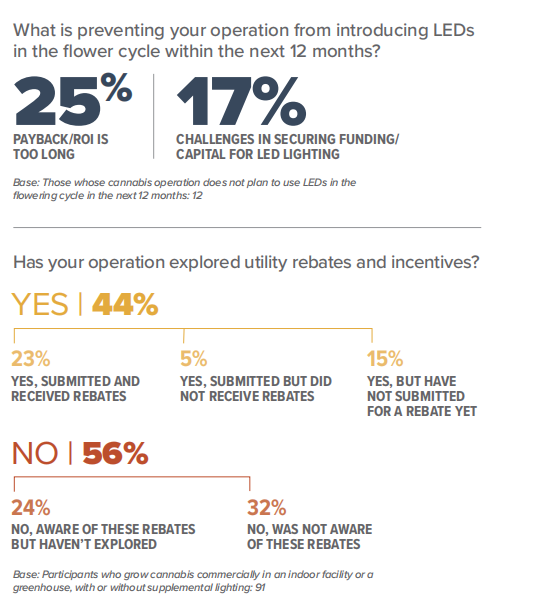
However, 56% of participants in 2023 did not consider rebates at all, showing little change compared to 2022. Of these, about one-quarter (24%) stated they "knew about these rebates but had not explored them," and nearly one-third (32%) "were unaware of these rebates."
Average Yield and Lighting Types
For many commercial growers in the cannabis Industry, interest in technologies such as Spectrum, light intensity, and lighting often boils down to yield. As demonstrated by the 2023 study, the average yield per square foot in greenhouses shows that advances in genetics are evident.
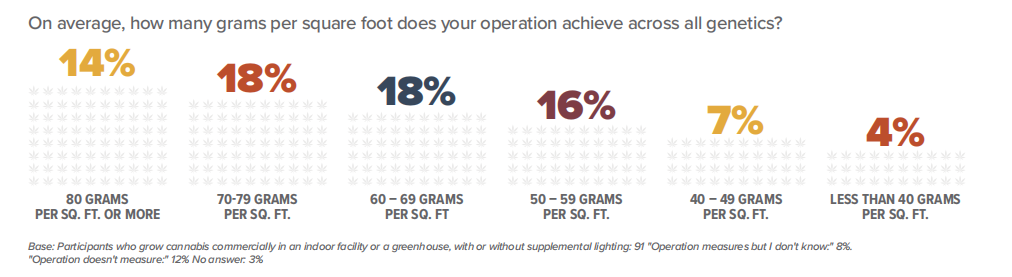
Last year, more than half (55%) of study participants operating commercial indoor or greenhouse facilities reported average yields exceeding 50 grams per square foot. By 2023, two-thirds (66%) of commercial growers fell within this range of over 50 grams.
This year's study also introduces a higher-tier new category: "80 grams or more per square foot." By 2023, 14% of commercial operations reported average yields in this highest range. According to participants, not all businesses follow this metric; 12% stated that their companies "do not measure" this. Another 8% said, "There are operational measures, but I don't know."
As growers pursue optimal yields, interest in adding top lights has increased slightly. Among study participants engaged in commercial cannabis cultivation in indoor facilities or greenhouses, with supplemental lighting or without, but considering greenhouse lighting within the next 12 months, over 34% expressed interest in exploring "side lighting," up from 30% last year.
Canopies and Growing Facilities
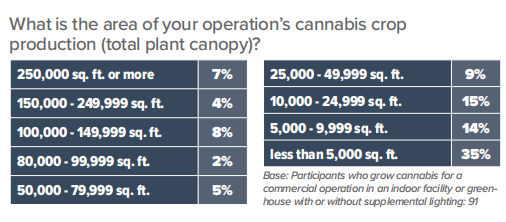
Last year, the report acknowledged that averages can be misleading when data includes extreme cases—commercial canopies are a pertinent example. The 2022 report shared the median total plant canopy for commercial participants, rather than the average canopy size: 10,000 square feet. This year's report again provides the median of all reported commercial canopy sizes, with half of the participants falling above the median and half below. Similarly, the median plant canopy in 2023 was 10,000 square feet. However, excluding the 40% of commercial growers who also operate amateur or personal-use grows, the median commercial growing canopy area increased to 19,370 square feet, up from 14,770 square feet last year. By 2023, 26% of commercial growers operating indoor or greenhouse facilities were cultivating plant canopies of 50,000 square feet or more. 16% operated plant canopies of less than 1,000 square feet.
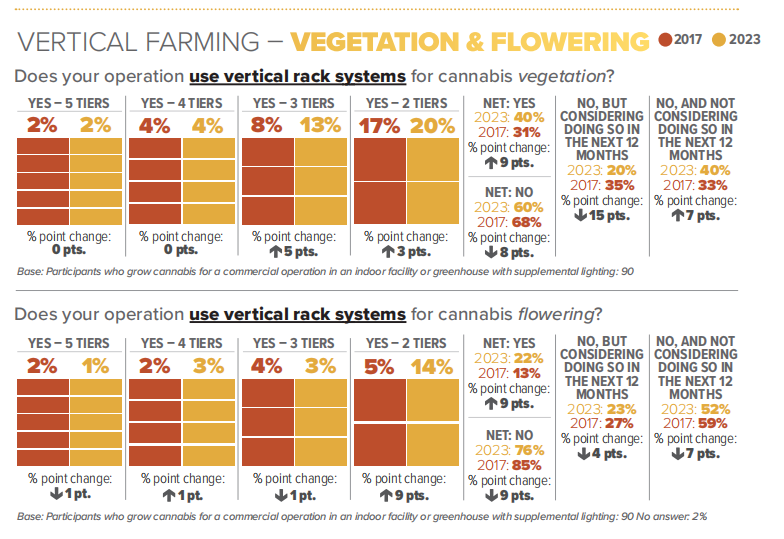
Among study participants engaged in commercial cultivation in indoor facilities or greenhouses in 2023, 40% used vertical racks for growing, an increase of 9 percentage points since this question was first asked in the 2017 report. Among those using vertical racks, 50% used two-tier shelving. Less than a quarter (22%) of commercial growers used vertical racks for flowering under supplemental lighting, up 9 percentage points from 2017. Among plants grown on vertical flower racks, 65% were kept on two-tier vertical racks for flowering. This year's study once again confirms that many commercial growers operate multiple facility types. More than three-quarters (76%) of commercial growers cultivated indoors, down from 88% last year. Meanwhile, 39% of commercial participants cultivated in greenhouses with supplemental lighting, an increase from 28% in 2022.
Obtain LED rebates
According to the 2023 Cannabis Lighting Market Survey by Cannabis Business Times, more than half (56%) of participantshave not explored rebates for light-emitting diodes (LEDs).
One quarter (24%) of respondents said they were aware of but had not investigated utility savings, while nearly one third (32%) said they were completely unaware of these rebates.
Cannabis growers in the know and companies leveraging these state-level programs have the opportunity to save hundreds of thousands of dollars, and sometimes even more, onLEDsretrofits and installations.
"Awareness is the first hurdle,"said Jeannie Sikora, Senior Energy Engineer atCLEAResult, a company that partners with utilities to implement energy efficiency rebate programs. "If I were a grower, I would first check with my local utility company. If you don't immediately see agricultural rebates through your local utility, instead of trying to browse the web, pick up the phone and call someone."
Sikora says that because utility rebates are often state-mandated programs, incentives and structures can vary significantly depending on where you operate. However, horticultural lighting rebates have become increasingly common in recent years, so it is worthwhile for cannabis growers to explore services offered by local electric (and natural gas) utilities.
Once you confirm that your utility company offers energy efficiency rebates for horticultural lighting, you can take the following steps to secure and maximize your rebate:
1.Identify available rebate incentive types
Generally, there are two main types of incentives available for horticultural lighting: prescriptive and custom. Prescriptive incentives provide funding for purchasing more energy-efficient equipment, while custom incentives do the same but may require measurement and verification of energy savings before awarding. Pre-approval is almost always required before purchase.
Travis Higginbotham is the Vice President of Cultivation at State House, a cannabis cultivation company in Salinas, California. He said his team was able to secure a substantial rebate that covered the entire cost of converting the company's greenhouse from HPS lighting to LEDs, meaning they did not need to seek or use capital to invest in the equipment.
Higginbotham said: "The California market has clearly been challenging for a long time, and 2022 was a very difficult year." He pointed out that in the past 18 months, millions of square feet of cannabis production have gone offline. According to an article published in SFGATE this April, since January 2022, the state has lost more than 1,760 cultivation licenses, accounting for about a quarter of the legal canopy area, or 19 million square feet. Higginbotham said: "Due to product saturation in the market, flower prices have dropped, so we decided to take more aggressive measures in 2022, focusing on improving cost-effectiveness while striving to optimize our area to produce more in less space."
As described by Higginbotham, their solution was to "utilize their total area," rearranging production stages in the company's five greenhouses, reducing flower space and increasing other growing spaces within the 205,000 square feet of space.
Higginbotham said: "One reason is to ensure that we do everything possible to prevent Hop Latent Virus, and another reason is to give our plants more space during vegetative growth, allowing them to grow for a longer period to reduce the number of flowering plants and lower direct costs." "At the same time, it may also leverage the advantages of plant sales."
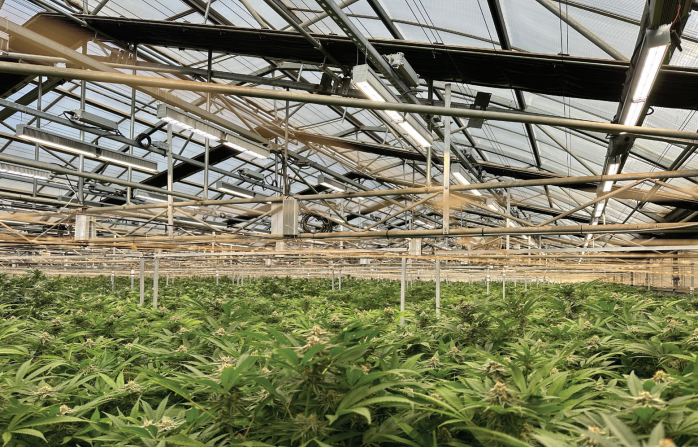
A key part of optimizing the space equation is increasing yield without expansion. Through tax rebates and other strategic infrastructure improvements, the company was able to increase light intensity in a smaller footprint. Higginbotham said the entire process was quick and relatively easy. The lights are compatible with HPS sockets, so it took only about a month from determining rebates and purchasing to retrofitting the facility.
2.Collaborate with suppliers to provide resources and support for tax rebates
For Higgibotham, one reason the LED rebate process was so easy is that the LED supplier handled the entire process from application to working with Pacific Gas and Electric (PG&E) and utility consultants to secure approval and maximize benefits.
Jushi's Holdings Inc.'s LED supplier also provided the same support and secured an LED rebate for the expansion of its 123,000-square-foot facility in Scranton, Pennsylvania. Vice President of Growing Operations, Josh Malman, said the U.S. facility made it possible.
"One of the biggest hurdles to getting discounts is the time and effort involved," Malman said. Jushi's rebate covered 26% of the cost of the LED luminaires and took about a year. Their LED supplier worked with them from the very beginning of designing the Scranton plant, helping them complete the application and calculate the comparative energy usage load of traditional equipment versus LED technology. "I think (growers) should be aware that rebates exist and work with partners who are willing to collaborate with you. Not every company has someone on their team responsible for the rebate process."
3.Check if the supplier is DLC certified
Before making lighting investments, Sikora recommends checking with the utility company to ensure the LED supplier qualifies. Most of the time, utility companies require products to be on the DesignLights Consortium (DLC) Qualified Products List.
4.Start exploring rebates early
The team at Jushi Holdings Ltd. knew before purchasing LEDs luminaires that the utility company PPL Electric Utilities would cover 5% to 26% of the total cost of its indoor facilities (including double and triple layers).
"LEDs capital cost is a barrier; but now there is enough research, and visible around LEDs companies with the right technology, these technologies can bury traditional lighting in indoor growth," Malman said, pointing out that energy efficiency plus HVAC cost savings (because LEDs generate less heat) make LEDs an obvious choice.
Two months after luminaire installation, Jushi Holdings Ltd. received a rebate on its LEDs investment, a relatively quick turnaround cycle, which was feasible because the company started the investment during the facility design phase.
5.Understand all available benefits and ask questions
Sikora says that most utilities offer a range of prescriptive and custom incentives. Once you contact your utility, ask about other available incentives.
Sikora says that in addition to lighting fixtures, the way companies operate their equipment can also save costs.
"For example, if they use dimming controls, and if your utility allows custom incentives, this could also be something eligible for additional rebates," she said. "If you have more and more automation software that can report information and data, because many such programs require us to measure and verify energy saving."
Malman says that in addition to rebates for LEDs installations, they also received rebates for airflow fans within vertical rack systems because they are more energy efficient, which was an unexpected surprise.
When building facilities, as Malman said, "every penny counts."
6.Record everything: Save procurement documents, calculate energy consumption of existing and new equipment
Most rebate programs require invoices to prove that the equipment was purchased, and representatives will verify that the equipment is installed. Some utility programs require post-installation monitoring to determine energy usage and rebate amounts.
Sikora says that facilities with complex controls can more easily generate this data to provide current energy usage, but if not, metering equipment can be installed and removed after data collection, which usually takes about eight weeks. “The more data you can provide, the easier it is to demonstrate that you are saving energy compared to typical baselines or industry standard practices.
”
For Higginbotham at the State Capitol, the equipment they use that requires electricity—such as fans, shading fabrics, and HVAC systems—is connected to separate meters, allowing seamless determination of the energy used by lighting. This is crucial for a comprehensive understanding of savings and approval for rebates in retrofits.
For Malman, these load calculations are provided by his LEDs supplier and utility program implementers.
7.Measurement Results
After one growing season at the State Capitol, Higginbotham and his team were impressed with the results of supplementing greenhouse sunlight with LEDs. Although Salinas is one of the most ideal places for agriculture, it experienced record rainfall earlier this year, affecting light levels and thus the photosynthetically active radiation (PAR) received by plants, which could compromise light intensity and impact yield and quality. Higginbotham stated that Photosynthetic Photon Flux Density (PPFD) is a method to measure how much usable light (PAR) plants actually receive, and also a way to track light intensity; after using supplemental LEDs, the light intensity doubled.
Higginbotham said, "Before we could take advantage of the rebates, the light intensity of our artificial lighting was close to 200 to 230 micromoles." This does not include the intensity from the sun. "Now with new and more lights, we are now reaching up to 500 micromoles of artificial supplemental lighting. So we were able to double the light levels on one acre of land, and we see yields following the same trend, almost doubling."
8. Do not assume rebates are always available
Sikora says that although rebate programs for horticultural lighting have become increasingly common, this may not always be the case. If you are interested in switching to LEDs and rebates are available in your state, act now.
"Don't wait; take advantage of the incentives while they're available," Sikora said. "The purpose of utility efficiency programs is to influence buyers to choose more efficient equipment and systems. When higher-efficiency equipment becomes the norm, programs will reduce or eliminate incentives because they are no longer seen as a factor influencing purchasing decisions."
As Malman stated, "LEDs are the future of cannabis lighting," and the future is now.
First-mover advantage
The combination of experience, experimentation, and cutting-edge technology enabled Root&Bloom to establish its brand and respond to consumer trends in its first year of sales in the Massachusetts cannabis market.
Tom Regan spent seven years commuting between his home in Massachusetts and his workplace in Colorado, and he wasn't necessarily looking to fully commit to the cannabis industry.
He was one of the leaders at MINDFUL, a Denver-based pharmacy chain that originated in the state's medical market, where he served as President of the Retail Division, as well as for the company's other vertically integrated brands, TR Concentrates and Link Brands.
In early 2021, he reached an acquisition agreement with Liv Well, and after selling the company, he moved back east.
Regan said, "I was exhausted" after more than a year of work. He took a break while considering his next steps, imagining that he would eventually start a cannabis consulting firm. Meanwhile, he contacted business and residential developers Brad Kutcher and George Haseltine, who were building a new cultivation, extraction, and manufacturing facility to serve Massachusetts' three-year-old adult cannabis market. He began offering advice and eventually signed on as a consultant for Root&Bloom. Root&Bloom is a cultivation, extraction, manufacturing, and distribution company based in Salisbury, Massachusetts.
"Over the next year or so, (Kutcher and Haseltine) would come to me with questions, or ask if I knew someone who could help. Many of my teammates and colleagues from Colorado whom I know in Massachusetts were available," Regan said. "So, I started directing the best people I knew to Root&Bloom, and eventually in 2022, Brad and George invited me to join (as CEO), which was truly an incredible opportunity."
Regan helped Root&Bloom. One of the growers recruited from Denver was Vice President of Cultivation William Windham, who was one of the first people Regan met at MiNDFUL. "He joined [MiNDFUL] as a trimmer. He came from the food service industry, and when he joined our company, it was probably one of the most entry-level positions. Through his own efforts, he became the company's Head Grower," Regan said, adding that his other colleagues also joined the new company. "As soon as I met the team, I thought, this is it. You can't always choose who you work with. But our team is very calm, grounded, and confident."
With over 40 years of cannabis experience in the team, Regan says they are ready to meet the challenges of new markets.
1. Competitive Advantage
In the cannabis industry, many experts note the first-mover advantage. As domestic markets come online, competition for licenses is fierce, as potential business owners try everything to stand out in often crowded applicant pools and complex requirements. People gamble, making large investments, hoping to enter an emerging, lucrative market when prices are highest.
The Massachusetts Cannabis Control Commission approved Root&Bloom's license in July 2020. According to an August 2022 report by Cannabis Benchmarks, by October 2022, when Root&Bloom's products entered the Massachusetts market, the average wholesale price of cannabis was about $2,270 per pound, compared to an average price of about $3,530 per pound for growers the previous year. By January 2023, the price had fallen to $1,400, although it has rebounded since then.
But Regan stated that there are many opportunities in the Massachusetts market. He said that due to its limited licensing model (for example, each cultivation company can operate at most three dispensaries), small businesses also have room for development. Massachusetts currently has only slightly more than 120 approved cannabis cultivation licenses, and this state with a population of nearly 7 million saw medical and adult-use sales exceed $1 billion in 2021 and 2022. As of August 31, 2023, cumulative sales under the program reached $5 billion since the first adult-use dispensary opened its doors in November 2018.
Regan and Windham are accustomed to the ups and downs of this industry. Colorado has experienced the most severe price compression among all states with adult cannabis use, and although markets on the East Coast have declined, cannabis has not seen prices like those in Massachusetts for many years.
Massachusetts companies. This understanding of price fluctuations after market maturity, combined with state-of-the-art custom cultivation and manufacturing facilities, means they can efficiently produce high-quality flower, vapes, pre-rolls, and edibles for partners and their own brands, and compete immediately.
Windham stated: “We are able to work with people to bring brands to market that otherwise might not be able to, because they don’t have facilities, licenses, and teams like ours.” When the company was founded, Massachusetts had only 40 dispensaries; now there are more than 150. “We are excited to offer some very unique products and quickly get into many stores.”
2. Lighting Applications
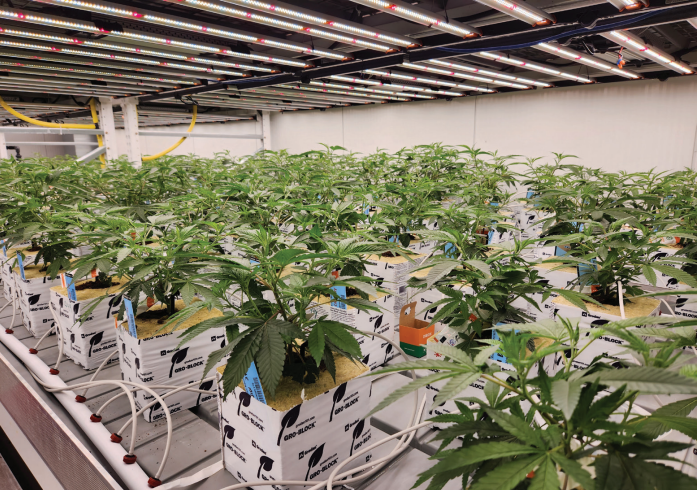
The indoor cultivation facility helped 75 veteran employees and "hungry" new employees achieve these goals, avoiding some of the growing pains typical of startups. The facility is divided into two floors, each with one cloning room, two vegetative rooms, and four flowering rooms, each equipped with independent irrigation, HVAC, plumbing, and other necessary systems. The systems are automated. Producing high-quality handcrafted products is the top priority, and preventing any pest or disease outbreaks is the founders' primary concern. Built-in redundancy measures—including a generator and a backup generator—are in place to protect the crops.
After observing the development of horticultural lighting in Colorado, Regan and Windham believed it was crucial to equip the entire facility with top-tier energy-saving Light-emitting diodes (LEDs). Each of the eight 1,900-square-foot grow rooms is equipped with 99 fixtures.
By using LEDs and separate vegetative rooms, Windham can allow crops more time to flower without compromising operational efficiency, harvesting approximately 150 pounds per week.
"We were able to change the vegetative light cycle to a 12/12 cycle to induce flowering. We could do this before moving the plants into the flowering rooms because we have the number of rooms and the room size here," Windham said of the 20,000-square-foot greenhouse. "In other facilities where I've worked, we had large vegetative rooms, and we couldn't put that room on 12 hours of darkness without affecting the other crops there."
By growing one crop per vegetative room, growers can cultivate flowers several weeks earlier, accelerating the harvest time for strains, giving them flexibility and the ability to respond faster to the market.
他们还能够使用需要更长时间才能完成的基因,其他商业种植者可能已经停止使用一些基因,因为它们需要大约70天的时间才能成熟。如果有必要,他们也有能力更快地完成栽培,因为他们正在使用的灯光可以将成熟度提高到38到42天。但Windham关注的是质量,而不是速度。
Windham said: “That’s not how we use them, but LEDs do help us achieve our goal of producing the most beautiful, perfectly expressed flowers.” “Bud structure, color, trichome coverage and maturity.”
This is also one of the reasons Windham pushed for additional lighting during the expansion, initially requesting 85 fixtures per grow room.
“I don’t think you can have too much light,” Windham said. “If I could, I’d probably increase that number by 50%. One thing we learned early on is that we haven’t yet found the upper limit of how much light we can give these plants.”Regan said that by increasing intensity, yields have climbed.
Regan said: “It’s been fantastic, and it clearly helps with the brand launch to be able to consistently maintain high yields.” “It’s everything. Many times, when you build large facilities like this, your costs are fixed. If your yields go up, your cost per pound goes down, which makes you more competitive, gives you greater margins, and allows you to pass the savings on to customers. It’s a huge competitive advantage.”
When asked about Root&Bloom's preferred intensity levels and average yield, Windham said it varies by growth stage and cultivar, but they are continuing to increase intensity even in early-stage vegetables.
"I would say the most important factor I've found so far is increasing light intensity as quickly as possible," he said. "If we delay this growth, the plants seem to struggle to handle the same intensity later in life. But if we can get the plant to accept (intensity) early in its life, it seems to continue craving more and more food, and we are able to increase that demand."
3. Looking Ahead
Although Windham emphasized his impression of the progress and speed of innovation over the past decade, one limitation of lighting today is that cleaning fixtures is not simple. Mitigating and preventing pests and diseases is crucial for any cultivation, and ideally, the Root&Bloom team would welcome new innovations to disinfect their lights between growth cycles, just as they do for benches, floors, and walls.
Regan said that when Windham hires staff, "he tells them that the job here is about cleanliness, consistency, and high quality."
Regan's wish list includes greater integration between environmental control systems and LEDs, as well as more information sharing among growers regarding the optimal parameters for their goals. However, he is impressed by the maturity of Massachusetts' relatively young adult-use cannabis market.
"The most surprising thing about Massachusetts is how quickly the industry developed in its early stages. What took seven years in Colorado happened here in just two and a half to three years," Regan said. "It seems that much of what those states learned previously was brought to Massachusetts."
What initially attracted Regan to this industry was that it felt like a tech startup, similar to what he was accustomed to while working at Cisco. In many ways, it still is.
Windham stated that to thrive in this unpredictable field, it is important to continuously experiment and refine best practices.
Source: Overseas Network, compiled by "Xinma Online"
Article sourced from Xinma Online , author Aaron
China Light
The official website of the China Association of Lighting Industry and a full-media platform for the lighting sector. We provide authoritative and timely lighting information while striving to be a growth partner for businesses. From brand promotion and channel expansion to consulting, talent training and participation in standards development, we provide comprehensive professional services to help businesses improve quality and efficiency and jointly advance the high-quality development of the lighting industry.
Business Contacts
仇纯 (Ms.): 158 6155 3579
顾君 (Mr.): 137 7157 5253