
2023 China Plant Growth Light Industry Market Panorama Analysis: Large Export Market Demand, Good Prospects for Medicinal Plant Cultivation Market
1
HID lamp applications are relatively mature,LED lamp penetration continues to increase due to high efficiency and energy saving
Plant growth lights refer to luminaires that provide the light energy required by plants in the absence of natural light conditions or when supplemental light is needed. Plant growth lights can generally be divided into HID plant growth lights, LED plant growth lights, and other plant growth lights. Traditional luminaires are mainly used in indoor and outdoor lighting, landscape lighting, etc., with the main function of meeting human lighting needs, belonging to visual lighting;the application field of plant growth light products is mainly plant supplemental lighting, with the main function of providing the light energy required for plant growth, belonging to non-visual lighting;there are significant differences between the two in terms of application scenarios, power supply, spectrum, light source, control factors, etc.
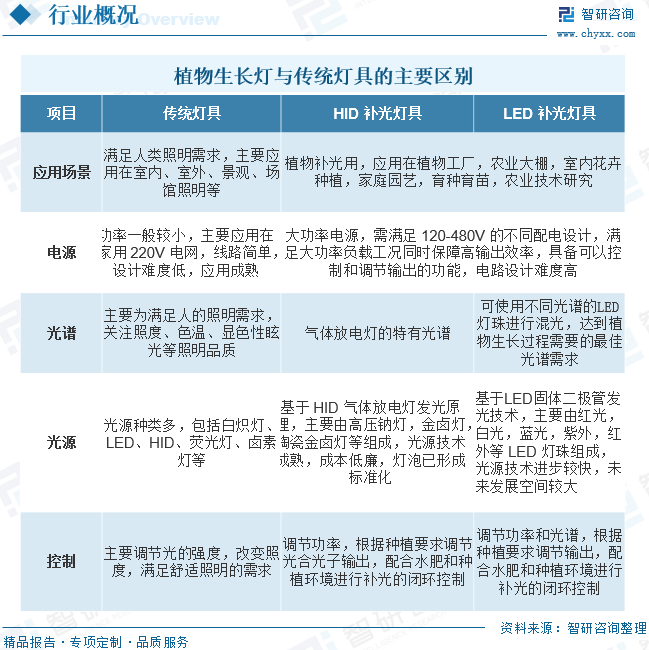
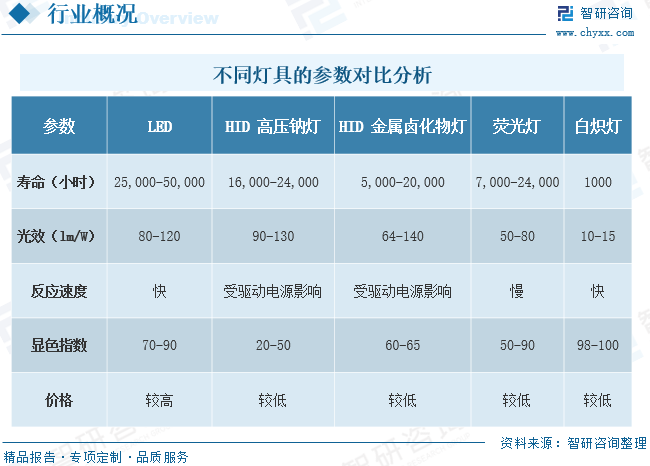
HID lamps are an abbreviation for high-intensity discharge lamps, generally consisting of HID electric light sources, drivers (ballasts), luminaires, and other components. Based on the inert gases and metal vapors used, HID luminaires can be classified into high-pressure sodium lamps, high-pressure mercury lamps, xenon lamps, metal halide lamps, etc. HID plant growth lamps are one of the most widely used light sources in the field of plant growth lighting, highly suitable for lighting in large-scale plant cultivation and planting. HID plant growth lamps have a low unit price, are resistant to lumen depreciation, and feature mature and reliable technology. In recent years, with the development of LED technology, more and more downstream industries have begun to use LED plant growth lamps, mainly because LEDs allow adjustable spectra, enabling better design of the required spectrum for plants, resulting in higher spectrum utilization and greater energy saving.
2
The supply chain is relatively mature, and downstream market applications are at the forefront
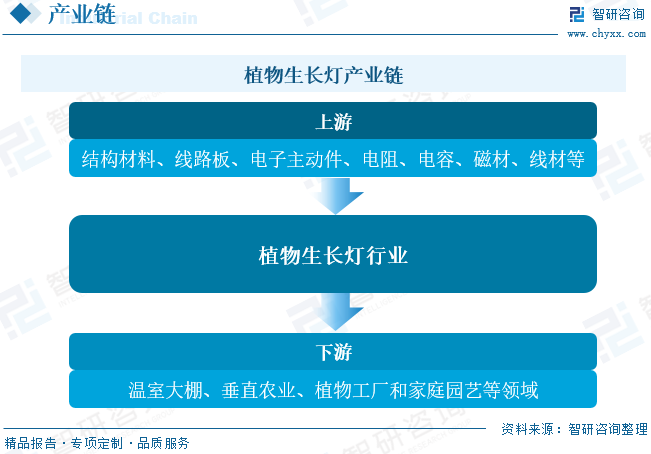
From the perspective of the industry chain, the upstream of the plant growth lamp industry includes luminaire materials, equipment, and labor; luminaire materials include luminaire structural parts and electronic components; downstream of plant growth lamps, plant growth lamps are usually applied in greenhouses, vertical agriculture, plant factories, and home gardening. Currently, high-value-added agricultural products such as vegetables, fruits, and flowers in developed countries are mainly grown in greenhouses, using artificial light sources for light environment regulation. In addition, plant growth lamps are also applied in fields such as laboratory research.
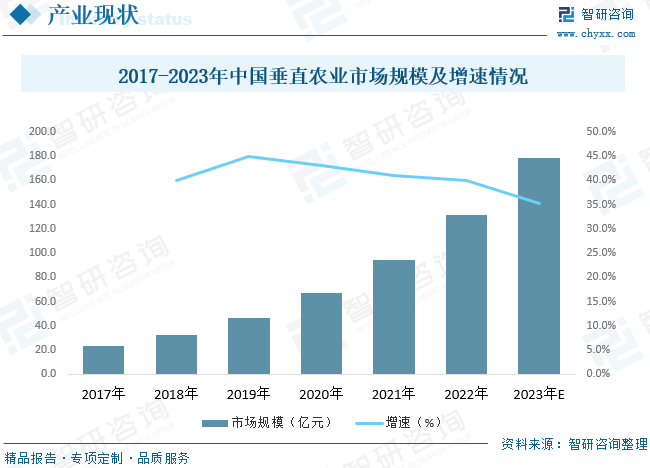
Vertical agriculture and plant factories are application areas with huge potential downstream of plant growth lamps . Data shows that the market size of vertical agriculture in China was about 13.17 billion yuan in 2022, and is expected to reach 17.81 billion yuan in 2023. Plant factories are generally divided into 5 levels: sprout plant factory → mushroom and medicinal fungus plant factory → leafy vegetable plant factory → berry and flower plant factory → traditional Chinese medicine plant factory. Currently, plant factories in China are generally at the third and fourth levels. Shanghai / Beijing, Shandong, Jiangsu, Fujian and other places have "plant factories" engaged in production and R&D, with planting varieties including lettuce, tomatoes, rape, grapes, okra, peppers, etc., as well as some high-end flower seedlings. According to statistics, the number of plant factories in China reached 272 in 2021, with 48 new additions, and the area of new factories reached 215,400 square meters, the development speed of domestic plant factories has become the fastest in the global market, and the market is expected to continue to maintain rapid growth in the future.
Related Report: "Analysis of Market Demand and Forecast of Development Scale of China's Horticultural Lighting Industry from 2023 to 2029" released by Zhiyan Consulting
3
The global market is growing faster than the domestic market, with great potential in the export market, while domestic market demand is steadily increasing
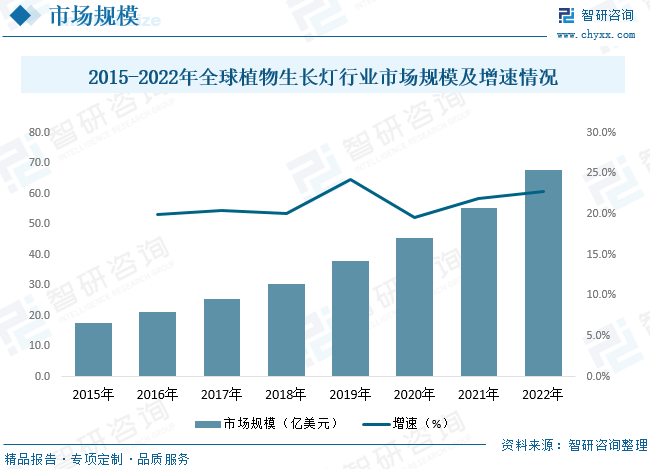
In recent years, driven by rapid technological development and government policies, many lighting companies have expanded into the field of horticultural lighting, and the market size of plant growth lights has continued to expand. Data shows that the global market size of the plant growth light industry was approximately US$6.78 billion in 2022, a year-on-year increase of 22.83%. With the development of modern agriculture, new agricultural forms such as greenhouses and plant factories will become more popular, and the demand for plant growth lights will continue to grow.
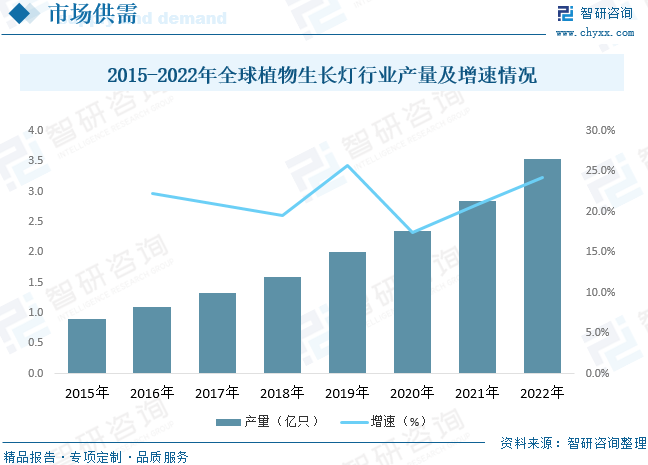
In terms of global market supply, more and more investments are tending towards large-scale development of growth lights, and companies are seeking mergers, collaborations, or acquisitions of technical capabilities, with an increasing number of market participants and rapid growth in industry production capacity and output. According to statistics, the global production of plant growth lights was approximately 353 million units in 2022, a year-on-year increase of 24.30%.
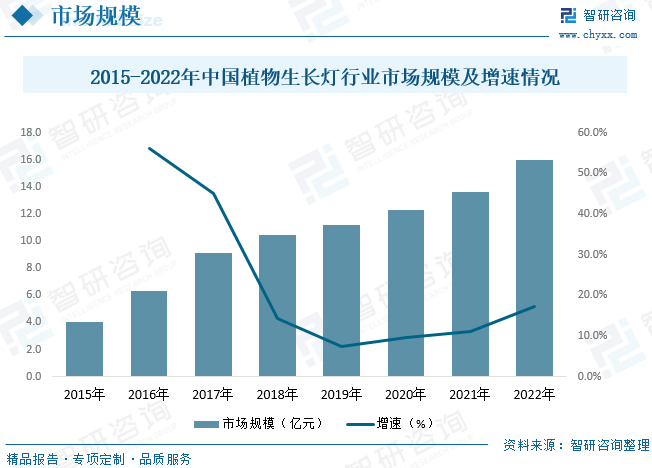
Regarding the domestic market size, the market sentiment in China's horticultural lighting sector has declined in recent years, with slowing growth rates, although it still maintains a relatively fast growth pace. Data shows that the market size of China's plant grow light industry was approximately 1.6 billion yuan in 2022, a Year-on-year (YoY) increase of 17.3%. The growth rate is slightly slower than that of the global market, mainly due to the accelerated technological development and industrialization scale of global plant factories and vertical agriculture.
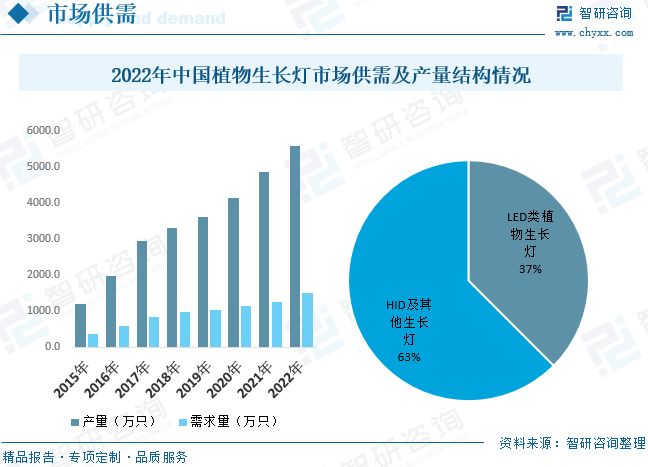
Regarding domestic market supply and demand, currently, domestic supply exceeds demand, with exports accounting for more than 70% of the consumption structure. According to statistics, the production volume of China's plant grow light industry was approximately 55.641 million units in 2022, while demand was only 15.141 million units, with the import and export market exceeding 40 million units. In the future, the steady development of downstream planting industries, increased penetration of plant grow light products, and price declines driven by industrial scale effects will become important drivers for the growth of demand for plant grow lights in China.
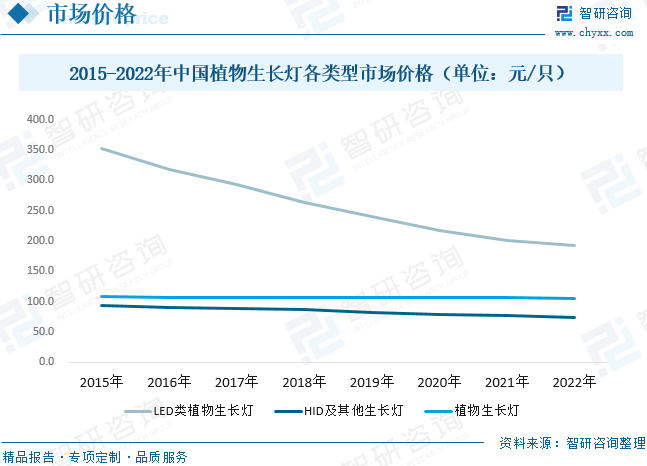
Regarding market prices, driven by the industrialization scale of the industry in recent years, market prices have continued to decline. Data shows that the overall average market price of plant grow lights in China dropped from 109.2 yuan/unit in 2015 to 105.7 yuan/unit in 2022, mainly due to a significant decrease in the market price of LED plant grow lights. The price of LED plant grow lights fell from 352.2 yuan/unit in 2015 to 192.5 yuan/unit in 2022. Currently, traditional lighting companies are deploying related technologies and beginning to enter the horticultural lighting sector, which will drive further declines in plant grow light prices in the future.
4
The concentration of the lighting Industry is low, with traditional lighting companies expanding into the horticultural lighting sector
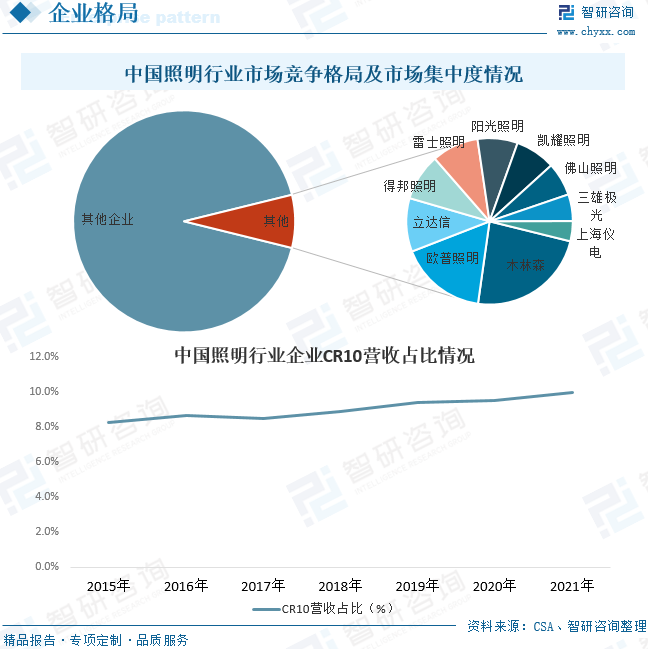
The competitive landscape of the lighting industry is characterized by a large industry with many small companies, resulting in low industry concentration. In 2015, the CR10 revenue share of the lighting industry was 8.26%. By 2021, amid intensified domestic market competition due to the pandemic, sustained prosperity in exports, and significant increases in raw material prices, the industry's CR10 revenue share reached approximately 10.0%. The first tier includes MLS Co., Ltd., OPPLE Lighting, NVC Lighting, and Foshan Lighting, among others, with annual sales revenues exceeding RMB 2 billion. Due to factors such as diverse personalized demands for lighting products, low entry barriers, and fragmented channels, the industry has a large number of private-label enterprises. According to statistics from the China Association of Lighting Industry (CALI), there are currently nearly 30,000 lighting enterprises nationwide, with only about 10% being enterprises above designated size, indicating low industry concentration.
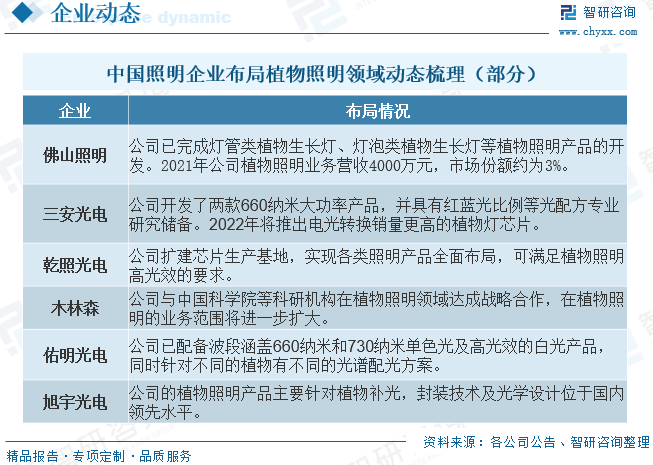
The rapid growth of economic crops such as cannabis in North America has driven the horticultural lighting sector through domestic cannabis cultivation and export markets. However, the domestic horticultural lighting market is still in its early stages, with many lighting companies actively exploring this field. For instance, Foshan Lighting has launched products such as cannabis supplemental lights, and supplemental lights for flowers, vegetables, and fruits. In the area of animal lighting, the company has introduced animal heating lamps, breeding insulation lamps, pig farming supplemental lights, and UV sterilization lamps. In 2021, Foshan Lighting's revenue from plant and animal lighting approached RMB 40 million, accounting for approximately 3% of the market share. Currently, lighting companies are in the stage of small-scale trial production and promotion for plant and animal lighting. Challenges such as the lack of core technologies in the upstream and midstream sectors and high cost inputs remain, requiring further development time.
5
High-value economic crops have broad application prospects, with products trending towards specialization, high efficiency, and intelligence.
With the deepening of optical and botanical research, and the continuous advancement of supplemental lighting technology, controlling the growth of more plants through customized light environment control will become an important trend in the industry. As technology matures, plant growth lights are gradually being applied to more biological categories. In addition to vegetables, fruits, flowers, and green plants which are currently widely used, they are also increasingly used for the cultivation of medicinal plants and fungi. Medicinal plants belong to the high-end cultivation sector. Herbs such as Cordyceps, Anoectochilus roxburghii, and Dendrobium officinale have high economic value and represent an industry with significant application of plant growth lights, offering broad development prospects. Development trends in the plant growth light industry:
1. Specialization
Plant growth lamps, with their adjustable spectrum and light quantity, low heat generation, and excellent waterproof performance, are well-suited for horticultural lighting in various scenarios. Meanwhile, changes in the natural environment and the pursuit of food quality have promoted the vigorous development of facility agriculture and plant factories, bringing the plant growth lamp industry into a period of rapid development. In the future, plant growth lamps will play an important role in improving agricultural production efficiency, enhancing food safety, and improving the quality of fruits and vegetables. The light sources for plant growth lamps will further develop towards more targeted directions as the industry becomes increasingly specialized.
2. High Efficiency
Improving luminous efficacy and energy efficiency is key to significantly reducing the operating costs of horticultural lighting. Replacing traditional luminaires with LED and dynamically optimizing the light environment according to the light recipe requirements from the seedling stage to harvest is an inevitable trend for precision agriculture in the future.To increase yield, cultivation can be carried out in stages and zones combined with light recipes based on plant development characteristics, thereby improving production efficiency and yield at each stage; to improve quality, methods such as nutrient regulation and light regulation can be used to increase the content of nutritional components and other health-functional ingredients.
The seedling industry has high environmental requirements, with production seasons mostly in winter and spring when natural light is weak, requiring artificial supplemental lighting. The input-output ratio of horticultural lighting is relatively high, leading to high acceptance of investment. Grafting is required for fruit and vegetable crops (such as tomatoes, cucumbers, melons, etc.), and specific spectrum supplemental lighting under high humidity conditions promotes the healing of grafted seedlings, where LED offers unique advantages. Supplemental lighting for greenhouse vegetable cultivation can compensate for insufficient natural light, improve photosynthetic efficiency, promote flowering and fruiting, increase yield, and enhance product quality.The application prospects of plant growth lamps in vegetable seedling raising and greenhouse production are extensive.
3. Intelligence
Horticultural lighting has a strong demand for real-time regulation of light quality and quantity. With the improvement of intelligent control technology and the application of the Internet of Things, combining multiple monochromatic spectra with intelligent control systems to achieve time control, light control, and timely adjustment of light quality and quantity output based on plant growth status is bound to become the main trend in the future development of plant growth lamp technology.
In-depth Study Tour of Japan's Plant Factory Industry Chain in 2023
During the pandemic years, what new technologies and developments have emerged in plant factories? AgriLighting Network will join forces with Beijing Huake Runnong Consulting Co., Ltd. and Future Smart Agriculture (Beijing) Technology Co., Ltd. to launch the long-awaited in-depth study tour plan for Japan's plant factory industry chain. Starting with the Japan Agricultural Expo in Tokyo in October, this inspection will include field visits to Mirai Inc., Kimitsu Plant Factory, PlantX, and the Plant Factory Research Association. It will also conduct technical training on artificial light-type plant factories, helping enterprises and related researchers gain a deeper understanding of the development of Japan's agricultural industry chain and the practical application of artificial light sources in plant factories. A highly cost-effective study tour choice, we welcome you to explore and learn together.
For details, please click:
Notice on Organizing In-Depth Study Tour of Japan's Plant Factory Industry Chain in 2023
China Light
The official website of the China Association of Lighting Industry and a full-media platform for the lighting sector. We provide authoritative and timely lighting information while striving to be a growth partner for businesses. From brand promotion and channel expansion to consulting, talent training and participation in standards development, we provide comprehensive professional services to help businesses improve quality and efficiency and jointly advance the high-quality development of the lighting industry.
Business Contacts
仇纯 (Ms.): 158 6155 3579
顾君 (Mr.): 137 7157 5253