
2023 Home Smart Lighting Development Report: Whole-House Intelligence Becomes the Major Industry Direction
Home smart lighting systems can interconnect with other smart devices, offering more convenient and personalized lighting experiences through features like smart control, scheduled on/off, and remote control. Users can freely adjust light brightness, color, and scenes according to their needs, creating a comfortable and cozy home environment.
——Guanyan Report Network
1
Overview of the Smart Lighting Industry for Home Use
Industry Perspective: Smart lighting refers to a distributed control system composed of IoT technology, wired, wireless, and power line carrier communication technologies, embedded computer intelligent information processing, and energy saving control technologies. It achieves intelligent control of lighting equipment, including luminance, color temperature, timing control, scene control, and more. It can even interact synergistically with natural light to provide a comfortable light environment for people at the right time and space, based on human needs.
From the consumer perspective: Achieve intelligent control through voice, mobile/tablet apps, wireless panels, or remote control technologies to adjust Luminance and Color temperature, schedule on/off times, and manage scenes, delivering an intelligent lighting experience that adapts to different scenarios.
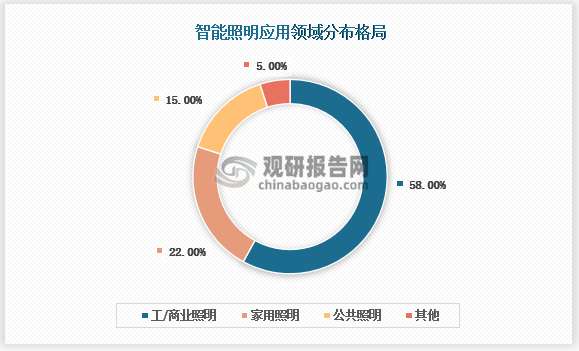
Smart lighting is widely used in various home and commercial sectors. Commercial and industrial lighting is the largest application area for the smart lighting industry, accounting for 58%; followed by residential lighting, accounting for 22%. The scope of this article is limited to the residential sector and does not include commercial and industrial sectors.
Source: Analysis of Development Trends and Future Investment Forecast Report for China's Household Smart Lighting Industry (2023-2030)
2
Smart lighting is an important part of smart homes
Configuration rate up to 84.3%
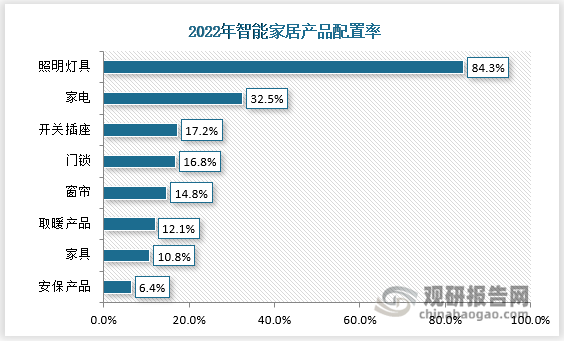
As people's pace of life accelerates and technology advances, home intelligence has become a trend, with smart lighting becoming a key component in the development of smart homes. Data shows that residential smart lighting is currently one of the most widely configured systems in smart homes, accounting for as high as 84.3%.
Source: Analysis of Development Trends and Future Investment Forecast Report for China's Household Smart Lighting Industry (2023-2030)
Home smart lighting systems can interconnect with other smart devices, offering more convenient and personalized lighting experiences through features like smart control, scheduled on/off, and remote control. Users can freely adjust light brightness, color, and scenes according to their needs, creating a comfortable and cozy home environment. Home smart lighting systems can also link with other smart devices such as smart door locks and security systems, enabling联动 between lighting and safety equipment to enhance the safety of the living environment.
Compared with traditional lighting installation methods, the installation process of smart lighting systems is significantly simpler. It can use wireless and wired methods to meet installation and deployment needs in various wiring environments, saving a lot of wiring work and costs, while protecting the integrity and aesthetics of home walls.
According to the "Analysis of Development Trends and Future Investment Forecast Report for China's Residential Smart Lighting Industry (2023-2030)", the primary purpose of smart home systems is energy saving, environmental protection, convenience, and speed, bringing diversity to people's lives. Most importantly, it reduces energy consumption in society to achieve environmental protection effects. From this perspective, smart lighting systems can apply energy-saving technologies and intelligent control algorithms to realize functions such as smart dimming and automatic sensing, effectively reducing energy consumption and electricity costs, and extending the lifespan of light sources by 2–4 times, which is particularly significant for areas with extensive light source usage and difficult installation conditions.
Data shows that the current smart lighting control system is the system that reduces energy consumption the most in smart home systems, accounting for 60-70% of the entire system. Therefore, the smart lighting control system has become an important core part of smart home systems.
Analyst View: Pre-installed smart lighting for homes ensures comprehensive, integrated, and personalized design. Currently, some manufacturers of pre-installed home smart lighting have begun collaborating with real estate developers and home decoration companies, bundling their products into overall smart pre-installation solutions. This approach leverages offline sales channels to reach consumers more quickly while expanding the target audience to groups with stronger purchasing power and a wider age range. It is expected that the development potential of the pre-installation market will far exceed that of the retrofit market in the future.
3
The high-growth development of whole-house intelligence drives
Rapid growth in demand for smart home lighting
With the rapid growth of the whole-home smart industry, there are higher requirements for both the quantity and quality of home smart lighting. Currently, the penetration rate of smart home devices in whole-home smart setups in China remains low. According to IDC's "Top 10 Predictions for China's Smart Home Market in 2022," data shows that only 2% of smart home devices will serve whole-home smart solutions in 2022. A survey by iResearch indicates that among users who have expectations for smart homes, only 3.5% have actually used whole-home smart systems.
At present, the public has a high awareness of individual smart appliances, but to achieve true smart home living, whole-home intelligence is required—connecting individual smart appliances through an integrated system. As an important scenario in whole-home intelligence, whole-home smart lighting serves as a key entry point for people to intuitively experience a healthy light environment and whole-home smart features.
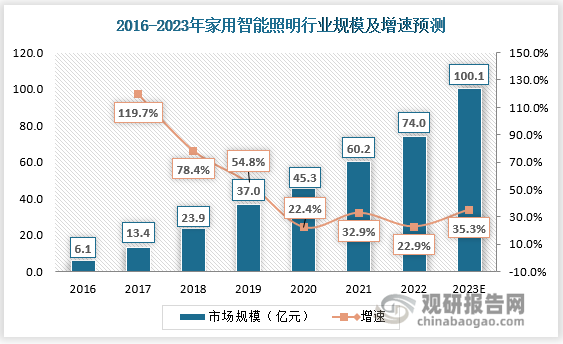
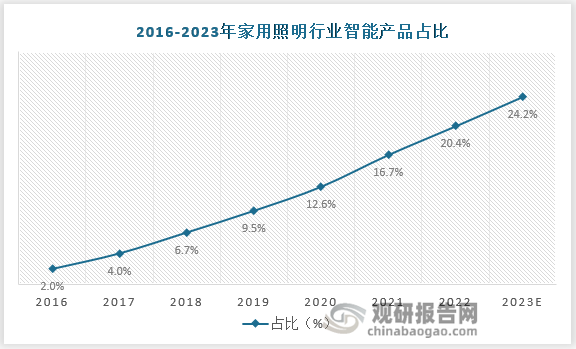
Due to the large number of connected IoT device nodes, lighting enables strong user perception in smart scenarios. Meanwhile, whole-house smart lighting can adjust rhythms by changing light luminance and color temperature based on the personalized needs of different groups, achieving full-scenario lighting modes. Therefore, the continuous penetration of whole-house intelligence will bring more incremental demand for whole-house smart lighting, and the market space for home smart lighting is vast. Data shows that the home smart lighting industry has maintained a trend of rapid growth from 2016 to 2022, with market share rising from only 2.0% in 2016 to 20.4% in 2022, an increase of 20 percentage points over 7 years. It is estimated that the market size of home smart lighting will exceed ten billion in 2023, with smart products accounting for 24.2%.
Source: Analysis of Development Trends and Future Investment Forecast Report for China's Household Smart Lighting Industry (2023-2030)
Source: Analysis of Development Trends and Future Investment Forecast Report for China's Household Smart Lighting Industry (2023-2030)
Analyst View: As whole-home intelligence drives the comprehensive adoption of smart lighting in residences, customized design will become the main theme of residential smart lighting. Centered on the user, it aims to meet multidimensional needs—including illuminance/luminance as well as physical and mental well-being—significantly enhancing users' quality of life and happiness, which is the ultimate goal of residential smart lighting.
4
A trillion-yuan blue ocean attracts numerous companies to compete for entry
A market worth tens of billions, with a blue ocean potential of hundreds of billions, the home smart lighting industry is attracting numerous entrepreneurs and capital to compete for entry. Current industry participants can mainly be divided into three categories: traditional lighting companies, smart lighting companies, and smart home companies.
Smart lighting player types for home use
- | Traditional Lighting Companies | Smart lighting enterprise | Smart Home Enterprise |
Typical Enterprises | OPPLE, NVC Lighting, Philips (lighting business: Signify), Cidun, etc. | Yeelight, Qi Yi and others | Orvibo, Aqara, Xiaomi, Huawei, etc. |
Smart & Standard Luminaire Sales | Traditional luminaires account for over 80% of sales, with smart luminaires mainly sold as single or multi-luminaire combinations, while whole-house lighting design is still in the refinement stage | Smart luminaires account for a high sales proportion, with some companies exceeding 80%, offering smart single-luminaire solutions, multi-luminaire combinations, and relatively complete whole-house lighting designs | Centered on scenario-based services for smart homes, Smart lighting is an important part of the smart home system, with whole-home intelligence sales as the main focus |
Smart lighting layout | Online sales mainly rely on flagship stores on e-commerce platforms, while most offline stores still primarily display traditional lighting luminaires. Some companies have begun renovating their stores or adding smart lighting demonstration and experience zones. | Offline stores serve as the main sales channel, featuring scenario-based displays of smart lighting. With independent smart lighting designers and construction teams, we provide personalized customization services. Online sales focus primarily on individual lamps | Offline stores offer an enhanced smart experience with a strong whole-home smart feel, multiple standardized packages to choose from, a rich variety of products with high selectability, and comprehensive installation and after-sales services |
Source: Analysis of Development Trends and Future Investment Forecast Report for China's Household Smart Lighting Industry (2023-2030)
1. Typical traditional lighting companies: OPPLE, NVC Lighting, Philips (lighting business: Signify), Cidoni, etc.
Typical traditional lighting companies include OPPLE, NVC Lighting, Philips (lighting business: Signify), and Cidun. Since traditional lighting equipment can no longer meet the needs of modern consumers, smart and personalized products are more favored by them. In addition, traditional lighting companies have spent many years building their (sales) channels and established a comprehensive channel network. Based on this foundation, companies can provide consumers with an immersive smart home experience by setting up smart experience zones in offline stores, thereby stimulating consumers' purchasing enthusiasm. Many traditional companies have begun to shift their focus to the smart lighting market. For example, NVC Lighting established three major R&D directions in 2021: smart lighting, healthy lighting, and integrated lighting. Similarly, OPPLE Lighting has also been continuously expanding its presence in the smart lighting field.
2. Smart lighting companies: Yeelight, Qi Yi, etc.
Typical enterprises in smart lighting include Yeelight and Qi Yi. Among them, Yeelight, with its internet DNA, has successfully transformed in recent years, now holding the dual identity of professional smart lighting and whole-home intelligence. These two directions complement each other, positioning it at the competitive center of the pan-smart era. Professional smart lighting brands may not have the deep resource accumulation of traditional lighting brands, but they possess their own unique advantages.
Firstly, professional smart lighting brands can delve deeper into smart lighting with a more focused business strategy, which means they can allocate the most resources to the smart lighting sector for product refinement and R&D. Taking Yeelight as an example, relevant data shows that as of November 15, 2022, Yeelight held a total of 737 domestic and international patents and patent applications, including 68 granted invention patents and 139 invention applications under examination. Since companies mostly focus on product R&D, the quality gap between them is not significant. They mainly strive to simulate natural light effects with standout products, such as Yeelight's popular Sky Ceiling Light and its dynamic gaming light strips. However, in terms of diversified products and system capabilities in the mainless lighting sector, leveraging years of understanding of "lighting + intelligence," Yeelight is able to create a more delicate and comfortable light environment compared to its competitors.
Secondly, the professional smart lighting sector also holds strong advantages in sales and service capabilities. Retail stores feature professional scenario-based displays for smart lighting, with dedicated smart lighting designers offline, as well as localized installation and after-sales teams. For example, Yeelight and the China Illuminating Engineering Society jointly established the "Lighting Design Academy," which has conducted 25 sessions of lighting designer training and 9 sessions of delivery engineer training, cumulatively training over 3,000 smart lighting designers and 1,200 delivery engineers. This is also a key guarantee and competitive barrier for Yeelight to ensure the quality of smart lighting project delivery.
3. Smart home companies: ORVIBO, Aqara, Xiaomi, Huawei, etc.
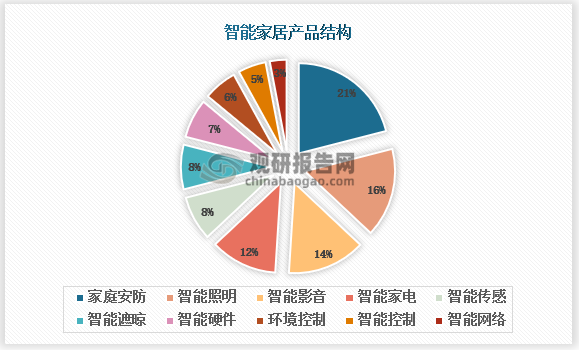
In addition to traditional lighting companies and smart lighting companies, smart home companies are also frequently appearing. In the actual implementation solutions for whole-house intelligence in recent years, whole-house lighting equipment accounts for more than half of the total number of whole-house smart devices. Furthermore, according to data from the China Smart Home Industry Alliance (CSHIA), smart lighting holds a significant market share in smart homes, reaching 16%, second only to home security.
In this context, it is only natural for smart home brands to continue focusing on the smart lighting sector. Typical companies include Orvibo, Aqara, Xiaomi, and Huawei. The residential smart lighting products launched by these companies are more closely integrated with their other smart home products, making device linkage and interaction easier to achieve. This also results in higher stability and intelligence levels, thereby enhancing the user's smart home experience.
Source: Analysis of Development Trends and Future Investment Forecast Report for China's Household Smart Lighting Industry (2023-2030)
5
Prices continue to rise
2023 Industry Sees Another Wave of Price Increases
In recent years, the home smart lighting industry has seen successive waves of price increases, with many brands raising their prices accordingly.
事实上早在2020年下半年,行业就因原材料价格不断上涨、供应紧张,限电调控等多方不可控因素的影响,掀起了一波涨价潮,短时间内,家用智能照明行业涨势难止。传统镇流器产品最大涨幅20%,LED电源和模组产品最大涨幅10%。这个趋势一直延续到2021年底,西蒙电气、西门子、西顿照明、企一、欧瑞博等多家企业宣布将智能照明产品价格普遍上调3%-10%。而各家照明企业给出的涨价原因基本一致,一方面是原材料价格持续上涨,另一方面是人工成本不断上涨。原以为经历了2021年的“至暗时刻”,在2022年初涨价潮稍有回落的势头,智能照明企业将迎来曙光,但好景不长,由于市场环境的持续变动,疫情反复、俄乌战争、原材料涨价、限电政策等因素的重重影响,从三月中旬开始,家用智能照明产品的涨价函便纷至沓来。
From May to June 2023, the industry's "wave of price increases" continued. More than 30 mid- and downstream smart lighting companies, including MLS Co., Ltd., Siemens, Leyard, Unilumin, Ruisheng Optoelectronics, Dongshan Precision, Schneider Electric, Shanghai Yaming Lighting, Signify, and Delixi Electric, successively issued price increase notices. Some companies were not raising prices for the first time. The "reasons for price increases" were almost the same as in previous years, mostly due to rising raw material prices, labor costs, and transportation costs. Adjustments were made to ensure the continued provision of high-quality products and services.
Overall, price increases will become the norm in the industry. Rather than worrying excessively about the impact of rising prices , companies should accelerate the "upgrade and replacement" of home smart lighting products, exploring breakthroughs in product variety improvement, service quality enhancement, technology-driven design, and cultivation of user needs. This is the only way to truly drive the industry back to focusing on technology, business rationality, and consumer value.
Overview of Price Increases by LED Industry Chain Companies
Enterprise | Product | Change | Effective Time |
MLS | LED Packaging/Lighting | All product series price increase by 15%-20% | 6.1 |
Siemens | LED Device | "Haocai Retail Series" price increased by 10% | 6.1 |
Schneider | LED Device | 3% price increase for the "Zhenbo PC" series | 7.1 |
Dongshan Precision | LED Device | All product prices have increased by 10%. Prices for outdoor high-brightness models and other special specifications are subject to separate negotiation | 5.12 |
Hanshi Zhixian Technology | LED Display / LCD Screen | LCD/LED display products increased by 5%-10%; prices for other custom products and special specifications are negotiable | 5.12 |
BOE Crystal Core | LED Direct Display | LED direct display product price adjustment | 5.15 |
Ruisheng Optoelectronics | LED Device | Indoor channel products increased by 10%–20% | 6.5 |
Nationstar Optoelectronics | LED Packaging | Some RGB products have been reduced by 3.5-11.5% | 5.17 |
Leyard | LED Display | Prices for various product models have increased to varying degrees | 5.18 |
Unilumin | LED Display | LED Display Price Adjustment | 5.18 |
Skyworth | LED Display | Prices for various models have increased by varying amounts | 5.20 |
Source: Analysis of Development Trends and Future Investment Forecast Report for China's Household Smart Lighting Industry (2023-2030)
Analyst View: The current penetration rate of home smart lighting remains low, and the industry is still in its early stages. Against the backdrop of digitalization and intelligence, whole-home intelligence continues to iterate and upgrade. Emerging technologies such as 5G, AI, IoT, big data, and cloud computing are driving smart homes into a phase of proactive intelligence. The market for home smart lighting will further expand with the future development of the whole-home smart market, offering broad growth potential, which means that prices for related products will also decrease accordingly.
Source: Guan Yan Tian Xia
China Light
The official website of the China Association of Lighting Industry and a full-media platform for the lighting sector. We provide authoritative and timely lighting information while striving to be a growth partner for businesses. From brand promotion and channel expansion to consulting, talent training and participation in standards development, we provide comprehensive professional services to help businesses improve quality and efficiency and jointly advance the high-quality development of the lighting industry.
Business Contacts
仇纯 (Ms.): 158 6155 3579
顾君 (Mr.): 137 7157 5253