
Call for Comments | 6 National Standard Projects on Rare Earth Phosphor for LED
Recently, the Standardization Administration of China decided to publicly solicit opinions on 285 proposed national standard projects, including the "Methods for detection of Salmonella in animals and animal products". The deadline for comments is August 6, 2023. Among them, there are 6 lighting-related national standard projects, such as "Test methods for rare earth phosphors used in LED - Part 1: Determination of spectral performance" and "Test methods for rare earth phosphors used in LED - Part 2: Determination of relative luminance". The China Association of Lighting Industry has compiled these lighting-related national standard projects for your reference.
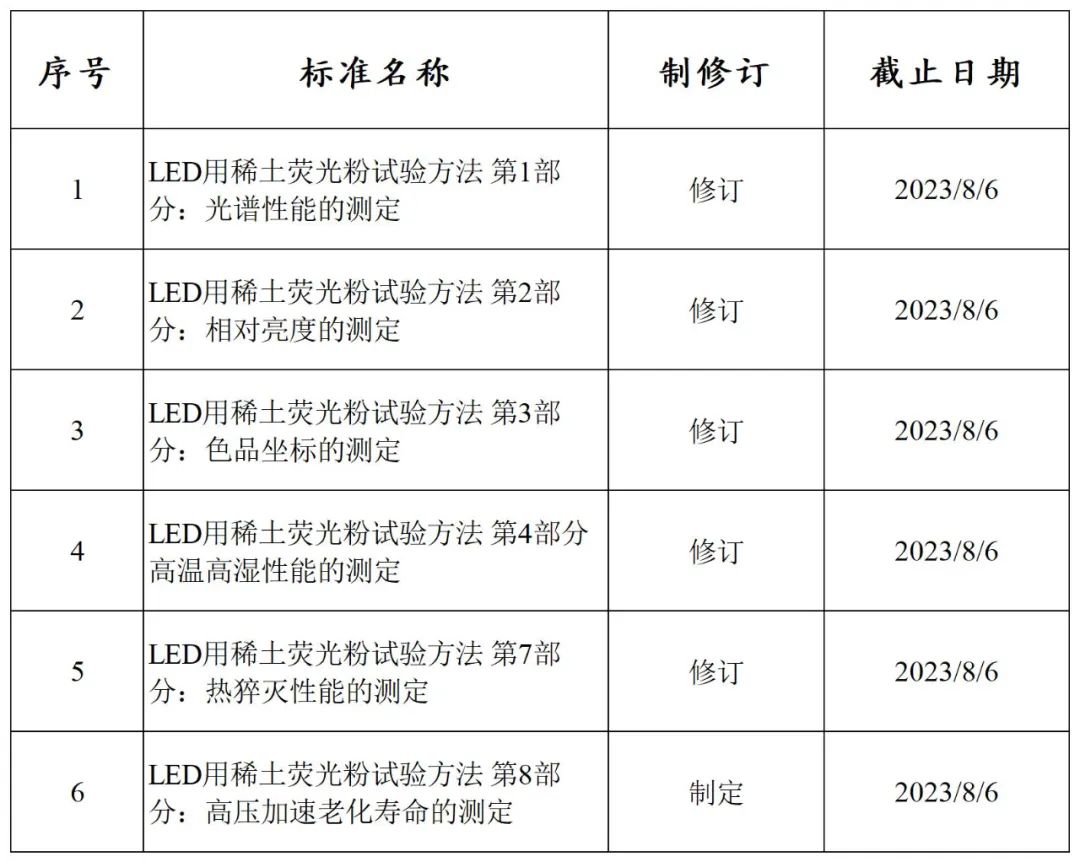
1. Test methods for rare earth phosphors used in LEDs Part 1: Determination of spectral performance
Replace standard number: GB/T 23595.1-2009
Replacement Standard Name: Test Methods for Rare Earth Yellow Phosphor Used in White LED Lamps: Part 1: Determination of Spectral Performance
Main technical content:
1. Modified the scope of application of the standard, expanding the phosphor excitation wavelength range (see Part 1 for details, Part 1 of the 2009 edition);
2. Added normative references;
3. Added Section 3: Terms and Definitions;
4. Revised instrument technical specifications (fluorescence spectrophotometer accuracy changed from ±0.5 nm to ±0.3 nm; see Section 5.1, and Section 3.1 of the 2009 edition);
6. Modified the peak wavelength of the excitation spectrum and the main peak wavelength of the emission spectrum (changed to excitation peak wavelength and emission peak wavelength; see 6.2.2 and 6.2.4, and sections 4.2.2 and 4.2.4 of the 2009 edition);
7. Modified the test precision parameters (reduced the repeatability limits and permissible errors for the peak wavelength of the excitation spectrum and the peak wavelength of the emission spectrum; see 8.1 and 8.2 for details, corresponding to 6.1 and 6.2 in the 2009 version);
8. Added test report requirements (see Chapter 9 for details).
II. Test Methods for Rare Earth Phosphors Used in LEDs Part 2: Determination of Relative Luminance
Replace standard number: GB/T 23595.2-2009
Replacement Standard Name: Test Methods for Rare Earth Yellow Phosphor Used in White LED Lamps: Part 2: Determination of Relative Luminance
Main technical content:
1. Modified the excitation light source range from "440nm-480nm" to "350nm-480nm";
2. Added normative references;
3. Added terms and definitions;
4. Added 5 standard powders;
5. Changed the test instrument to a Spectrometer / Spectroradiometer;
6. Modified the test environment;
7. Removed "barium sulfate", "barium sulfate disk", "adjust the calibration button so the reading is 0, then irradiate with excitation light", and "calibration adjustment button";
8. Added test grades and corrected repeatability limits.
3. Test methods for rare earth phosphors for LED - Part 3: Determination of chromaticity coordinates
Replace standard number: GB/T 23595.3-2009
Replacement Standard Name: Test Methods for Rare Earth Yellow Phosphor Used in White LED Lamps: Part 3: Determination of Chromaticity Coordinates
Main technical content:
1. Modified the excitation light source range from "440nm-480nm" to "350nm-480nm";
2. Added normative references;
3. Added three terms and definitions, and revised the CIE standard chromaticity in the definitions from "CIE" to "CIE-1931";
4. Revised instrument technical specifications (wavelength accuracy changed from "±0.5 nm" to "±0.3 nm", chromaticity coordinate accuracy changed from "±0.002" to "±0.0015");
5. Changed the test instrument to a Spectrometer / Spectroradiometer;
6. Added photodetector description;
7. Modified the test environment;
8. Added test grades and corrected repeatability limits;
9. The allowable tolerance has been changed from "0.005" to "0.003".
4. Test methods for rare earth phosphors for LEDs Part 4: Determination of high temperature and high humidity performance
Replace standard number: GB/T 23595.4-2009
Replacement Standard Name: "Test Methods for Rare Earth Yellow Phosphor for White LED Lamps: Part 4: Determination of High Temperature and High Humidity Performance"
Main technical content:
1. Revised the scope of application of the standard, expanded the phosphor excitation wavelength range, and added humidity testing;
2. Added normative references;
3. Added Section 3: Terms and Definitions;
4. Modified the test method principle (changed from a temperature test at 180°C to a temperature and humidity test at 85°C and 85% relative humidity);
5. Modified instruments and apparatus: added a constant temperature and humidity test oven, removed weighing bottles, replaced the desiccator with a petri dish, and updated the technical specifications of the relative Luminance meter by changing the excitation source wavelength from 460 nm to 400-460 nm;
6. Modified the measurement procedure;
7. Revised the test result description;
8. Modified precision;
9. Added test report requirements.
Note: In this standard, the temperature and relative humidity of the constant temperature and humidity test oven are set to 85±1 °C and 85±2%. Once the temperature and relative humidity reach the set values, the phosphor sample is placed inside and stored for 1000 h. It is then removed and naturally cooled to room temperature in a desiccator. The relative luminance, chromaticity coordinates, or other relevant performance metrics of the samples subjected to constant temperature and humidity treatment and those untreated are measured. The change between the two is used to indicate the high-temperature and high-humidity stability of the tested phosphor.
5. Test methods for rare earth phosphors for LEDs Part 7: Determination of thermal quenching performance
Replace standard number: GB/T 23595.7-2009
Replacement Standard Name: Test Methods for Rare Earth Yellow Phosphor Used in White LED Lamps: Part 7: Determination of Thermal Quenching Performance
Main technical content:
1. Modified the excitation light source range from "440nm-480nm" to "350nm-480nm";
2. Added normative references;
3. Added three terms and definitions, and revised the chromaticity standard in the definitions from "CIE" to "CIE-1931";
4. Changed the instrument name from "Thermal Quenching Analysis System" to "Phosphor Excitation Spectrum and Thermal Quenching Analysis System";
5. Revised instrument technical specifications (accuracy: ±1.5% changed to temperature control accuracy ±2℃);
6. Modified formula (1), the numerator result is changed to absolute value;
7. Removed "The permissible difference in the analysis results of thermal quenching of chromaticity coordinates in the laboratory (△xq, △yq) shall not be greater than 0.0080, and the permissible difference in the analysis results of thermal quenching of relative luminance (△Bq) shall not be greater than 2.00%";
8. For two independent test results obtained under repeatability conditions, the absolute difference between these two results shall not exceed the repeatability limit (r) within the average range given below. Cases exceeding the repeatability limit (r) shall not exceed 5%. The repeatability limit (r) is determined by linear interpolation based on the data in Table 1;
9. Added test grades and corrected repeatability limits;
10. The allowable error has been changed from "5.00%" to "2.00%".
6. Test methods for rare earth phosphors for LED - Part 8: Determination of high-pressure accelerated aging life
Main technical content:
This standard specifies the test method for the high-pressure accelerated aging life of rare earth phosphors used in LEDs excited by ultraviolet to blue light in the range of 350 nm to 480 nm. This standard applies to the determination of the high-pressure accelerated aging life of rare earth phosphors used in LEDs excited by ultraviolet to blue light in the range of 350 nm to 480 nm. Principle of the method: Set the temperature, relative humidity, and internal pressure of the high-pressure accelerated aging test chamber to the specified values. Once the temperature, relative humidity, and pressure reach the set values, place the phosphor samples inside, store them for the specified duration, then remove them and allow them to cool naturally to room temperature in a desiccator. Measure the relative luminance, chromaticity coordinates, or other relevant performance characteristics of both untreated samples and samples subjected to high-pressure accelerated aging treatment. The absolute value of the difference between the two is used to represent the high-pressure accelerated aging life of the tested phosphor.
Source: National Public Service Platform for Standards Information
China Light
The official website of the China Association of Lighting Industry and a full-media platform for the lighting sector. We provide authoritative and timely lighting information while striving to be a growth partner for businesses. From brand promotion and channel expansion to consulting, talent training and participation in standards development, we provide comprehensive professional services to help businesses improve quality and efficiency and jointly advance the high-quality development of the lighting industry.
Business Contacts
仇纯 (Ms.): 158 6155 3579
顾君 (Mr.): 137 7157 5253