
Questions regarding urban tunnel lighting design standards
The following article is sourced from Lighting Moment , author Mr. Li Jing
If sports lighting is considered the most complex indoor functional lighting scenario, then tunnel lighting is the most complex outdoor functional lighting scenario. Indeed, although a tunnel is an enclosed space with a "roof," its primary function is transit; it is part of the road network and not a building where people live or work. Therefore, it is classified as an outdoor space rather than an indoor one, and accordingly, its lighting falls under outdoor functional lighting, not indoor functional lighting.
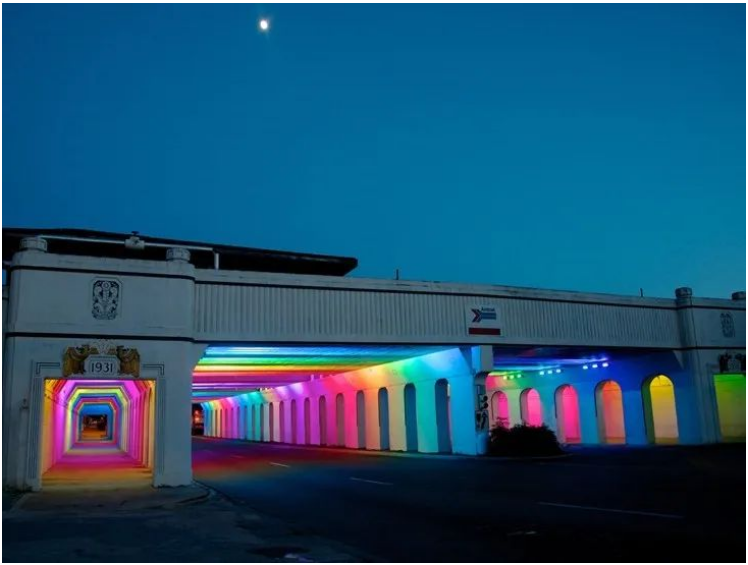
The core concept of tunnel lighting design lies in "visual adaptation." During the day, due to the significant luminance contrast between the inside and outside of the tunnel, it is impossible to illuminate the tunnel interior to the same level as the outdoors (if the luminance were the same, it would require an excessive number of luminaires, which is neither scientific nor necessary). Entering the tunnel is an adaptation process from bright to dark, while exiting is an adaptation from dark to bright. Enhanced lighting is required upon entry to ensure a smooth transition in luminance from outside to inside, allowing the human eye to adapt steadily at a given vehicle speed; a similar approach applies when exiting. At night, if enhanced lighting is turned off, the luminance contrast between the inside and outside is generally not significant, so it suffices to maintain similar lighting luminance levels both inside and outside the tunnel.
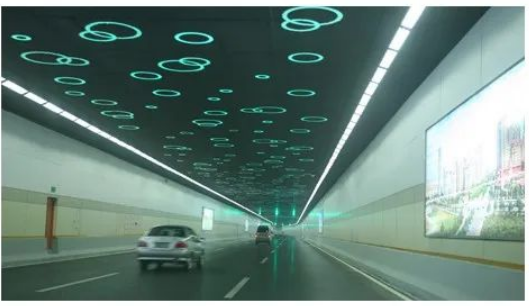
Tunnel lighting is quite complex, and design standards are also very important. The most comprehensive tunnel lighting standard is the "Detailed Rules for Lighting Design of Highway Tunnels" (JTG/T D70/2-01-2014). This standard includes regulations, calculations, and case studies. By thoroughly studying this standard, you will basically master the principles of tunnel lighting.
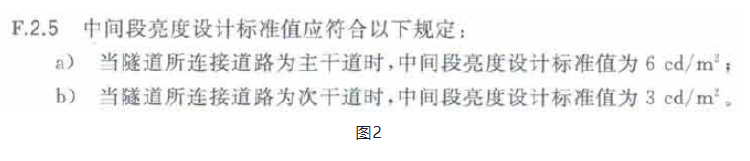
However, there is no dedicated standard for urban tunnel lighting, and even among different standards, the requirements for the same indicator are inconsistent. Taking the "mid-section luminance" indicator as an example, CJJ45 cites the provisions of the "Code for Design of Urban Road Traffic Facilities" (GB 50688-2011) (as shown in Figure 1). However, in the "Technical Requirements for LED Urban Road Lighting Applications" (GB/T 31832-2015), the requirements for mid-section luminance differ significantly from those in GB 50688 (as shown in Figure 2).
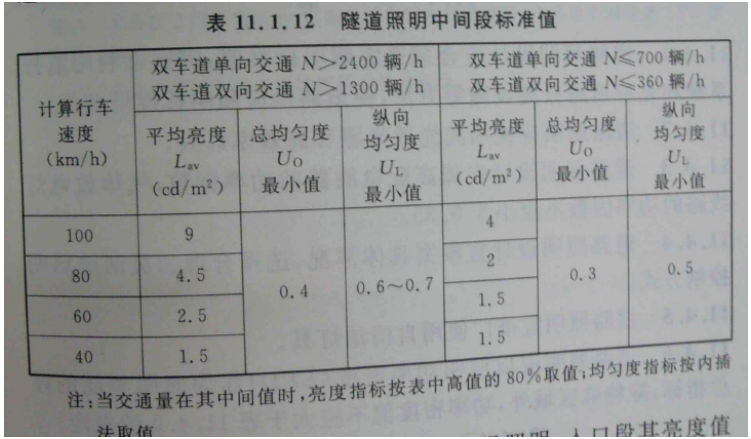
Figure 1
Regulations also vary by region. In the Jiangsu Provincial local standard "Standard for Lighting Design of Urban Tunnels" (DB32/T 3692-2019), the specification for "mid-section luminance" differs from the two aforementioned national standards (see Figure 3). Meanwhile, the "Technical Provisions for Construction and Renovation Upgrade of Underpass Tunnel Lighting in Chengdu (Trial)" adopts the mid-section lighting specifications from GB 50688 (see Figure 4).
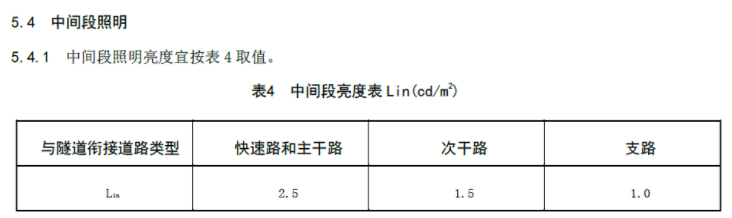
Figure 3
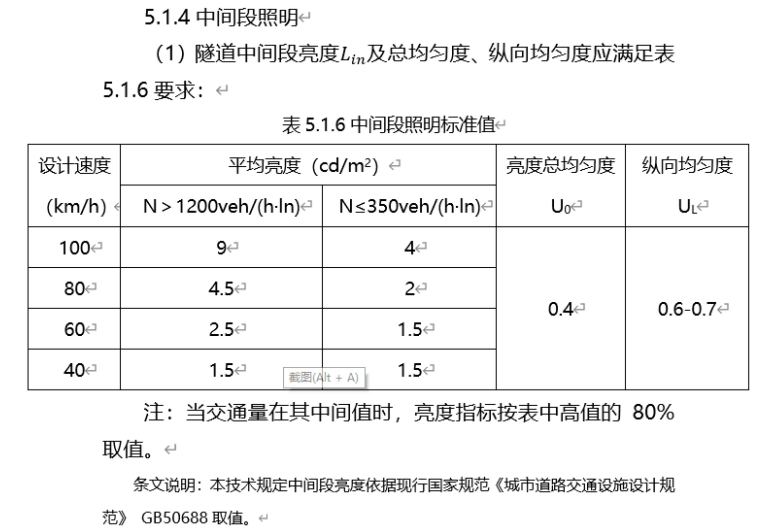
Figure 4
以上标准在原理上或许一致,但在具体指标上确实存在较大差异。从标准层级上来看,GB 50688的层级最高,当指标发生冲突时,应以这一标准为准。但该标准的照明内容规定较为宽泛,不够细致,可用性不强,仍需结合JTG/T D70/2-01等标准配套使用。期待相关部门和业内大拿能根据城市隧道的特点,研究制定城市隧道照明的专门的国家或行业标准,用以指导城市隧道照明的设计。
Source: Lighting Moment
China Light
The official website of the China Association of Lighting Industry and a full-media platform for the lighting sector. We provide authoritative and timely lighting information while striving to be a growth partner for businesses. From brand promotion and channel expansion to consulting, talent training and participation in standards development, we provide comprehensive professional services to help businesses improve quality and efficiency and jointly advance the high-quality development of the lighting industry.
Business Contacts
仇纯 (Ms.): 158 6155 3579
顾君 (Mr.): 137 7157 5253