
Major Announcement: Five Departments Including the Ministry of Industry and Information Technology Release "Guiding Opinions on Promoting High-Quality Development of the Light Industry"
Editor's Note
Since the 18th National Congress of the Communist Party of China, the light industry has achieved remarkable results in implementing the "Three Products" strategy, with significantly enhanced innovation capabilities. It has played an important role in meeting consumer demand, stabilizing exports, and expanding employment. However, challenges remain, such as insufficient supply of mid-to-high-end products, a lack of internationally renowned brands, and a low level of modernization in the supply chain. To address these issues, on June 17, 2022, five departments including the Ministry of Industry and Information Technology, the Ministry of Human Resources and Social Security, the Ministry of Ecology and Environment, the Ministry of Commerce, and the State Administration for Market Regulation jointly released the Guiding Opinions on Promoting High-Quality Development of the Light Industry (hereinafter referred to as the "Guiding Opinions").
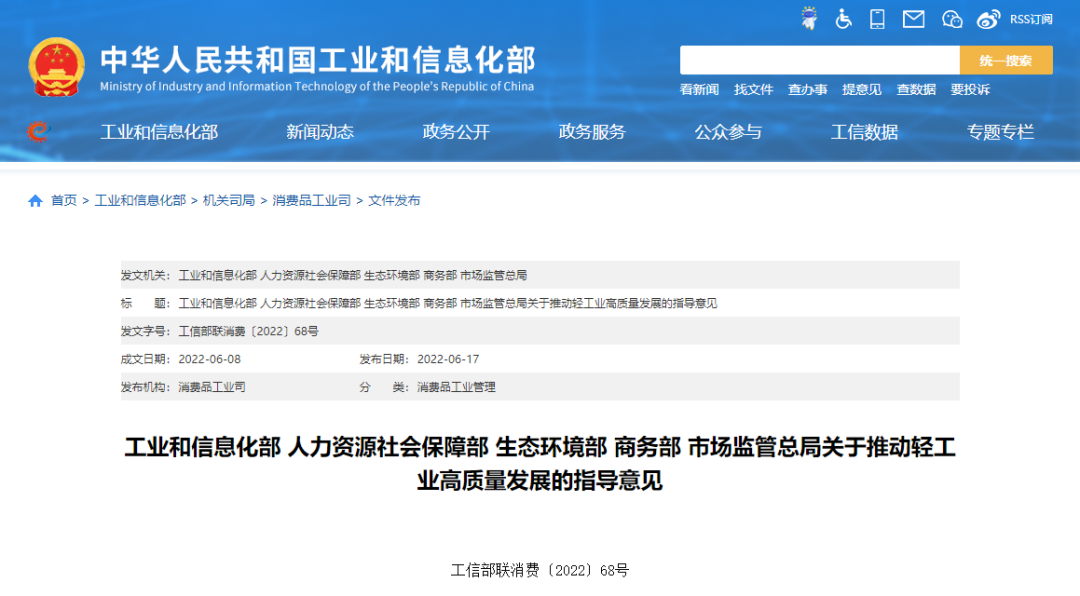
The "Guiding Opinions" focus on six major development goals: stable industry economic operation, new breakthroughs in technological innovation, continuous optimization of industrial structure, significant enhancement of brand competitiveness, continuous improvement of the modernization level of the supply chain, and new progress in green development. It proposes five key tasks: strengthening strategic support for technological innovation, building a high-quality supply system, enhancing the modernization level of the supply chain, deeply promoting green and low-carbon transformation, and optimizing the industrial ecosystem for coordinated development. Additionally, it outlines five major projects in special columns: key technology R&D project, innovative product manufacturing upgrade project, brand cultivation project, digital development promotion project, and green low-carbon technology development project.
Among them, the "Guiding Opinions" put forward clear opinions for the lighting industry , guiding the industry to strengthen the supply of high-end products and improve the modernization level of the industry chain, providing strong support for promoting the high-quality development of the lighting industry. In the key task of "Strengthening Strategic Support for Scientific and Technological Innovation", it is proposed to accelerate the formulation and revision of mandatory national standards in fields such as lighting appliances, focusing on product safety, quality improvement, energy saving, water conservation, environmental protection, and cybersecurity management, and to optimize the supply of recommended national standards, industry standards, and group standards; in the key task of "Deeply Promoting Green and Low-Carbon Transformation", it is proposed to accelerate the improvement of energy efficiency standards for terminal energy-consuming products such as lighting products, and promote the consumption of green and energy-saving light industrial products such as high-efficiency lighting products. In the column of "Upgrading Innovative Product Manufacturing Engineering", it is proposed that lighting appliances need to upgrade innovative functional lighting products and intelligent, integrated lighting system solutions; in the column of "Digital Development Promotion Engineering", it is proposed that lighting appliance products need to strengthen digital development promotion engineering in aspects such as online inspection technology, flexible manufacturing technology, and intelligent warehousing and logistics.
The release of the "Guiding Opinions" is timely for the development of the lighting industry. The "Guiding Opinions" cover all dimensions of high-quality industry development, offering strategic and forward-looking insights. We hope industry colleagues will study them carefully and, following the guidance of the "Guiding Opinions", build a leading lighting nation with high-quality lighting products, continuously promoting the high-quality development of China's lighting industry. The specific content of the "Guiding Opinions" is as follows.
For related interpretations, see the link:
[Interpretation] Guiding Opinions on Promoting High-Quality Development of the Light Industry
[Infographic] Guiding Opinions on Promoting High-Quality Development of the Light Industry
Guiding Opinions of the Ministry of Industry and Information Technology, the Ministry of Human Resources and Social Security, the Ministry of Ecology and Environment, the Ministry of Commerce, and the State Administration for Market Regulation on Promoting High-Quality Development of the Light Industry
MIIT Joint Consumer Document [2022] No. 68
To the competent departments of industry and information technology, human resources and social security, ecology and environment, commerce, and market regulation in all provinces, autonomous regions, municipalities directly under the Central Government, cities with independent planning status, and the Xinjiang Production and Construction Corps:
The light industry is a traditional advantageous Industry and an important livelihood Industry of China's national economy, with strong international competitiveness. Since the 18th National Congress of the Communist Party of China, the "Three Products" strategy in the light industry has achieved remarkable results, with significantly enhanced innovation capabilities. It plays an important role in meeting consumption demands, stabilizing Export, and expanding employment. However, it still faces problems such as insufficient supply of mid-to-high-end products, a lack of internationally renowned brands, and a low level of modernization in the Supply chain. To promote high-quality development of the light industry, the following opinions are hereby proposed.
I. General Requirements
(I) Guiding Ideology. Adhere to the guidance of Xi Jinping Thought on Socialism with Chinese Characteristics for a New Era, fully implement the spirit of the 19th National Congress of the Communist Party of China and all its plenary sessions, base ourselves on the new stage of development, fully, accurately, and comprehensively implement the new development philosophy, build a new development pattern, focus on promoting high-quality development, take deepening supply-side structural reform as the main line, use reform and innovation as the driving force, and aim to meet the people's growing needs for a better life as the fundamental purpose. Deeply implement the digital "Three Products" strategy, build a modern light Industry system with stronger innovation capability, higher added value, and more sustainable development, and achieve the leap from large to strong in China's light Industry.
(II) Development Goals. By 2025, the comprehensive strength of the light industry will be significantly enhanced, its proportion in the industrial sector will remain basically stable, its role in expanding domestic demand and promoting consumption will be evident, and its capacity to serve the construction of a new development pattern and promote high-quality economic and social development will be strengthened.
—The industry economy operates steadily. The growth rate of value added in the light industry aligns with the national average for industrial value added, while profit margins in key sectors and the international market share of major products remain broadly stable, with significant improvements in quality and efficiency.
—New breakthroughs have been achieved in technological innovation. The number of valid invention patents held by enterprises above designated size has grown rapidly, and R&D investment intensity in key industries has significantly improved. A number of key technologies have been突破, and an increasing number of upgraded and innovative consumer goods are added each year.
—The industrial structure continues to be optimized. A number of competitive enterprises and advanced manufacturing clusters have been cultivated and formed. The development advantages of domestic and international linkage and east-west mutual support have been consolidated and enhanced, and the regional layout has been further optimized.
—Significant enhancement of brand competitiveness. Cultivate a batch of light industry product brands with strong consumer leadership capabilities. Create a number of enterprises with brand values exceeding RMB 1 billion, and continuously enhance the influence of regional brands in key industrial clusters.
—The modernization level of the industry / supply chain continues to improve. The industrial base is further consolidated, digital transformation is steadily advancing, and a number of competitive industry / supply chains have been formed. A batch of smart manufacturing demonstration factories has been built, and a number of excellent smart manufacturing scenarios have been promoted.
—New progress has been made in green development. Resource utilization efficiency has significantly improved, while energy consumption per unit of industrial value added, carbon emissions, and emissions of major pollutants continue to decline.
II. Strengthen the strategic support for scientific and technological innovation
(3) Accelerate breakthroughs in key technologies. Addressing weak links in industries such as papermaking, home appliances, and daily chemicals, we will study, formulate, and release a batch of technology innovation roadmaps for key areas, implement measures such as "open competition to select the best candidates," deeply promote technological R&D, engineering, and industrialization, accelerate the establishment of core technology systems, and enhance the industry's technical level. Facing future major consumer demands, we will promote the establishment of cross-industry and cross-disciplinary exchange mechanisms and strengthen the layout of strategic frontier technologies.
Column 1 Key Technology R&D Project
Home Appliances: High-speed motors, high-efficiency heat exchangers, intelligent control technology, human-machine interaction technology, smart IoT technology, information security technology, health appliance technology, and other common key technologies.
Papermaking: High-grade insulation paper, high-purity dissolving pulp production technology, special paper-based composite materials, new biomass materials such as cellulose, hemicellulose, and lignin-based materials, and paper-based materials for medical and hygiene applications.
Light Industry Machinery: High-speed rotary PET bottle blow molding machines, high-speed aseptic paper filling machines, new washing equipment, aseptic packaging materials and equipment for liquid food canning, reagents and equipment for detecting toxic and harmful substances, etc.
Daily Chemicals: Oral care products, efficacy and safety evaluation technologies for cosmetics, functional water-soluble films and key formulation technologies for laundry pods, distinctive plant-based cosmetic ingredients, bio-fermentation manufacturing of flavors and fragrances, etc.
Bicycles, clocks, and weighing instruments: bicycle derailleurs, mid-drive motor torque sensors, high energy efficiency lithium battery safety technology, precision manufacturing technology for mechanical watch movements, micro-pressure technology for smartwatches, dynamic electronic scales, smart scales, wireless force and weighing sensors, dynamic mass measurement technology, etc.
Food: Functional base materials for infant formula milk powder, rapid online microbial detection technology, industrial core strain and enzyme preparation industry support technology and equipment, hazard factor discovery and intelligent monitoring traceability, etc.
(4) Improve the scientific and technological innovation system. Accelerate the construction of a light industry innovation system with enterprises as the main body, market-oriented, and deep integration of government, industry, academia, research, and application. Strengthen the construction of common technology platforms, optimize the layout of innovation platforms in the light industry field such as manufacturing innovation centers, key laboratories, engineering (technology) research centers, and industrial design institutes, and encourage the establishment of innovation platform-type enterprises through market-oriented operations. Strengthen the construction of enterprise innovation and entrepreneurship service systems, cultivate a batch of technological innovation demonstration enterprises, and improve the conversion rate of scientific and technological achievements.
(V)Optimize the standard system construction. Focusing on product safety, quality improvement, energy saving, water conservation and environmental protection, and cybersecurity management, accelerate the formulation and revision of mandatory national standards in fields such as home appliances, furniture, lighting appliances, and infant and child products, and optimize the supply of recommended national standards, industry standards, and group standards. Establish a standard system for the elderly products industry to lead the development of age-friendly products. Further enhance the professional level of standardization technical organizations, leverage the role of national technical standard innovation bases, and promote the coordinated development of technological innovation, standard development, and industrialization. Accelerate the adoption of applicable international standards and actively participate in the formulation and revision of international standards.
3. Build a high-quality supply system
(6) Increase the supply of upgraded and innovative products. Focusing on urgent needs such as health, childcare, and elderly care, vigorously develop functional foods, cosmetics, leisure and fitness products, infant and child supplies, and age-friendly light industrial products. Seizing the opportunity of the rural revitalization strategy, actively develop products adapted to the rural market. Cultivate a batch of national-level industrial design centers, expand design parks and design towns, and support design innovation in industries such as home appliances, furniture, leather, hardware products, toys, and infant and child supplies. Promote the protection and inheritance of traditional handicrafts, explore the value and connotation of cultural relics and resources, and develop cultural and creative products in industries such as arts and crafts, cultural, educational and sports goods, and ceremonial and leisure products. Promote the industrialization of "local snack" foods.
Column 2: Upgrading Innovative Product Manufacturing Engineering
Home Appliances: Smart energy-saving and healthy air conditioners, refrigerators, washing machines, and other home appliances; emerging small appliances such as dishwashers, induction heating rice cookers, high-speed blenders, stick wireless vacuum cleaners, and robot vacuums; full-scenario solutions for internet-connected smart home appliances.
Plastic products: new antibacterial plastics, high-end plastics for 5G communication, special engineering plastics, blood purification plastics, high-end optical films, etc.
Hardware products: smart locks, high-end smart tools, and other smart hardware products; water-saving bathroom hardware products, etc.
Ceramics and Daily-Use Glass: New types of daily-use ceramics, arts and crafts ceramics, lightweight glass bottles and jars, high-end glass tableware, glass-ceramic products, etc.
Lighting Appliances: Functional lighting products, intelligent and integrated lighting system solutions.
Bicycles: A diverse range including fashionable leisure, sports and fitness, long-distance off-road, and high-performance folding bicycles, as well as lightweight, connected, and intelligent electric bicycles.
Eyewear & Watches: Multi-functional lens products offering protection against harmful light and photosensitivity, anti-fatigue features, myopia control for teenagers, and progressive lenses for adults.
Multifunctional high-end boutique watches, high-end clocks featuring intangible cultural heritage traditional craftsmanship, smartwatches related to the health industry, etc.
Food: Special dietary foods, fortified foods, canned dishes, self-heating convenience and functional canned products, novel functional fermented products, fermented aquatic food, fermented meat products, functional probiotic fermented foods, edible enzyme products, industrial sugar products, high-quality daily chemical and household salt products, diversified, personalized, and low-alcohol baijiu, huangjiu and other alcoholic beverages suitable for different consumer groups, non-alcoholic beer products, etc.
(7) Enhance the level of quality assurance. Promote enterprises to establish and improve quality management systems, actively apply new technologies, processes, and materials, and enhance product comfort, safety, and functionality. Encourage enterprises to aim for international standards to improve their levels and carry out benchmarking activities. Leverage the demonstrative and leading role of quality benchmark enterprises to conduct activities such as quality risk analysis and control, and quality cost management, thereby improving online quality monitoring, control, and product full lifecycle quality traceability capabilities. Build a number of high-level quality control and technical evaluation laboratories to enhance inspection and testing levels.
(8) Strengthen brand cultivation services. Cultivate brand-building exchange and exhibition platforms such as trade fairs and design competitions, and foster a batch of internationally renowned brands in fields including home appliances, leather, hardware products, watches and clocks, bicycles, furniture, cosmetics, detergents and cleaning products, dairy products, brewing, and functional foods. Promote products featuring Chinese culture, Chinese elements, and Chinese craftsmanship to establish industry brands. Encourage third-party institutions to strengthen services such as brand planning, evaluation, and promotion, assist with overseas trademark registration and international brand promotion, and enhance brand influence.
Column 3: Brand Cultivation Project
Industry Brand Promotion: Support industry research to establish and promote a brand evaluation system with light industry characteristics, carry out activities for the dissemination of enterprise brand cultivation standards, professional evaluation of brand value, and assessment of brand cultivation maturity. Make full use of opportunities such as international industrial cooperation and major events to promote brands in the light industry.
Regional Brand Building: Promote the construction of technical service platforms for light industry clusters, drive coordination of enterprise standards, collaborative innovation, business cooperation, and resource sharing within clusters, strengthen the registration and management of collective and certification trademarks, leverage the leading role of key enterprises, and enhance the influence of regional brands of industrial clusters.
Product brand cultivation: Strengthen brand building for niche products lacking brand influence. This includes plant-resource cosmetics, high-end makeup, customized cosmetics; comfortable and environmentally friendly leather shoes, sports shoes, shoes for the elderly, children's shoes and other footwear; personalized bags and luggage; smart fitness equipment, winter sports equipment and protective gear; stationery; concentrated cleaning products; personal care products suitable for mothers, infants, children and the elderly; environmentally friendly and healthy children's furniture; elderly furniture with special functions; high-quality traditional furniture; bamboo and rattan leisure furniture with cultural creativity; high-safety toys and baby products; musical instruments for primary and secondary school teaching, personalized musical instruments, and ethnic characteristic musical instruments, etc.
(9) Promote new business models. Encourage light industry enterprises to accelerate model innovation, build "product + service + culture" combinations characterized by cross-industry integration, collaborate with internet platform enterprises to extend and expand into offline channels, establish deep connections between brands and consumers, and form smart marketing models based on digital decision-making. Actively apply new technologies to drive the transformation of traditional manufacturing models towards new models driven by demand and supply chain collaboration.
4. Enhance the modernization level of the industry / supply chain
(10) Promote the advancement of industrial foundations. Leverage the Industrial Foundation Reengineering Project to address weaknesses in the light industry by focusing on basic materials, components, software, processes, electronic components, and industrial technology foundations. Advance the construction of a metrology testing system for the light industry, accelerate the development and application of metrology testing technologies, methods, and equipment, and enhance overall measurement capabilities and levels. Deeply implement the "one-stop" application plan for key products and processes to promote the innovative demonstration and application of achievements. Vigorously develop high-end specialized equipment for industries such as plastic products, home appliances, and food.
(11) Accelerate the supplementation and strengthening of the supply chain. Develop industry / supply chain maps for sectors such as home appliances, plastic products, cosmetics, and dairy products; establish lists of risky technologies and products; and promote supplementation, consolidation, and strengthening of the supply chain. Establish monitoring and early warning mechanisms, strengthen risk assessment, and provide information services. Leverage the role of industrial internet platforms and the identification and resolution system to enhance cooperation between upstream and downstream segments of the supply chain. Support the construction of high-quality raw material bases in industries such as dairy products, canned foods, brewing, and grain and oil.
(12) Deeply implement digital transformation. Guide enterprises to comprehensively apply new-generation digital technologies, gradually achieving digitization, networking, and intelligence across the entire chain of R&D, design, manufacturing, marketing, and services. Support leading enterprises in building intelligent manufacturing platforms and striving for national-level Industrial Internet and integration of informatization and industrialization projects. Promote a batch of excellent intelligent manufacturing scenarios in industries such as home appliances, furniture, leather, papermaking, plastic products, sewing machinery, hardware products, cleaning supplies, and food; promote classified and graded management of cybersecurity, and cultivate a batch of cybersecurity demonstration benchmarks. Cultivate digital "Three Products" demonstration cities.
Column 4: Digital Development Promotion Project
Light Industry Machinery: Intelligent papermaking equipment, cloud control platforms for plastic machinery and washing equipment, fully automatic blow-label-fill-cap integrated equipment, Baijiu brewing robots, intelligent operation and maintenance service systems for liquid product packaging production lines, etc.
Papermaking: intelligent warehousing and automated storage systems, cloud platform for production line operation and maintenance management, online quality inspection technologies, etc.
Home Appliances: End-to-end digital operations and large-scale personalized customization, with smart manufacturing solutions for digital production, quality, supply chain, equipment management, and remote operation and maintenance services.
Leather: Intelligent production of leather, fur, products, and footwear; integrated information platform for the entire process; intelligent leather defect detection technology and equipment.
Batteries: Intelligent and digital manufacturing of alkaline zinc-manganese batteries and lithium-ion batteries. High-speed, automated continuous plate production technology for lead-acid batteries, automated assembly line technology for power-type lead-acid batteries, etc.
Furniture: Integrated cloud empowerment platform, large-scale personalized custom furniture modular production, smart factories, etc.
Lighting Electrical Appliances: Online product inspection technology, flexible manufacturing technology, intelligent warehousing, logistics, etc.
Ceramic and Daily-Use Glass: Digital transformation of key processes such as ceramic forming and glazing, based on the collection, analysis, monitoring, process control, and R&D of centralized intelligent control systems for full production line process parameters, along with the application of digital technologies.
Bicycle and watch industry: Automated production equipment for high-precision machining and forming of components, "vehicle-grid integration" technology, intelligent watch assembly lines, intelligent online inspection technology, flexible manufacturing technology, etc.
Daily-use chemicals: Digital upgrades in R&D, formulation, and experience processes; digital simulation technologies for overall plant design, process flows, and layout; continuous, intelligent, and high-efficiency production lines for liquid detergents.
Sewing Machinery: Smart sewing factory technology, automated sewing unit technology, three-dimensional sewing technology, cloud platform and remote network O&M technology, intelligent sewing machines and CNC systems, etc.
Musical Instruments: Smart equipment dedicated to pianos, electric musical instruments, intelligent technologies and products for Chinese traditional instruments, etc.
Food: Intelligent processing equipment for bread, biscuits, and traditional preserves; intelligent bioreactors; intelligent separation and purification equipment; online monitoring and automatic control technologies and equipment for fermentation processes; intelligent information collection, monitoring, analysis, and control technologies; intelligent management and control systems driven by big data mechanism hybrids; product traceability systems; big data industry / supply chain service platforms for the liquor industry, etc.
(13) Develop new models of service-oriented manufacturing. Promote the deep integration of the light industry with modern service industries, accelerate the cultivation and development of new business forms and models of service-oriented manufacturing, and enhance the quality and efficiency of the light industry. Guide the light industry to improve the evaluation system for service-oriented manufacturing. Encourage enterprises to establish customer experience centers, online design centers, and other institutions to analyze customer demand information and enhance user participation in design.
5. Deeply promote green and low-carbon transformation
(14) Accelerate green and safe development. Orderly advance the carbon peak process in the light industry, and map out low-carbon development roadmaps for industries such as papermaking. Intensify energy saving, consumption reduction, pollution reduction, and carbon reduction efforts in industries including food, leather, papermaking, batteries, ceramics, and daily-use glass; accelerate the improvement of energy consumption limits and pollutant emission standards; establish benchmark enterprises for energy consumption and environmental protection; and promote compliance with energy efficiency and environmental protection standards. Promote the recycling of waste products in industries such as plastic products, household appliances, papermaking, batteries, and daily-use glass. In industries such as leather tanning, footwear manufacturing, ink production, and furniture manufacturing, increase source substitution efforts for raw and auxiliary materials with low or zero volatile organic compounds (VOCs) content; promote processes and equipment using low-volatility lead-free organic solvents; and accelerate the formulation and revision of standards limiting the content of toxic and hazardous chemical substances in products. Promote enterprises to disclose environmental information in accordance with the law and accept social supervision. Coordinate development and safety, guide enterprises to implement their primary responsibility for work safety, standardize work safety conditions, and enhance intrinsic safety levels.
Column 5: Green and Low-Carbon Technology Development Project
Plastic products: technologies such as ultra-fine synthetic leather manufacturing, clean preparation of foamed plastic core materials, short-process manufacturing of biomass-based composite products, and high-value utilization of plastic films; multifunctional plastic products such as fully biodegradable mulch films and intelligent temperature-control films; recyclable and easily recoverable packaging materials; ultra-high oxygen barrier transparent films, high-barrier food shrink films, and environmental protection plastic additives.
Papermaking: Biomass substitution for fossil energy technologies, low-energy cooking, oxygen delignification, turbine fans, sludge waste heat drying and other technologies and equipment. Water-saving and energy-saving technologies for pulping and papermaking, efficient utilization of plant fiber raw materials, wastewater treatment and reuse technologies, low-carbon pulping technologies for non-wood raw materials such as bamboo.
Leather: Biomass-based composite elastomer materials and production technology for footwear, waste liquid recycling technology, waste gas treatment technology, chrome-free tanning agents and tanning technology, low-salt and salt-free pickling technology, deodorization technology, biological leather-making technology, environmental protection adhesive technology, technologies and equipment for resource reuse of leather solid waste, etc.
Batteries: Advanced processes and intelligent equipment such as non-lead grids for lead-acid batteries, continuous casting and rolling of lead strips, punched and expanded mesh grids, regenerative charge-discharge power supplies, lead cold pelletizing, and cadmium-free battery manufacturing.
Daily Chemicals: Production technologies that replace petroleum-based raw materials with bio-based alternatives such as vegetable oils, microorganisms, and fermentation products; green manufacturing processes for flavors and fragrances.
Ceramics and daily-use glass: Low-temperature rapid firing and short-process production technologies for daily-use ceramics, thinning dry production and no-burn production technologies for ceramic tile bodies, energy-saving and environmentally friendly glass kilns, automated waste (crushed) glass processing systems, low-nitrogen combustion technology, full-oxygen combustion technology, waste heat recovery and utilization technology, etc.
Food: Green processing technologies for meat products, bulk oilseeds, grains, and food additives; clean production technologies such as advanced membrane separation and chromatographic separation; green manufacturing technologies for salt and bio-fermentation products; waste resource recovery technologies; biogas purification from wastewater to produce clean energy; comprehensive utilization technologies for brewing resources; optimized centralized control of thermal energy in sugar production and high-efficiency sugar boiling systems, etc.
(15) Comprehensively build a green manufacturing system. Strengthen source control of hazardous substances such as persistent organic pollutants, endocrine disruptors, lead, mercury, and chromium, and promote the procurement of green raw materials, advancing the concept of green development across the entire life cycle. Improve standards for green factory evaluation, water conservation, and energy saving norms, and establish a unified system for green product standards, certification, and labeling. Actively promote green manufacturing and cultivate a batch of typical green manufacturing models. Encourage enterprises to enter industrial parks and zones, guide them to gradually phase out high-energy-consuming equipment and processes, promote the use of green, low-carbon, and environmental protection processes and equipment, advance energy saving and carbon reduction retrofits, cleaner production retrofits, clean energy substitution, environmental risk control of new pollutants, and water-saving process upgrades, thereby enhancing the level of cleaner production, coordinated control of pollution reduction and carbon reduction, and comprehensive utilization of energy and resources.
(16) Guide green product consumption. Accelerate the improvement of energy efficiency standards for terminal energy-consuming products such as household appliances and lighting products , to promote the consumption of energy-saving air conditioners, refrigerators, water heaters, high-efficiency lighting products , biodegradable material products, low-VOC inks, and other green and energy-saving light industry products. Guide enterprises to enhance their supply capacity of green products and services through methods such as green design of industrial products. Improve government green procurement policies and increase procurement efforts for green and low-carbon products. Encourage eligible regions to carry out campaigns for bringing green smart home appliances to rural areas and trade-in programs.
6. Optimize the industrial ecosystem for coordinated development
(17) Enhance the level of differentiated corporate development. Focus on industries such as home appliances and batteries, and support capable enterprises in cultivating their own ecosystems to become leading companies. Implement projects to improve the innovation capabilities and specialization levels of small and medium-sized enterprises. Encourage enterprises to optimize the allocation of production factors such as capital, technology, and talent through mergers and reorganizations, achieving excellence and strength. Promote cooperation between large, medium, and small enterprises in areas such as collaborative manufacturing and supply chain management to achieve integrated development.
(18) Build high-level industrial clusters. Promote the transformation and upgrading of existing clusters, and build an ecological system characterized by efficient resource utilization, green low-carbon environmental protection, industrial division of labor and collaboration, and symbiotic development of enterprises. Promote the development of a batch of elderly product industrial parks towards industrial agglomeration areas. Select clusters with distinct leading industry characteristics, guided by strengthening and supplementing the supply chain, enhance regional coordination and international cooperation, and promote the formation of several world-class advanced manufacturing clusters.
(19) Optimize the spatial layout of the Industry. Implement major regional strategies and coordinated regional development strategies, strengthen ecological environment zoning control, prevent low-level redundant construction of Production capacity, and promote the formation of a spatial pattern in the light industry characterized by complementary advantages and coordinated development. Promote the aggregation of global innovation resources in the eastern region to establish R&D centers for frontier technologies, design centers, and brand centers. Guide the central and western regions to orderly undertake industrial transfer and cultivate a number of manufacturing bases with distinctive features and competitive advantages. Further stimulate enterprise vitality in the northeastern region and consolidate and upgrade traditional advantageous light industry sectors. Develop characteristic light industry sectors suited to local conditions in revolutionary base areas and ethnic minority regions.
(20) Actively integrate into the global industrial system. Leverage the production capacity advantages of the light industry, strengthen international cooperation, and support the joint development of the "Belt and Road Initiative". Increase product added value, consolidate traditional international markets, explore emerging markets, and encourage the light industry to "go global". Properly handle the issuance of certificates of origin under free trade agreements to help light industry products enjoy tariff reductions in partner countries or regions. Promote international cooperation on electronic inspection and quarantine certificates to enhance trade facilitation. Improve the standard system and product certification regime aligned with international practices, and enhance the ability to respond to technical barriers to trade.
7. Strengthen organizational safeguards for implementation
(21) Improve fiscal and financial support policies. Implement fiscal, tax, and financial policies that promote the development of small and medium-sized enterprises, and make good use of existing preferential tax policies. Encourage localities to improve relevant support policies according to the needs of local light industry development, enhancing the momentum for industrial development. Guide market-oriented funds to support innovation-driven development and breakthroughs in weak links in key light industry sectors. Leverage the role of the national industry-finance cooperation platform and relevant local policies. Guide financial institutions to innovate financial services and products, increase support for technological transformation and scientific and technological innovation in light industry enterprises, and improve the efficiency of light industry development.
(22) Strengthen support for high-quality talent. Improve the talent training system for the light industry, strengthen discipline and major construction, encourage ordinary universities, vocational colleges (including technical schools), research institutions, and enterprises to establish joint training models, build a number of modern Industry colleges, and accelerate the establishment of a multi-level vocational education and training system. Deeply implement knowledge update projects and skill enhancement actions, continuously carry out recommendation activities for Chinese Arts and Crafts Masters and Light Industry Great Country Craftsmen, support the holding of industry-specific innovation and entrepreneurship competitions, and increase recognition and publicity for outstanding creative design talents and teams. Comprehensively promote the vocational skill level system, the modern apprenticeship system, and the new enterprise apprenticeship system, and improve the master-apprentice inheritance mechanism. Cultivate a group of innovative entrepreneurs, advanced manufacturing technology talents, and advanced basic process talents.
(23) Strengthen the construction of public service capabilities. Support the development of public service platforms for standards, metrology, certification, inspection and testing, experimental verification, industry information, intellectual property, and achievement transformation. Encourage local governments to introduce policies and measures that strengthen public service capabilities and promote the development of the local light industry. Leverage industrial big data to support enterprises in aggregating data across the entire process of R&D, production, operations, and maintenance, and promote upstream and downstream enterprises to open up data for cooperation and sharing.
(24) Optimize the industrial development environment. Strengthen quality supervision of key light industry products, promote the implementation of a defective product recall system, and crack down on and expose quality violations and counterfeit manufacturing and sales. Strengthen anti-monopoly and anti-unfair competition supervision in accordance with the law. Enhance intellectual property protection and optimize a market-oriented, rule-of-law-based, and internationalized business environment. Establish a high-quality development evaluation system for enterprises in key industries and select several typical light industry enterprises. Strengthen publicity for green innovative light industry products and advanced enterprise practices, and organize the industry to release the "Guide to Upgraded and Innovative Consumer Goods (Light Industry)." Encourage eligible cities to use expos, shopping festivals, anime exhibitions, major sporting events, and other platforms to promote the production and consumption of light industry products.
(25) Strengthen organizational implementation. Local departments of industry and information technology, human resources and social security, ecological environment, commerce, and market regulation shall, in accordance with this Opinion and local conditions, strengthen overall coordination, enhance process management, and ensure effective implementation. Industry associations shall fully play their role as a bridge linking the government and serving enterprises, strengthen follow-up on the implementation of this Opinion, promptly reflect industry and enterprise demands, carry out various activities conducive to industry development around specific industry needs and common tasks, guide enterprises to strengthen self-discipline and integrity system construction, and actively fulfill social responsibilities.
Ministry of Industry and Information Technology
Ministry of Human Resources and Social Security
Ministry of Ecology and Environment
Ministry of Commerce
State Administration for Market Regulation
June 8, 2022
China Light
The official website of the China Association of Lighting Industry and a full-media platform for the lighting sector. We provide authoritative and timely lighting information while striving to be a growth partner for businesses. From brand promotion and channel expansion to consulting, talent training and participation in standards development, we provide comprehensive professional services to help businesses improve quality and efficiency and jointly advance the high-quality development of the lighting industry.
Business Contacts
仇纯 (Ms.): 158 6155 3579
顾君 (Mr.): 137 7157 5253