
Top-level design released: "Opinions on Fully, Accurately, and Comprehensively Implementing the New Development Philosophy to Achieve Carbon Peaking and Carbon Neutrality"
China's Top-Level Design for Carbon Peak and Carbon Neutrality Released
On October 24, 2021, the central-level overall deployment for carbon peak and carbon neutrality was unveiled!
The Central Committee of the Communist Party of China and the State Council issued the "Opinions on Fully, Accurately, and Comprehensively Implementing the New Development Philosophy to Achieve Carbon Peaking and Carbon Neutrality," which sets forth the following goals:
By 2025, an economic system for green, low-carbon, and circular development will be initially established, with a significant improvement in energy efficiency in key industries. Energy consumption per unit of GDP will decrease by 13.5% compared to 2020; CO₂ emissions per unit of GDP will decrease by 18% compared to 2020; the share of non-fossil energy consumption will reach around 20%; forest coverage will reach 24.1%, and forest stock volume will reach 18 billion cubic meters, laying a solid foundation for achieving carbon peaking and carbon neutrality.
By 2030, significant progress will have been made in the comprehensive green transformation of economic and social development, with energy efficiency in key energy-consuming industries reaching internationally advanced levels. Energy consumption per unit of GDP will drop significantly; CO₂ emissions per unit of GDP will decrease by more than 65% compared to 2005 levels; the share of non-fossil energy consumption will reach around 25%, with total installed capacity of wind and solar power exceeding 1.2 billion kilowatts; forest coverage will reach around 25%, forest stock volume will reach 19 billion cubic meters, and CO₂ emissions will peak and then steadily decline.
By 2060, an economic system for green, low-carbon, and circular development and a clean, low-carbon, safe, and efficient energy system will be fully established. Energy utilization efficiency will reach advanced international levels, the share of non-fossil energy consumption will exceed 80%, carbon neutrality goals will be successfully achieved, significant progress will be made in ecological civilization, and a new era of harmonious coexistence between humanity and nature will be开创.
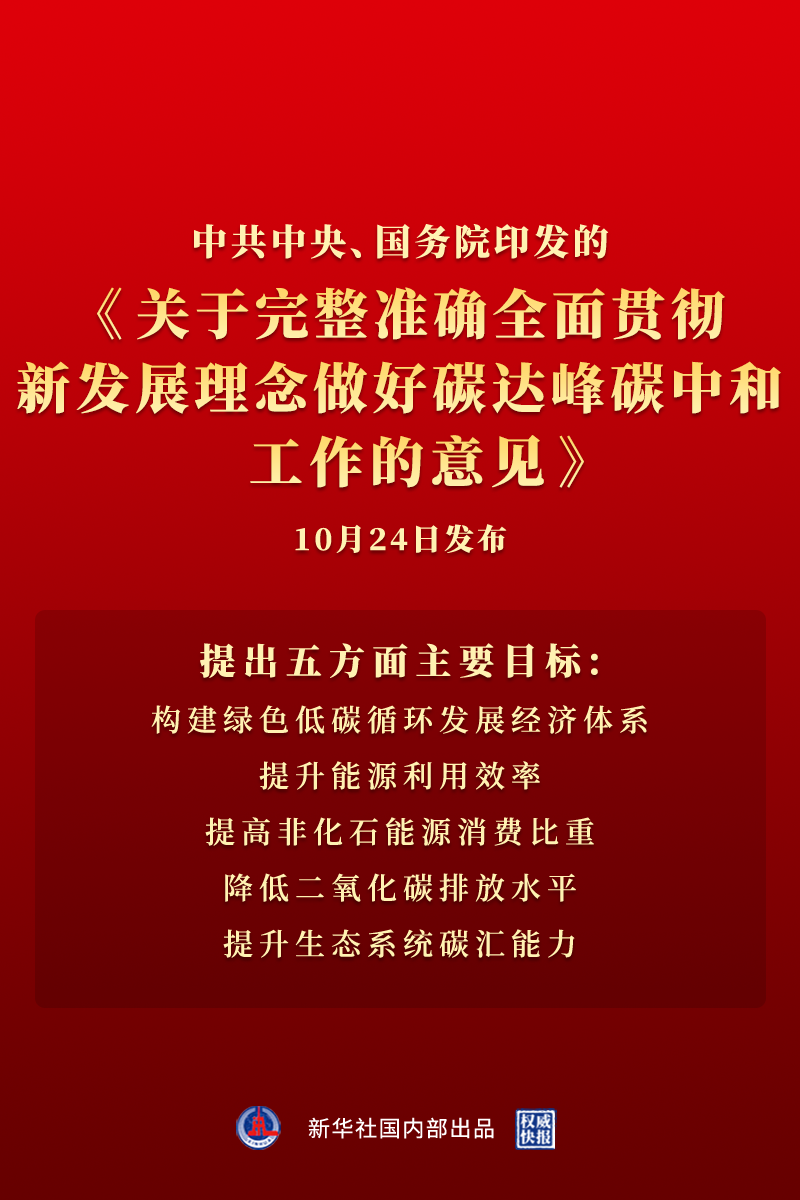
The full text is as follows:
Opinions of the CPC Central Committee and the State Council on Fully, Accurately, and Comprehensively Implementing the New Development Philosophy to Achieve Carbon Peaking and Carbon Neutrality
Achieving carbon peaking and carbon neutrality is a major strategic decision made by the CPC Central Committee with Comrade Xi Jinping at its core, taking into account both domestic and international situations. It is an inevitable choice to address prominent issues of resource and environmental constraints and achieve sustainable development of the Chinese nation, and a solemn commitment to building a community with a shared future for mankind. To fully, accurately, and comprehensively implement the new development philosophy and effectively carry out work on carbon peaking and carbon neutrality, the following opinions are hereby proposed.
I. General Requirements
(I) Guiding Ideology. Guided by Xi Jinping Thought on Socialism with Chinese Characteristics for a New Era, we will fully implement the spirit of the 19th National Congress of the Communist Party of China and its Second, Third, Fourth, and Fifth Plenary Sessions, thoroughly apply Xi Jinping Thought on Ecological Civilization, base ourselves on the new stage of development, implement the new development philosophy, and build a new development pattern. Adhering to a systemic approach, we will properly handle the relationships between development and emission reduction, the overall and the local, and the short-term and the medium-to-long term. We will integrate carbon peaking and carbon neutrality into the overall plan for economic and social development. Led by the comprehensive green transformation of economic and social development and focusing on the green and low-carbon development of energy, we will accelerate the formation of an industrial structure, production methods, lifestyle, and spatial pattern that conserve resources and protect the environment. We will unswervingly follow the path of high-quality development that prioritizes ecology and is green and low-carbon, ensuring the timely achievement of carbon peaking and carbon neutrality.
(2) Working Principles
To achieve the goals of peaking carbon emissions and carbon neutrality, we must adhere to the principles of "national coordination, prioritizing conservation, dual-wheel drive, smooth domestic and international circulation, and risk prevention."
—National coordination. Adopt a unified national approach, strengthen top-level design, leverage institutional advantages, implement joint Party and government accountability, and consolidate responsibilities across all parties. Implement categorized policies based on local conditions, encourage proactive initiatives, and strive to achieve peak carbon emissions first.
— Prioritize conservation. Place energy and resource conservation at the forefront, implement a comprehensive conservation strategy, continuously reduce energy and resource consumption and carbon emissions per unit of output, improve input-output efficiency, advocate a simple, moderate, green, and low-carbon lifestyle, and establish effective carbon emission control valves at the source and entry points.
Dual-wheel drive. Both government and market forces are leveraged. Establish a new nationwide system, strengthen technological and institutional innovation, and accelerate the green and low-carbon technological revolution. Deepen reforms in energy and related fields, leverage market mechanisms, and form effective incentive and constraint mechanisms.
—Smooth domestic and international circulation. Based on national conditions, coordinate domestic and international energy resources, and promote advanced green, low-carbon technologies and experience. Coordinate external efforts in addressing climate change through both struggle and cooperation, continuously enhance international influence and discourse power, and firmly safeguard China’s development rights and interests.
—Mitigate risks. Properly balance pollution reduction and carbon reduction with energy security, industry / supply chain security, food security, and people's normal lives; effectively address the economic, financial, and social risks that may accompany the green and low-carbon transition; prevent overreaction and ensure safe carbon reduction.
II. Main Objectives
By 2025, an economic system for green, low-carbon, and circular development will be initially established, with a significant improvement in energy efficiency in key industries. Energy consumption per unit of GDP will decrease by 13.5% compared to 2020; CO₂ emissions per unit of GDP will decrease by 18% compared to 2020; the share of non-fossil energy consumption will reach around 20%; forest coverage will reach 24.1%, and forest stock volume will reach 18 billion cubic meters, laying a solid foundation for achieving carbon peaking and carbon neutrality.
By 2030, significant progress will have been made in the comprehensive green transformation of economic and social development, with energy efficiency in key energy-consuming industries reaching internationally advanced levels. Energy consumption per unit of GDP will drop substantially; CO₂ emissions per unit of GDP will decrease by more than 65% compared to 2005 levels; the share of non-fossil energy in total energy consumption will reach around 25%, with total installed capacity of wind and solar power exceeding 1.2 billion kW; forest coverage will reach around 25%, forest stock volume will reach 19 billion cubic meters, and CO₂ emissions will peak and then steadily decline.
By 2060, an economic system for green, low-carbon, and circular development, along with a clean, low-carbon, safe, and efficient energy system, will be fully established. Energy utilization efficiency will reach advanced international levels, the share of non-fossil energy consumption will exceed 80%, carbon neutrality goals will be successfully achieved, significant progress will be made in ecological civilization, and a new era of harmonious coexistence between humanity and nature will be开创.
3. Promote a comprehensive green transition in economic and social development
(3) Strengthen the guiding role of green and low-carbon development planning. Fully integrate the goals of carbon peaking and carbon neutrality into medium- and long-term plans for economic and social development, and strengthen the support and safeguards provided by national development plans, territorial space plans, special plans, regional plans, and local plans at all levels. Enhance coordination and alignment among plans at all levels and of all types to ensure that the main objectives, development directions, major policies, and major projects for achieving carbon peaking and carbon neutrality are consistent across all regions and sectors.
(4) Optimize the regional layout for green and low-carbon development. Continuously optimize the layout of major infrastructure, key productive forces, and public resources to establish a new pattern of territorial space development and protection conducive to carbon peaking and carbon neutrality. In the implementation of major regional strategies such as the coordinated development of the Beijing-Tianjin-Hebei region, the development of the Yangtze River Economic Belt, the construction of the Guangdong-Hong Kong-Macao Greater Bay Area, the integrated development of the Yangtze River Delta, and the ecological protection and high-quality development of the Yellow River Basin, strengthen the orientation and task requirements for green and low-carbon development.
(5) Accelerate the formation of green production and lifestyles. Vigorously promote energy saving and emission reduction, comprehensively advance cleaner production, accelerate the development of the circular economy, strengthen comprehensive resource utilization, and continuously improve the level of green and low-carbon development. Expand the supply and consumption of green and low-carbon products, and advocate green and low-carbon lifestyles. Integrate green and low-carbon development into the national education system. Carry out demonstration creation for green and low-carbon social actions. Build consensus across society and accelerate the formation of a positive pattern of public participation.
4. Deeply adjust the industrial structure
(6) Promote the optimization and upgrading of industrial structure. Accelerate green development in agriculture to enhance carbon sequestration and efficiency. Formulate peak carbon emission implementation plans for industries and sectors including energy, steel, non-ferrous metals, petrochemicals, building materials, transportation, and construction. Revise the catalog for guiding industrial structure adjustment with a focus on energy saving and carbon reduction. Conduct "look-back" reviews on capacity reduction in steel and coal to consolidate achievements. Accelerate low-carbon process innovation and digital transformation in the industrial sector. Develop pilot parks for peak carbon emissions. Accelerate green transformation in commerce, circulation, and information services to enhance the low-carbon development level of the service industry.
(7) Resolutely curb the blind development of high energy-consuming and high-emission projects. For newly built or expanded projects in steel, cement, flat glass, electrolytic aluminum, and other high energy-consuming and high-emission sectors, strict implementation of equal or reduced production capacity replacement is required. Policies to control production capacity will be introduced for coal-fired power, petrochemicals, and coal chemicals. Projects not included in national industrial plans for relevant sectors are strictly prohibited from new construction, expansion, or reconstruction of oil refining, as well as new ethylene, para-xylene, and coal-to-olefins projects. Reasonably control the scale of coal-to-oil and gas production capacity. Raise energy consumption access standards for high energy-consuming and high-emission projects. Strengthen analysis, early warning, and window guidance on overcapacity.
(8) Vigorously develop green and low-carbon industries. Accelerate the development of strategic emerging industries such as next-generation information technology, biotechnology, new energy, new materials, high-end equipment, new energy vehicles, environmental protection, aerospace, and marine equipment. Build a green manufacturing system. Promote the deep integration of emerging technologies such as the Internet, big data, artificial intelligence, and fifth-generation mobile communication (5G) with green and low-carbon industries.
5. Accelerate the construction of a clean, low-carbon, safe, and efficient energy system
(9) Strengthen dual control of energy consumption intensity and total volume. Adhere to an energy development strategy that prioritizes Energy saving, strictly control the intensity of energy consumption and carbon dioxide emissions, reasonably control the total energy consumption, and coordinate the establishment of a system for controlling total carbon dioxide emissions. Ensure alignment between industrial layout, structural adjustment, Energy saving reviews, and dual control of energy consumption; for regions facing severe challenges in meeting energy intensity reduction targets, implement measures such as suspending or restricting project approvals and requiring equal or reduced energy consumption substitution. Strengthen Energy saving supervision and law enforcement, enhance analysis and early warning of control targets for energy consumption and carbon dioxide emissions, strictly implement responsibilities and evaluation assessments. Strengthen the control of non-carbon dioxide greenhouse gases such as methane.
(10) Significantly improve energy utilization efficiency. Integrate energy saving throughout the entire process and all sectors of economic and social development, continuously deepen energy saving in key areas such as industry, construction, transportation, and public institutions, and enhance the energy efficiency levels of information infrastructure such as data centers and new communications. Improve the energy management system, strengthen energy saving management and target responsibilities for key energy-consuming units. Aim for international advanced levels, accelerate the implementation of energy-saving and carbon-reduction retrofitting and upgrades, and create "front-runners" in energy efficiency.
(11) Strictly control fossil fuel consumption. Accelerate the reduction of coal consumption, strictly controlling its growth during the "14th Five-Year Plan" period and gradually reducing it during the "15th Five-Year Plan" period. Oil consumption will enter a peak plateau phase during the "15th Five-Year Plan" period. Coordinate coal-fired power development with supply guarantee and peak shaving, strictly control the installed capacity of coal-fired power, and accelerate energy saving upgrades and flexibility retrofits for existing coal-fired units. Gradually reduce and eventually prohibit scattered coal burning. Accelerate the large-scale development of unconventional oil and gas resources such as shale gas, coalbed methane, and tight oil and gas. Strengthen risk management to ensure safe, stable energy supply and a smooth transition.
(12) Actively develop non-fossil energy. Implement renewable energy substitution actions, vigorously develop wind energy, solar energy, biomass energy, ocean energy, geothermal energy, etc., and continuously increase the proportion of non-fossil energy consumption. Adhere to the simultaneous development of centralized and distributed systems, prioritizing the local and nearby development and utilization of wind and solar energy. Develop hydropower according to local conditions. Actively, safely, and orderly develop nuclear power. Reasonably utilize biomass energy. Accelerate the large-scale application of pumped storage and new energy storage. Coordinate the development of the entire hydrogen energy chain including "production, storage, transmission, and usage". Build a new power system with new energy as the main body, and improve the grid's ability to accommodate and regulate high proportions of renewable energy.
(13) Deepen the reform of energy systems and mechanisms. Comprehensively advance the market-oriented reform of the electricity sector, accelerate the cultivation and development of independent market entities in power distribution and sales, improve the coordination mechanisms among medium- and long-term markets, spot markets, and ancillary services markets, and expand the scale of market-based transactions. Advance the reform of the power grid system, clarifying the market entity status of incremental distribution networks, microgrids, and distributed power sources primarily for integrating renewable energy. Accelerate the formation of a new mechanism for power capacity expansion based on energy storage and peak-shaving capabilities. Improve the market-based price formation mechanism for energy commodities such as electricity. Deepen electricity price reforms from the perspective of facilitating energy saving, streamline the structure of transmission and distribution prices, and fully liberalize prices in competitive segments. Advance market-oriented reforms for coal, oil, and natural gas, and accelerate the improvement of a unified energy market.
6. Accelerate the development of a low-carbon transportation system
(14) Optimize the transportation structure. Accelerate the construction of a comprehensive three-dimensional transportation network, vigorously develop multimodal transport, increase the share of rail and waterway transport in comprehensive transportation, and continuously reduce energy consumption and carbon dioxide emission intensity in transportation. Optimize passenger transport organization and guide passenger transport enterprises toward large-scale and intensive operations. Accelerate the development of green logistics, integrate transportation resources, and improve utilization efficiency.
(15) Promote energy-saving and low-carbon transportation. Accelerate the development of new energy and clean energy vehicles and vessels, promote intelligent transportation, advance railway electrification upgrades, drive the construction of hydrogen refueling stations, and normalize the use of shore power by ships at ports. Accelerate the establishment of a convenient, efficient, and moderately forward-looking charging and battery-swapping network. Raise energy efficiency standards for fuel-powered vehicles and vessels, improve the energy efficiency labeling system for transport equipment, and accelerate the phase-out of high-energy-consuming, high-emission old vehicles and vessels.
(16) Actively promote low-carbon travel. Accelerate the construction of high-capacity public transport infrastructure, such as urban rail transit, dedicated bus lanes, and bus rapid transit (BRT) systems, and strengthen the development of urban slow-traffic systems, including dedicated bicycle lanes and pedestrian walkways. Comprehensively apply legal, economic, technical, and administrative measures to intensify efforts in addressing urban traffic congestion.
7. Enhance the quality of green and low-carbon development in urban and rural construction
(17) Promote the low-carbon transformation of urban and rural construction and management models. Fully implement green and low-carbon requirements in all stages of urban and rural planning, construction, and management. Promote cluster-style urban development, build urban ecological and ventilation corridors, and improve urban greening levels. Reasonably plan targets for urban building floor area development, and strictly control the construction of high-energy-consuming public buildings. Implement green construction throughout the entire engineering process, improve the management system for building demolition, and put an end to large-scale demolition and construction. Accelerate the construction of green communities. In combination with the implementation of rural construction initiatives, promote green and low-carbon development in county towns and rural areas.
(18) Vigorously develop energy-saving and low-carbon buildings. Continuously raise energy efficiency standards for new buildings, accelerate the large-scale development of ultra-low energy, near-zero energy, and low-carbon buildings. Strongly promote energy-saving retrofits of existing urban buildings and municipal infrastructure to enhance the energy-saving and low-carbon performance of buildings. Gradually implement building energy consumption quota management, promote building energy efficiency assessment and labeling, and conduct performance evaluations for low-carbon development in the building sector. Comprehensively promote green and low-carbon building materials and advance the circular utilization of construction materials. Develop green rural housing.
(19) Accelerate the optimization of building energy consumption structure. Deepen the application of renewable energy in buildings, and accelerate the electrification and low-carbon transition of building energy use. Launch rooftop photovoltaic initiatives for buildings to significantly increase the electrification rate for space heating, domestic hot water, and cooking. In northern urban areas, accelerate the promotion of centralized heating through combined heat and power (CHP), scale up the use of industrial waste heat for heating, steadily advance nuclear waste heat heating, and promote clean, low-carbon heating solutions such as heat pumps, natural gas, biomass, and geothermal energy according to local conditions.
8. Strengthen major scientific and technological breakthroughs and promote the application of green and low-carbon technologies
(20) Strengthen basic research and frontier technology layout. Formulate action plans for scientific and technological support of carbon peaking and carbon neutrality, and compile a roadmap for carbon neutrality technology development. Adopt the "open competition" mechanism to tackle key problems in low-carbon, zero-carbon, negative-carbon and energy storage new materials, new technologies and new equipment. Strengthen basic theoretical and methodological research on the causes and impacts of climate change, ecosystem carbon sinks, etc. Promote breakthroughs in low-carbon frontier technologies such as high-efficiency solar cells, hydrogen production from renewable energy, controlled nuclear fusion, and zero-carbon industrial process reengineering. Cultivate a batch of national key laboratories, national technology innovation centers, and major scientific and technological innovation platforms for the R&D of energy saving, carbon reduction and new energy technology products. Build a talent system for carbon peaking and carbon neutrality, and encourage higher education institutions to add disciplines and majors related to carbon peaking and carbon neutrality.
(21) Accelerate the research, development, and promotion of advanced and applicable technologies. Conduct in-depth research on smart grid technologies that support the large-scale, grid-friendly integration of wind power and solar power generation. Strengthen the breakthroughs, demonstration, and industrial application of new energy storage technologies such as electrochemical and compressed air storage. Enhance the research, development, demonstration, and large-scale application of key technologies for hydrogen production, storage, and utilization. Promote energy-saving and low-carbon technologies such as cascaded energy utilization in industrial parks. Advance the research and application of new materials such as aerogels. Promote the research, development, demonstration, and industrial application of large-scale carbon capture, utilization, and storage (CCUS) technologies. Establish and improve evaluation and trading systems for green and low-carbon technologies, as well as platforms for technological innovation services.
9. Continuously consolidate and enhance carbon sink capacity
(22) Consolidate the carbon sink capacity of ecosystems. Strengthen territorial spatial planning and land-use control, strictly adhere to ecological protection red lines, strictly control the occupation of ecological space, and stabilize the carbon sequestration functions of existing forests, grasslands, wetlands, oceans, soils, permafrost, and karst landscapes. Strictly control the scale of new construction land, and promote the revitalization and utilization of existing urban and rural construction land. Strictly implement land use standards, strengthen evaluations of economical and intensive land use, and promote land-saving technologies and models.
(23) Increase the carbon sink increment of ecosystems. Implement major ecological protection and restoration projects, and carry out integrated protection and restoration of mountains, rivers, forests, farmlands, lakes, grasslands, and deserts. Deeply advance large-scale national greening initiatives, consolidate the achievements of returning farmland to forests and grasslands, implement precision forest quality improvement projects, and continuously increase forest area and stock volume. Strengthen ecological protection and restoration of grasslands. Enhance wetland conservation. Comprehensively promote the protection and restoration of marine ecosystems, and enhance the carbon sequestration capacity of mangroves, seagrass beds, and salt marshes. Carry out actions to improve cultivated land quality, implement the national black soil protection project, and enhance the carbon sink of ecological agriculture. Actively promote the development and utilization of karst carbon sinks.
10. Enhance the level of green and low-carbon development in opening up to the outside world
(24) Accelerate the establishment of a green trade system. Continuously optimize the trade structure and vigorously develop trade in high-quality, high-tech, and high-value-added green products. Improve export policies and strictly manage the export of high-energy-consuming and high-emission products. Actively expand imports of green and low-carbon products, energy saving and environmental protection services, and environmental services.
(25) Promote the green development of the Belt and Road Initiative. Accelerate the green transformation of investment and cooperation under the Belt and Road Initiative. Support countries participating in the Belt and Road Initiative in the development and utilization of clean energy. Vigorously promote South-South cooperation to help developing countries enhance their capacity to address climate change. Deepen exchanges and cooperation with all countries in green technologies, green equipment, green services, and green infrastructure construction, and actively promote the global expansion of China’s new energy and other green, low-carbon technologies and products, making green the defining feature of jointly building the Belt and Road Initiative.
(26) Strengthen international exchange and cooperation. Actively participate in international negotiations on climate change, uphold China's position as a developing country, adhere to the principles of common but differentiated responsibilities, equity, and respective capabilities, and safeguard China's development rights and interests. Fulfill obligations under the United Nations Framework Convention on Climate Change and its Paris Agreement, release China's long-term strategy for low greenhouse gas emissions, actively participate in the formulation of international rules and standards, and promote the establishment of a fair, reasonable, and win-win global climate governance system. Strengthen international exchanges and cooperation on climate change response, coordinate domestic and international efforts, and proactively engage in global climate and environmental governance.
11. Improve laws, regulations, standards, and statistical monitoring systems
(27) Improve laws and regulations. Comprehensively review existing laws and regulations to remove provisions inconsistent with carbon peaking and carbon neutrality work, and strengthen coordination and alignment among laws and regulations. Study and formulate special legislation on carbon neutrality, and promptly revise the Energy Conservation Law, the Electric Power Law, the Coal Law, the Renewable Energy Law, the Circular Economy Promotion Law, and other relevant laws to enhance their pertinence and effectiveness.
(28) Improve the standards and metrology system. Establish and improve the standards and metrology system for carbon peaking and carbon neutrality. Accelerate the update and upgrade of energy saving standards, promptly revise a batch of mandatory national standards (GB / GB/T) on energy consumption limits, product and equipment energy efficiency, and engineering construction standards, raise energy consumption limit requirements for key products, expand the coverage of energy consumption limit standards, and improve supporting standards for energy accounting, testing and certification, assessment, and auditing. Accelerate the improvement of standards for carbon emission verification, accounting, and reporting at regional, industry, enterprise, and product levels, and establish a unified and standardized carbon accounting system. Formulate greenhouse gas emission standards for key industries and products, and improve the standard labeling system for low-carbon products. Actively participate in the formulation of relevant international standards and strengthen international alignment of standards.
(29) Enhance statistical monitoring capabilities. Improve energy consumption statistical monitoring and metering systems in sectors such as electric power, steel, and construction, and strengthen the development of online energy consumption monitoring systems for key energy-using entities. Strengthen capabilities for CO₂ emission statistics and accounting, and improve the level of信息化 (informatization-based) actual measurement. Rely on and expand the natural resources survey and monitoring system to establish an ecosystem carbon sink monitoring and accounting system, conduct baseline surveys and carbon stock assessments for forests, grasslands, wetlands, oceans, soils, permafrost, and karst, and implement monitoring and evaluation of carbon sink effectiveness from ecological protection and restoration.
12. Improve Policy Mechanisms
(30) Improve investment policies. Fully leverage the guiding role of government investment, build a financing and investment system aligned with carbon peaking and carbon neutrality, strictly control investments in high-carbon projects such as coal-fired power, steel, electrolytic aluminum, cement, and petrochemicals, and increase support for projects in energy saving and environmental protection, new energy, low-carbon transportation equipment and organizational models, and carbon capture, utilization, and storage. Improve policies to encourage social capital participation and stimulate market entities' vitality in green and low-carbon investment. State-owned enterprises should increase green and low-carbon investment and actively carry out R&D and application of low-carbon, zero-carbon, and negative-carbon technologies.
(31) Actively develop green finance. Orderly promote the development of green and low-carbon financial products and services, establish monetary policy tools for carbon emission reduction, incorporate green credit into the macroprudential assessment framework, and guide banks and other financial institutions to provide long-term, low-cost funding for green and low-carbon projects. Encourage development and policy-oriented financial institutions to provide long-term and stable financing support for achieving carbon peaking and carbon neutrality in accordance with market-oriented and rule-of-law principles. Support eligible enterprises in raising funds through IPO and refinancing for the construction and operation of green and low-carbon projects, and expand the scale of green bonds. Study the establishment of a national low-carbon transition fund. Encourage social capital to establish green and low-carbon industry investment funds. Establish and improve the green finance standard system.
(32) Improve fiscal, tax, and price policies. Finance departments at all levels shall increase support for the development of the green and low-carbon industry, R&D, etc. Improve government green procurement standards and increase procurement of green and low-carbon products. Implement tax incentives for environmental protection, energy and water conservation, new energy, and clean-energy vehicles and vessels. Study tax policies related to carbon emission reduction. Establish and improve a price mechanism that promotes the large-scale development of renewable energy. Improve policies on differentiated electricity prices, time-of-use electricity prices, and tiered residential electricity prices. Strictly prohibit electricity price incentives for high energy-consuming, high-emission, and resource-based industries. Accelerate the reform of heat metering and charging based on heat supply. Accelerate the formation of a carbon pricing mechanism with reasonable binding force.
(33) Promote the development of market-based mechanisms. Relying on public resource trading platforms, accelerate the construction and improvement of the national carbon emissions rights trading market, gradually expand market coverage, enrich trading varieties and methods, and improve quota allocation management. Incorporate carbon sink trading into the national carbon emissions rights trading market, and establish and improve an ecological protection compensation mechanism that reflects the value of carbon sinks. Improve carbon emission reporting and information disclosure systems for enterprises, financial institutions, and other entities. Improve the paid use and trading system for energy usage rights, and accelerate the construction of a national energy usage rights trading market. Strengthen the coordination and integration of electricity trading, energy usage rights trading, and carbon emissions rights trading. Develop market-based energy saving approaches, implement Energy performance contracting (EPC / EMC), and promote comprehensive energy saving services.
13. Strengthen Organization and Implementation
(34) Strengthen organizational leadership. Strengthen the centralized and unified leadership of the CPC Central Committee over carbon peaking and carbon neutrality work. The Leading Group for Carbon Peaking and Carbon Neutrality shall provide guidance and overall coordination for carbon peaking and carbon neutrality efforts. Support regions with favorable conditions, key industries, and key enterprises in taking the lead in achieving carbon peaking; organize and carry out pilot demonstrations for carbon peaking and carbon neutrality to explore effective models and valuable experience. Incorporate carbon peaking and carbon neutrality as important components of the cadre education and training system, enhancing the ability of leading officials at all levels to promote green and low-carbon development.
(35) Strengthen overall coordination. The National Development and Reform Commission shall enhance overall planning, organize the implementation of the Action Plan for Peaking Carbon Emissions Before 2030, strengthen strategic planning for carbon neutrality, regularly monitor and coordinate the progress of all regions and relevant departments in achieving the targets for peaking carbon emissions and carbon neutrality, strengthen follow-up evaluation and supervision, and coordinate to resolve major issues encountered during implementation. All relevant departments shall strengthen coordination and cooperation to form a joint work force, ensuring consistent policy direction and coherent steps and intensity.
(36) Consolidate local responsibilities. Implement the accountability system for ecological civilization construction among leading officials. Local party committees and governments at all levels must firmly shoulder the responsibilities for carbon peaking and carbon neutrality, define clear targets and tasks, formulate implementation measures, and proactively contribute to achieving carbon peaking and carbon neutrality.
(37) Strengthen supervision and assessment. All regions shall incorporate carbon peaking and carbon neutrality-related indicators into the comprehensive evaluation system for economic and social development, increase their weight in assessments, and strengthen indicator constraints. Enhance the assessment of the implementation of carbon peaking and carbon neutrality targets and tasks; regions, entities, and individuals with outstanding performance shall be commended and rewarded in accordance with regulations, while regions and departments that fail to meet their targets shall be subject to circulated criticism and accountability interviews in accordance with laws and regulations. The relevant implementation status shall be included in the central ecological and environmental protection inspections. All regions and relevant departments shall report annually to the CPC Central Committee and the State Council on their implementation progress.
(Publicly Released)
China Light
The official website of the China Association of Lighting Industry and a full-media platform for the lighting sector. We provide authoritative and timely lighting information while striving to be a growth partner for businesses. From brand promotion and channel expansion to consulting, talent training and participation in standards development, we provide comprehensive professional services to help businesses improve quality and efficiency and jointly advance the high-quality development of the lighting industry.
Business Contacts
仇纯 (Ms.): 158 6155 3579
顾君 (Mr.): 137 7157 5253