
New Progress in Research on Micro-LED and Other Fields
Micro-LED is a new generation of display technology that has attracted significant attention in recent years. The research group led by Associate Professor Liu Zhaojun from the Department of Electronics at Southern University of Science and Technology focuses on research areas such as Micro-LED luminescent materials, device design and fabrication, and colorization, while exploring practical application scenarios, achieving systematic research results.
近来,刘召军课题组综述了Micro-LED全彩显示技术的研究进展,包括Micro-LED器件制备、巨量转移及结合量子点(QD)的单片全彩显示技术,成果以“Micro-light-emitting diodes with quantum dots in display technology”为题,发表在《Light: Science & Applications》论文1。刘召军副教授为该篇文章第一作者,文章获得该期刊2020年高下载量荣誉证书。
Recently, Liu Zhaojun's research group has made progress in full-color Micro-LED displays based on quantum dot color conversion layers. The results were published in The Journal of Physical Chemistry Letters under the title "Dual Role of Quantum Dots as Color Conversion Layer and Suppression of Input Light for Full-Color Micro-LED Displays".
This work demonstrates that, due to the high extinction coefficient of quantum dots, using them as a color conversion layer can significantly suppress residual blue excitation light. For green and red core/shell CdSe/ZnS quantum dot films with a thickness of less than 17 µm, the blue light transmittance is only 0.1%, while generating green and red emission. Adding TiO2 nanoparticles to the quantum dot solution increases the luminous intensity by more than 10% through scattering effects. It also shows that suppressing reabsorption in quantum dots is key to achieving high color conversion efficiency. Figure 1 illustrates the schematic of the quantum dot color conversion layer in GaN-based blue Micro-LEDs.
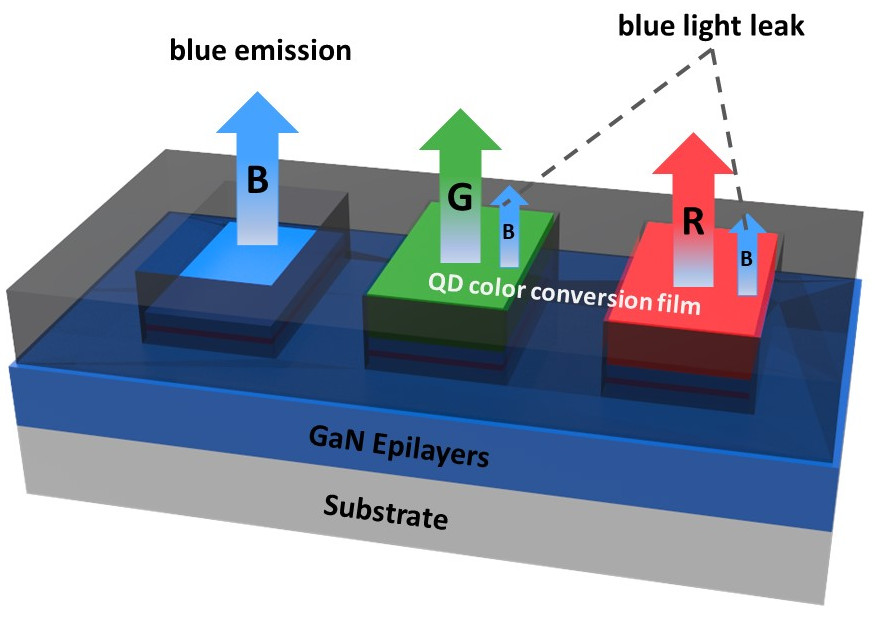
Figure 1 Schematic diagram of the quantum dot color conversion layer on GaN-based blue Micro-LED
The research results provide a clear path for the low-cost manufacturing of quantum dot conversion layer Micro-LED displays. The corresponding authors are Associate Professor Zhaojun Liu from the Department of Electronics at Southern University of Science and Technology and Professor Hao-Chung Kuo from National Chiao Tung University. Dr. Byung-Ryool Hyun from Southern University of Science and Technology and Dr. Qingwei She from the Fok Ying Tung Research Institute at The Hong Kong University of Science and Technology are the first authors of the article.
随着Micro-LED器件尺寸的不断减小,Micro-LED器件的效率衰减成为需要解决的关键问题。为了探究如何提高Micro-LED器件的效率,刘召军题组通过模拟仿真研究,以“Exploring Superlattice DBR Effect on Micro-LED as Electron Blocking Layer”为题在《Optics Express》期刊论文3上提出了一种新方法在外延生长层面提高器件的插座效率,并讨论了内在的物理机制。具体方法为通过将超晶格结构和分布式布拉格反射器相结合并替代传统AlGaN电子阻挡层的方式,在通过增强辐射复合的同时提高光出射效率。文章第一作者为南方科技大学本科学生严格维,通讯作者为刘召军。
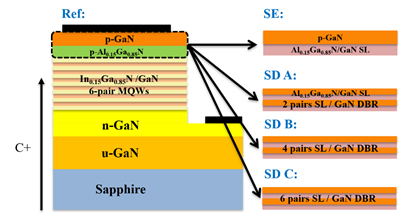
Figure 2: Device Structure Diagram
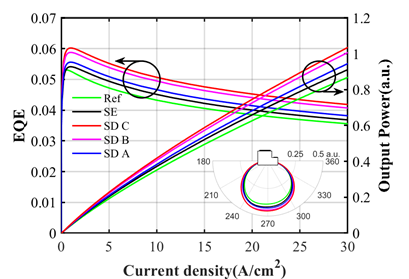
Figure 3: External quantum efficiency and output power vs. current density curves for different devices
Associate Professor Liu Zhaojun's research group has made progress in the thermal stability of Micro-LED devices. They reported their research on the temperature stability of green Micro-LED devices in the journal AIP Advances under the title "Thermal Characteristics of InGaN-based Green Micro-LEDs". In this work, InGaN-based green Micro-LED devices were fabricated. The junction temperature calibration curves for green Micro-LED devices of different sizes were obtained using the forward voltage method, and the optoelectronic characteristics of the green Micro-LED devices were analyzed over a wide junction temperature range of 298 K to 453 K. Figure 4 shows the fabrication process flow of the Micro-LED devices.
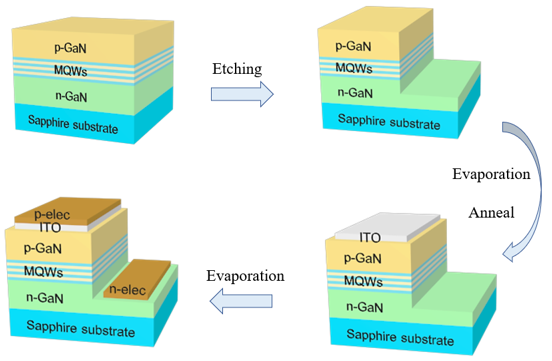
Figure 4 Schematic diagram of the green Micro-LED fabrication process
Experimental results show that the fabricated green Micro-LED devices exhibit stable performance within a junction temperature range of 298 K to 453 K, demonstrating significant potential for future color high-definition display applications. Feng Yang, a master's student from the class of 2019 at Southern University of Science and Technology, is the first author, and Liu Zhaojun is the corresponding author.
It is widely believed that the efficiency attenuation of Micro-LED devices is caused by etching damage to the device sidewalls, but there is still no clear theoretical model. To address this issue, Associate Professor Liu Zhaojun's research group from the Department of Electronic Engineering investigated the intrinsic physical mechanisms of Micro-LED efficiency attenuation through simulation, proposed a surface recombination model, and further verified its correctness through experiments. The results were published as a cover article in Physica Status Solidi Rapid Research Letters under the title "Role of Intrinsic Surface States in Efficiency Attenuation of GaN-Based Micro-Light-Emitting-Diodes". The first author is Dr. Jiang Fulong, a postdoctoral researcher in the group, and the corresponding author is Liu Zhaojun.
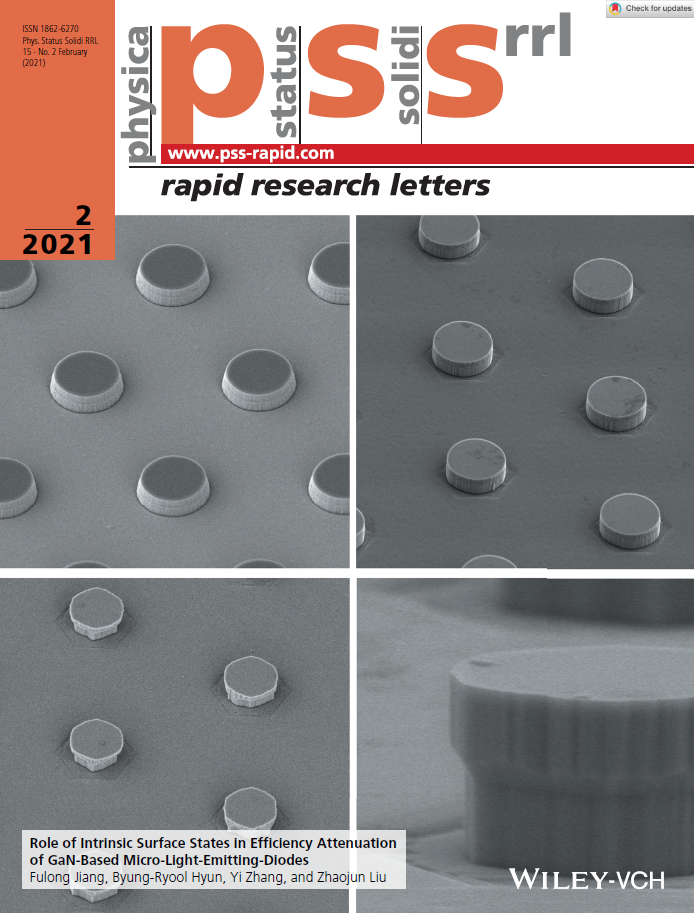
Figure 5: Cover of Physica status solidi rapid research letters, Issue 2, 2021
In addition, Associate Professor Liu Zhaojun's research group reviewed the current technical challenges and research status of GaN-based Micro-LED display technology, mainly including: wafer epitaxial growth technology applied to Micro-LED displays, the intrinsic physical mechanisms of efficiency droop in Micro-LED devices, and monolithic full-color Micro-LED display technology using color conversion media. The paper, titled "Research Progress on GaN-based Micro-LED Display Technology" (Paper 6), was published in the Journal of Synthetic Crystals, a Peking University Core Journal, and was selected as an outstanding review paper for 2019-2020 by the Journal of Synthetic Crystals. The co-first authors are Jiang Fulong, a postdoctoral fellow at Southern University of Science and Technology, and Xu Feifan, a doctoral student at Nanjing University. The corresponding authors are Academician Zheng Youyan and Professor Liu Bin from Nanjing University, and Associate Professor Liu Zhaojun from Southern University of Science and Technology.
Graduate student Sun Tianhao, under the supervision of Professor Liu Zhaojun and Professor Chengfeng Qiu, proposed using WO3 as the material for the electrochromic layer and fabricated electrochromic devices. He investigated an improved scheme using an Ag-WO3 composite layer as the electrochromic layer to study its impact on response time. The research results were published in Issue 5, 2021 of the core journal "Liquid Crystals and Display" under the title "Response Time Testing and Improvement Scheme for WO3 Thin-Film Electrochromic Devices," and was selected as the cover article.
Micro-LED and wide-bandgap semiconductor optoelectronic devices can achieve high-speed communication over medium to long underwater distances in Underwater Wireless Optical Communication (UWOC) applications, attracting widespread attention from researchers at home and abroad. Liu Zhaojun's research group has also made new progress in UWOC.
Misalignment is a critical issue in UWOC systems based on laser light sources, as underwater motion easily affects the optical communication link. Therefore, UWOC systems based on laser light sources require precise alignment systems. Based on this, the research team proposed a novel method in paper 8 published in Optics Express, titled "CMOS monolithic photodetector with a built-in 2-dimensional light direction sensor for laser diodes based underwater wireless optical communications", which expands the receiver's field of view to 120° and enhances the robustness of UWOC systems based on laser light sources.
The specific implementation involves integrating a CMOS photodetector with a built-in two-dimensional light direction sensor into a single chip, fabricated using a standard 0.5 µm CMOS process. Figure 7 shows the rendering. The first author of the article is Lv Zhijian, Research Assistant Professor at Southern University of Science and Technology, and the corresponding author is Liu Zhaojun.
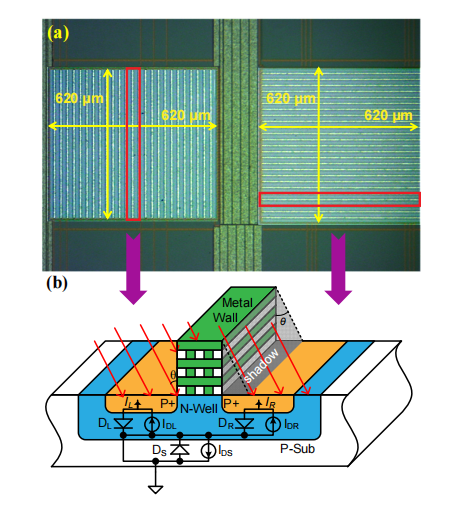
Figure 7 (a) Photo of a CMOS photodetector with a built-in two-dimensional light direction sensor (b) Structure of a single sensor unit
Previous studies have often focused on the absorption and scattering of light by seawater, but oceanic turbulence effects may have a more severe impact on UWOC. Based on this, Liu Zhaojun's research group reported in the paper "Investigation of underwater wireless optical communications links with surface currents and tides for oceanic signal transmission" published in IEEE Photonics Journal [9] on the impact of pure water and saltwater on UWOC systems based on a 520 nm laser light source under conditions of oceanic turbulence. A closed-loop system was used to simulate oceanic turbulence phenomena in the laboratory by using long straight pipes, tee joints, hoses, and submersible pumps, as shown in the schematic diagram in Figure 8. The first author of the article is Lv Zhijian, Research Assistant Professor at Southern University of Science and Technology, and the corresponding author is Liu Zhaojun.
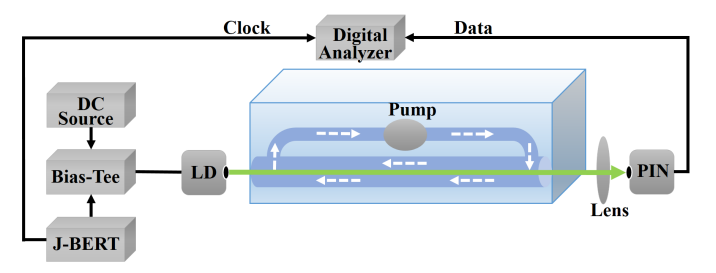
Figure 8 Schematic diagram of a UWOC system setup based on a 520 nm laser light source
Experimental tests under pure water conditions showed communication rates of 3.4 Gb/s and 3.5 Gb/s, with ocean turbulence having a minor impact on UWOC system performance. Further experiments used added salt to simulate seawater, first testing the relationship between different salinities and the BER of the UWOC system at a communication rate of 3.0 Gb/s. The experimental results indicated that as salt concentration increased, the BER of the UWOC system worsened at the same communication rate.
To make the experimental conditions closer to the real marine environment, the relationship between the BER of the UWOC system and different water flow velocities was tested at a salt concentration of 35.4 g/L. The results show that under the condition of 35.4 g/L salinity, marine turbulence has a certain impact on the performance of the UWOC system, but this impact is limited. The corresponding eye diagram is shown in Figure 9.
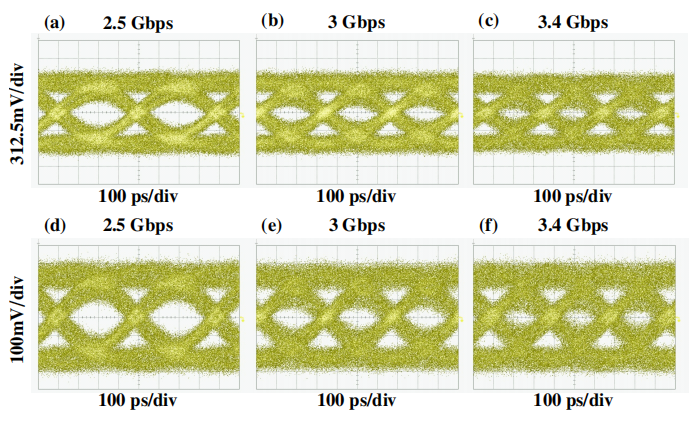
Figure 9 Eye diagrams at a salt concentration of 35.4 g/L: water flow velocity of 0 m/s (a) 2.5 Gbps, (b) 3 Gbps, (c) 3.4 Gbps; water flow velocity of 1.08 m/s (a) 2.5 Gbps, (b) 3 Gbps, (c) 3.4 Gbps
China Light
The official website of the China Association of Lighting Industry and a full-media platform for the lighting sector. We provide authoritative and timely lighting information while striving to be a growth partner for businesses. From brand promotion and channel expansion to consulting, talent training and participation in standards development, we provide comprehensive professional services to help businesses improve quality and efficiency and jointly advance the high-quality development of the lighting industry.
Business Contacts
仇纯 (Ms.): 158 6155 3579
顾君 (Mr.): 137 7157 5253