
LED industry recovery trend strengthens; Jucan, Sanan, and Fullhan Electronics hit limit-up
Currently, the semiconductor sector shows the strongest certainty in performance growth. The combination of "price increases + capacity expansion" driving up both volume and price has made a significant surge in interim financial results almost a foregone conclusion.
In the semiconductor sector, market performance has been strong since June, with the third-generation semiconductor segment posting significant gains; the average share price of nearly 50 stocks rose by 15.56%. On June 17 (yesterday), third-generation semiconductor stocks were almost universally limit-up, with Jucan Optoelectronics, Sanan Optoelectronics, Luxiao Technology, NCE Power, StarPower Semiconductor, and Silan Microelectronics among those hitting the limit.
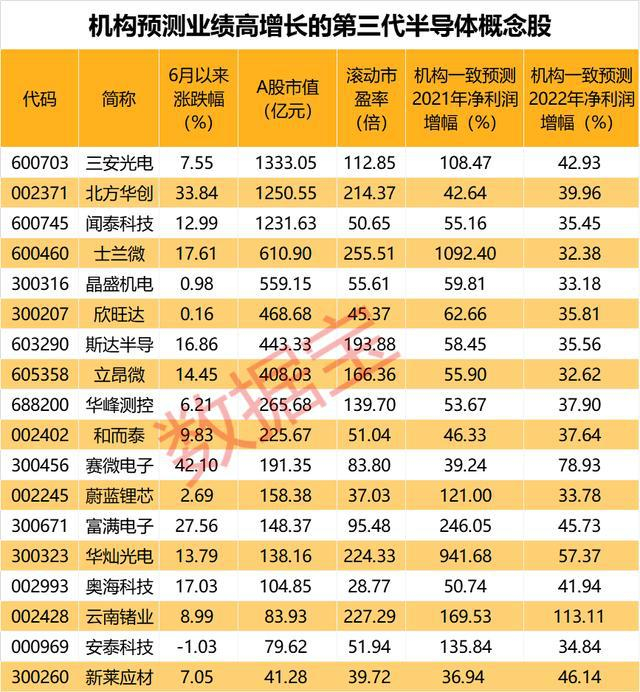
The LED sector has shown outstanding performance. According to Wind, the LED index rose by 6.45%, marking its largest single-day gain this year. The LED industry, which is on a recovery path, has continued to be validated in the secondary market.
Sanan Optoelectronics
Sanan Optoelectronics opened at 27.15 yuan on June 17. As of 13:40, the stock rose 10.02% to 29.76 yuan, hitting the upper limit.
Sanan Optoelectronics is primarily engaged in the R&D and application of compound semiconductor materials. As a leader in the entire LED industry, its core business focuses on epitaxial wafers and chips based on new semiconductor materials such as gallium arsenide, GaN, SiC, indium phosphide, aluminum nitride, and sapphire. Its products are mainly applied in lighting, displays, backlights, agriculture, healthcare, microwave RF, laser communications, power devices, optical communications, and sensing.
The substrate materials used for LED chips include gallium arsenide and GaN. Compared with other enterprises, the company has a deeper understanding of compound semiconductor technology. Meanwhile, the company has extensive coverage from materials to chips and then to packaging, aiming to build a closed-loop compound semiconductor industry chain from substrates to devices.
In addition, the company has a long-standing presence in the Mini LED sector, with significant asset investment and strong accumulation of technology and experience. It is highly competitive in the domestic market, currently supplying Samsung in volume and undergoing validation with other customers.
It is reported that demand in the LED chip market is recovering, with several mid-to-low-end lighting LED chips in short supply. Sanan Optoelectronics has raised prices for some of its low-end products since March 2021, and further increases are expected, improving supplier profitability. A downward trend in LED chip inventory has emerged; Sanan's LED chip inventory decreased by RMB 224 million quarter-on-quarter at the end of the first quarter, and the company expects to clear existing inventory by the end of the second quarter. In addition, Sanan will expand market applications for horticultural lighting, automotive, and UV/IR products to improve gross margin levels.
Sanan achieved revenue of RMB 8.45 billion in 2020, a 13% increase, with net profit attributable to shareholders of RMB 1.02 billion, a 22% decrease. In 1Q21, revenue and net profit attributable to shareholders were RMB 2.72 billion and RMB 560 million respectively, representing Year-on-year (YoY) increases of 62% and 42% respectively.
Jucan Optoelectronics
聚灿光电昨日发布股价异常波动公告称,公司股票交易价格连续两个交易日内(2021年6月16日、6月17日)收盘价格涨幅偏离值累计超过30%,根据《深圳证券交易所交易规则》的有关规定,属于股票交易异常波动的情况。
As of June 17, the company's latest P/E ratio is 393.99x. According to official data released by China Securities Index Co., Ltd., the latest P/E ratio for the optoelectronic devices industry to which the company belongs is 42.77x. The company's P/E ratio is significantly higher than the industry average.
In addition, in response to questions about whether its product prices have increased, Jucan Optoelectronics stated that there has been a certain degree of price increase for its products. Internal data analysis shows that the average selling price is indeed steadily rising, with the specific magnitude of price increases varying significantly across different products.
Jucan Optoelectronics is mainly engaged in the R&D, production, and sales of compound optoelectronic semiconductor materials. Its main products are GaN-based high-brightness LED epitaxial wafers and chips, positioned in the upstream of the LED industry chain. The products are mainly applied in mid-to-high-end fields such as display backlighting, general lighting, horticultural lighting, and medical aesthetics.
Silan Micro
Silan Micro opened at 41.3 yuan on June 17. As of 13:15, the stock rose 9.99% to 46.56 yuan, hitting the upper limit.
Silan Micro's main products include three major categories: integrated circuits, semiconductor discrete devices, and LED (Light-emitting diode) products. After more than twenty years of development, the company has evolved from a pure chip design company into one of the few comprehensive semiconductor product companies in China that primarily adopts the IDM model (Integrated Design and Manufacturing).
In 2020, Silan Micro achieved Revenue of RMB 4.281 billion, a Year-on-year (YoY) increase of 37.61%, with Net profit of RMB 68 million, up 365.16% Year-on-year (YoY). In the first quarter of this year, Silan Micro saw an explosive performance in its operating results. The company recorded Revenue of RMB 1.475 billion, a Year-on-year (YoY) increase of 113.47%. Net profit and Net profit after deducting non-recurring gains and losses (hereinafter referred to as "deducted Net profit") were RMB 174 million and RMB 163 million respectively, representing Year-on-year (YoY) increases of 7,726.86% and 1,189.04%, which is astonishing growth.
Silan Micro has adjusted prices multiple times. The price increase notice dated May 31 indicates that due to rising costs of raw and auxiliary materials and packaging, the cost of the company's related products continues to rise. The company has decided to adjust the prices of LED lighting driver products effective June 1.
According to a research report by Guojin Securities, Silan Micro is one of the few power semiconductor companies that significantly increased its production capacity between 2020 and 2022. By the end of this year, its monthly production capacity for 8-inch wafers is expected to rise from 40,000 wafers at the end of 2019 to 70,000 wafers. Its 12-inch production capacity is also substantial. Considering only the increase in production capacity, the 12-inch production line will reduce the unit cost of products by 20%-30%, while improving device consistency and reducing energy consumption.
Fuman Electronics
Fullhan Electronics, engaged in the production of LED control and driver chips, has seen its stock price surge strongly this year. Within the semiconductor sector, Fullhan Electronics has led gains since the second quarter, with the latest closing price up 6.52% to close at 72.39 yuan per share.
During recent institutional research, senior executives of Fullhan Electronics responded to the price increase trend by stating that due to continuous price hikes by upstream wafer fabs, orders are fully booked for this year and next. Some orders will no longer be accepted in 2023. The shortage is expected to persist until next year, and the company will adjust prices accordingly, with further increases anticipated in the third quarter.
It was revealed that the company's 12-inch Production capacity can reach 3,000-5,000 wafers next year, and the overall Production capacity is expected to double by the second quarter of next year. As the 12-inch Production capacity continues to be released, performance will hit new highs every quarter, and profits will also continue to reach new highs. Currently, several main lines, including Mini and Micro LED, fast charging, and power supplies, are in a stage of hitting new highs, and the turnover of 5G switches and tuner products is also gradually increasing, rising continuously in the third and fourth quarters.
"Currently, there is a severe shortage of LED components. All major manufacturers must pay full deposits and sign agreements to guarantee production capacity," stated an executive at Fullhan Electronics. "In the future, methods such as prepaying six months' worth of goods will be adopted to secure production capacity. The shortage of LED production capacity will intensify; otherwise, these major manufacturers would not be willing to prepay six months' deposits to ensure supply volumes."
As one of the important directions in the LED industry, Mini LED shipments are continuously increasing. It is reported that among existing LED chips, Fullhan Electronics' Mini LED accounts for 80% of shipments, while standard products account for about 10%. In terms of price, high-end products are 4-5 times more expensive than low-end ones, and high-end products have successfully transitioned to 12-inch production lines.
Interpretation of Third-Generation Semiconductors:
First-generation semiconductor materials are primarily silicon and germanium, which are the main materials used in integrated circuits such as CPU processors. Second-generation semiconductors refer to certain compound semiconductors, including gallium arsenide (GaAs) and indium phosphide (InP). Their main characteristic is higher frequency, and the key communication chips currently used in mobile phones are made from these materials.
Third-generation semiconductor materials are mainly wide-bandgap semiconductor materials represented by silicon carbide (SiC), gallium nitride (GaN), zinc oxide (ZnO), diamond, and aluminum nitride (AlN). Among them, research and development of SiC and GaN are more mature.
Compared to first- and second-generation semiconductor materials, third-generation semiconductor materials offer advantages such as high thermal conductivity, high breakdown field strength, high saturated electron drift velocity, and high bonding energy, meeting the new demands of modern electronic technology for harsh conditions including high temperature, high power, high voltage, high frequency, and high radiation.
Therefore, it can be used as power devices and RF devices, widely applied in fields such as 5G base stations, new energy vehicles, ultra-high voltage, consumer electronics, aerospace, and data centers.
With the rise of emerging markets such as 5G and new energy vehicles, the performance of first-generation silicon (Si)-based semiconductors can no longer fully meet demand, and the performance advantages of third-generation semiconductors are beginning to stand out.
On the other hand, domestic preparation technologies have also made certain breakthroughs. Both SiC and GaN materials have evolved from 4-inch to 6-inch wafers, while growth technologies for larger sizes such as 8-inch are already under development. The upgrade in preparation technology has also reduced the cost of third-generation semiconductors, accelerating their large-scale application.
In the coming years, the domestic SiC and GaN power semiconductor market will experience rapid growth. Driven by both policy and market forces, the domestic third-generation semiconductor sector in power electronics and RF is showing a clear upward trend.
Chen Dongpo, Deputy General Manager of Sanan's Beijing branch, believes that compound semiconductors are the best breakthrough point for China to enter the semiconductor industry. First, in terms of development stage, compound semiconductors are in their early stages; although there is a gap compared with foreign countries, it is not as large as in the silicon semiconductor field. Second, regarding processes and equipment, the application scenarios of compound semiconductors mean that they do not need to pursue particularly advanced processes, and the requirements for equipment and materials are relatively lower.
This article was compiled and edited by China Light Network. Some materials are sourced from Data Bao and Yicai. Please credit the source when reprinting.
China Light
The official website of the China Association of Lighting Industry and a full-media platform for the lighting sector. We provide authoritative and timely lighting information while striving to be a growth partner for businesses. From brand promotion and channel expansion to consulting, talent training and participation in standards development, we provide comprehensive professional services to help businesses improve quality and efficiency and jointly advance the high-quality development of the lighting industry.
Business Contacts
仇纯 (Ms.): 158 6155 3579
顾君 (Mr.): 137 7157 5253