
Wen Qidong | 2020 China Outdoor Lighting Market Operation Report
1. Landscape Lighting: Dual impact of policy and epidemic, Smart city cultural tourism composite transformation.
In 2020, the novel coronavirus pandemic swept across the globe and ravaged China. The domestic economy and society were once brought to a standstill. Subsequently, the entire nation united with one heart and one mind, enabling China to become the only major economy globally that comprehensively contained the epidemic. The Chinese economy, which rapidly recovered from the pandemic, ultimately achieved an annual GDP exceeding 100 trillion RMB, with a growth rate of 2.3%. While multiple economic indicators turned from negative to positive, society also basically returned to normal. At the same time, the landscape lighting sector also experienced a magical year.
At the end of 2019, the Leading Group for the Theme Education of 'Staying True to Our Original Aspiration and Keeping Our Mission Firmly in Mind' issued by the Central Committee printed the 'Notice on Rectifying Problems such as Excessive Brightness in 'Landscape Lighting Projects' and Other 'Political Achievement Projects' or 'Face-Saving Projects''. The core lies in preventing excessive brightness and political achievement/face-saving projects; the level of urban lighting should be adapted to the level of socio-economic development and cultural characteristics of the city itself, promoting the entire landscape lighting market into a new stage of rational construction.
The outbreak of the domestic epidemic at the beginning of 2020 mainly manifested as a stagnation in project construction and business expansion, while also adversely affecting project acceptance and payment collection, causing a sharp increase in bad debt provisions made by relevant enterprises.
Overall, the impact of policies regulating the lighting market is greater than that brought by the epidemic. The impact of the epidemic is temporary, but the impact of the documents is profound on the industry structure.
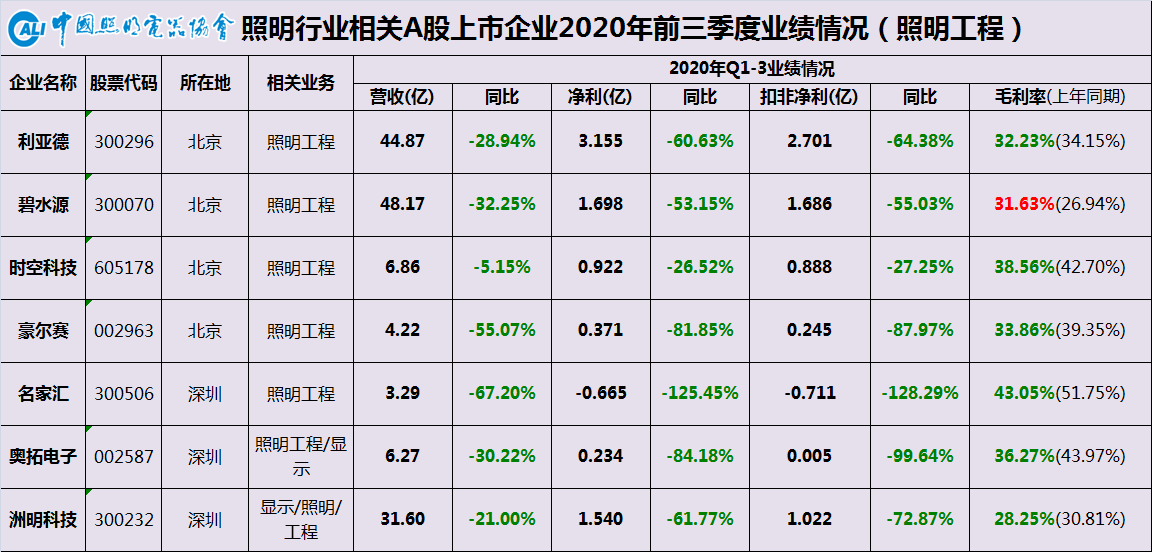
Under the dual influence of regulatory policies and the new crown epidemic, the overall performance of the lighting engineering sector in 2020 can be described as exceptionally bleak; from another perspective, it can also be said to have returned to rational normality. Large-scale city-wide lighting projects are now hard to find, while cultural tourism night tours, commercial real estate, smart cities and other projects have taken their place as the mainstream. As the saying goes, 'When the spring water warms, the duck knows first'; at the same time, we can see that relevant enterprises in the field of lighting engineering have begun to enter the transformation stage: some are transforming into cultural tourism night tour projects, others are transitioning towards smart city construction, and still others are doing both. The entire lighting engineering sector has entered a new normal for development.
Looking ahead to 2021, first of all, the central government's rectification documents target excessive lighting and image projects, not banning lighting. With China's comprehensive national strength continuously growing, sustained economic and social development, deepening urbanization, and the vigorous demand of the broad masses for a better life, the market demand for landscape lighting still exists. In the post-pandemic era, first, the state will maintain its investment intensity in two new infrastructures and one major project; as an important means to boost domestic consumption demand, landscape lighting will continue to play an important role in developing nighttime economies in cities. What the industry needs to do is to better combine this technical means of lighting with the cultural and artistic content it interprets, prepare to welcome the recovering market, and let lighting truly become a helper that reflects the spiritual core of cities, promotes urban culture, and drives urban economies.
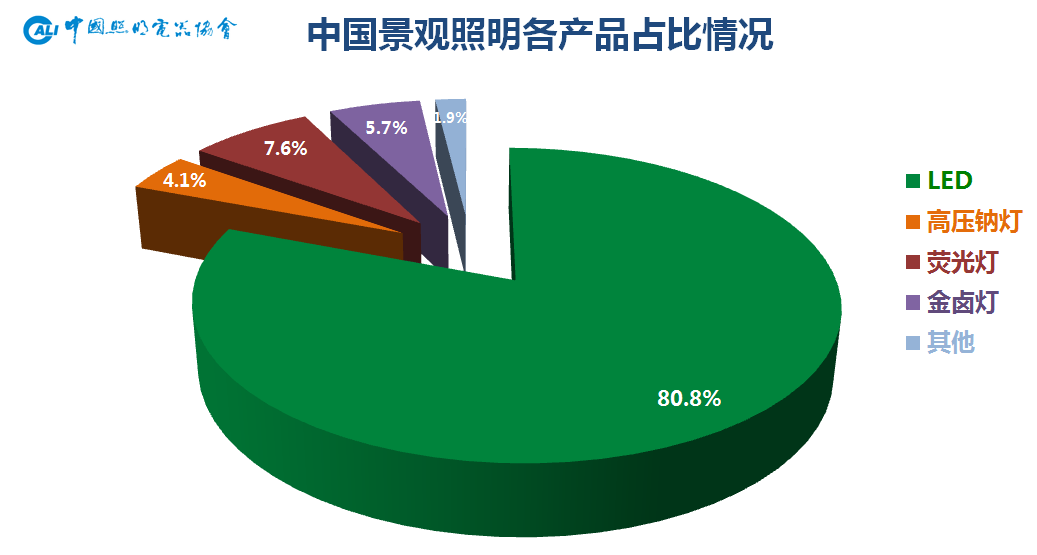
According to estimates, the market size of landscape lighting products in 2020 was about 16 billion yuan, a year-on-year decline of about 40%; unlike road lighting, LED products dominate in the landscape lighting field.
2. Road lighting: replacement potential remains considerable, and the market landscape remains fragmented.
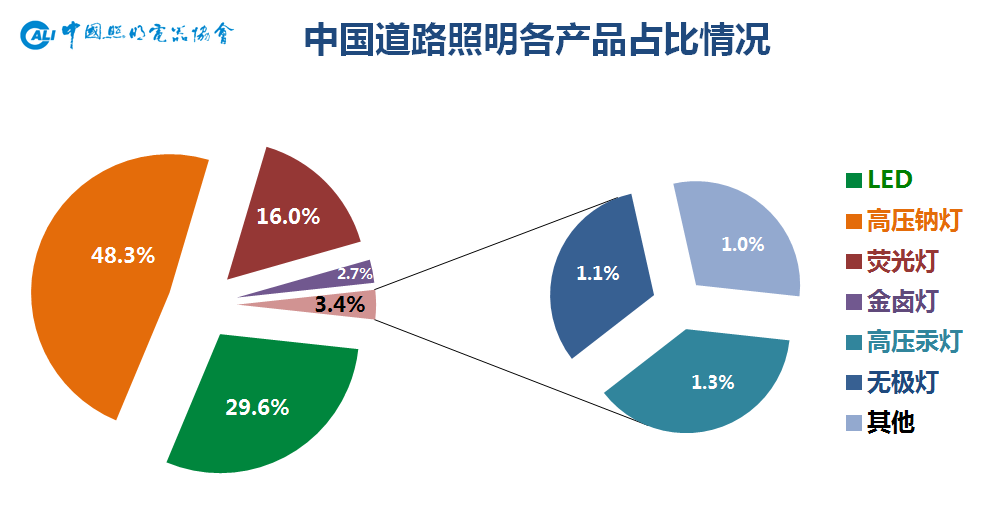
According to statistics from China's street light management departments, mainstream products in road lighting applications in China are still high-pressure sodium lamps (HPS). After years of substitution, LED products account for only 30%, reflecting that in the field of road lighting, China still has over 20 million street lights that are not LED. Globally, the penetration rate of LED street lights is still no higher than 15%. Whether focusing on China or looking globally, LED holds a relatively high proportion in incremental markets, but in the much larger existing stock market, there is still significant replacement potential.
From the perspective of market landscape, changes have occurred in recent years. Enterprises represented by Huapu Yongming have adopted an innovative operating model focused on R&D and manufacturing, selling directly to street light manufacturers, achieving substantial development and causing significant impact on the original landscape.
The current landscape can be summarized as "two concentrations and one fragmentation" . "One concentration" refers to the fact that after years of development, some large-scale head enterprises in street lighting have emerged, including: Huapu Yongming, Signify (Chengdu), Unilumin, Sansi, Jinghe, Jingri, Qingshang, Yashi, Delos, OPPLE, Dabang, Yaming, Liyang, etc.; "The other concentration" refers to the gradual formation of concentrated manufacturing and supply chain regions such as Gaoyou Yangzhou, Zouqu Changzhou, Shenzhen, Guzhen Zhongshan, Henglan Zhongshan, etc. Although individual enterprises may not be large in scale, they excel in numbers, maintain close ties with engineering terminals, and have formed a certain industrial cluster.
"One fragmentation" refers to the fact that the overall industrial concentration in the street lighting industry remains low, similar to the overall landscape of the lighting industry. In the nearly 30 billion yuan street lighting market, head enterprises are rare; currently, no enterprise at the 1 billion yuan level has emerged, and enterprises at the 500 million yuan level are also few. However, there are a vast number of small and medium-sized enterprises with sales in the tens of millions of yuan, accounting for the absolute majority of the entire market.
It is also worth mentioning that in 2020, tunnel lighting achieved solid growth driven by investments in 'New Infrastructure' and 'New Urbanization' projects. Particularly in the Southwest region, the volume of projects showed impressive growth, driving performance improvements for related enterprises.
3、智慧灯杆:如火如荼方兴未艾,两新一重推动发展。
1、为什么是灯杆?
First and foremost, it must be clear that 'combining multiple poles into one, using one pole for multiple purposes' is the trend. It represents the integrated utilization of various urban resources and is based on the vision for future smart city construction. Its implementation benefits urban management by reducing costs and improving efficiency.
Poles serve as carriers; their characteristic lies in their widespread and uniform distribution across cities. The pole network penetrates every corner of the city like capillaries: wherever there are people and roads, there are poles, making them ubiquitous in human activity; they also possess a certain height and function as electrical terminals. Against the backdrop of vigorous promotion of new infrastructure, 5G network construction will face a surge in base station deployment. Under current technology, the density of existing 3G/4G macro base stations from major operators can already achieve broad signal coverage in cities. However, to achieve deep signal coverage, micro base stations must play a role. At this stage, poles meet the conditions to carry micro base stations during the transition from 4G to 5G. Simultaneously, under the context of smart city construction requiring all-domain perception and universal connectivity, poles also serve as excellent carriers for data-collecting sensors.
2. Policy-driven application-side construction
Since the state began promoting smart city construction in 2012, the Ministry of Housing and Urban-Rural Development has successively released three batches of smart city pilot lists. The total number of pilot cities has reached 290, providing many development opportunities for enterprises engaged in smart city-related businesses. In 2019, the Ministry of Industry and Information Technology and the State-owned Assets Supervision and Administration Commission jointly issued the "Implementation Opinions on Promoting Co-construction and Sharing of Telecommunications Infrastructure to Support 5G Network Construction," requiring telecommunications enterprises and tower companies to intensively utilize social pole and tower resources, carry out new micro-base station construction, and reserve 5G site resources in advance.
At the local level, Beijing, Shanghai, Tianjin, Chongqing, Guangdong, Jiangsu, Zhejiang, Hebei, Shaanxi, Fujian, Hunan, Sichuan, Anhui and other places have successively introduced relevant policies to promote the construction of smart lamp posts with "multiple poles combined, one pole used for multiple purposes" for various types of poles and towers in cities.
It can be seen that both central and local governments are making layouts in the field of smart lamp posts. As smart lamp posts possess the attribute of urban public facilities, policy will play a core driving role in their construction.
3. Market growth rate is considerable and potential is huge
Under the investment background of national promotion of 'two new and one heavy' construction, the total number of related projects in 2020 was approximately 200, with a total investment scale of nearly 50 billion yuan. The average price of project targets jumped from the tens of millions level in 2018 and 2019 to the hundreds of millions level.
According to current data, China has nearly 30 million street light poles, and there are also about 15 million other poles such as video surveillance poles and communication poles. However, the penetration rate of smart street light poles is currently quite low, so the potential is huge.
4. Standard system construction is still in the primary development stage.
China's smart city construction process is currently at the forefront of the world. Precisely because of this, there is a lack of experience to draw upon, and many aspects of standard system construction still need to be explored independently. It can be seen that not only the National Committee for Urban Public Facility Services Standards, the National Information Technology Standards Committee, the China Electricity Council, etc., are committed to establishing relevant national standards; relevant associations and societies are also exploring the formulation of group standards; Shanghai, Guangdong, Jiangsu and other places are also formulating local standards and specifications based on local application promotion situations.
Overall, the construction of the standard system related to smart street light poles is in the primary exploration stage, and currently focuses on the establishment of interface standardization to release space for stock renovation.
5. Issues/Pain Points in Development
Smart lamp posts, as a comprehensive smart city infrastructure, are expected to enable the co-construction, sharing, and governance of information infrastructure. However, as an emerging entity, there are still many issues that need to be addressed urgently.
01 技术/业态跨界
Smart lamp posts are a composite of various equipment, facilities, and technologies. They carry multiple functions such as road lighting, 5G base stations, traffic signs, environmental monitoring, video surveillance, radio frequency identification, notification broadcasting, charging facilities, network transmission, and even advertising displays, serving as an access terminal for building smart cities.
This industry not only involves lighting technology itself but also spans cross-border fields such as communications, sensing, security, control, the internet, and industrial design. Due to limitations in the capabilities of single enterprises or even single business models, it is difficult to comprehensively address all aspects; therefore, cross-industry collaboration across multiple sectors is inevitably an effective way to promote its development.
02 Cross-departmental Business Operations
Currently, China's infrastructure construction, management, and operation involve multiple departments, with data sources scattered across various locations. A single lamppost integration solution involves different urban management functions such as traffic, municipal services, public security, environmental protection, meteorology, and urban administration. How to break through 'multi-head management' and eliminate 'information silos' is a major challenge in promoting the market-oriented operation of smart lampposts.
这时就需要有个综合协调能力强的管理部门来总体规划和统筹安排。比如上海进博会前为推进合杆共杆成立的“城市综合管理办公室”,就是一个打通“多头管理”的尝试。而新基建中,大数据中心的建设也将在智慧城市中发挥重要作用,解决“信息/数据孤岛”的问题。
03 规划设计和具体建设
随着中国社会经济的快速发展,在不同历史时期不同社会发展水平下激发了多样的基建需求,由此也造成了一些全城工地、冗余建设问题,既影响城市美观、干扰居民生活又造成资金浪费。所以现在强调新基建、新城镇化建设,就是无论是存量改造还是增量新建,做好上层规划设计是前提。目前一种流行的想法是智慧城市应先从智慧园区开始尝试,因智慧园区一方面投资相对较少,另一方面利益权属关系简单,便于推动工作。
In the specific construction of smart lamp poles, issues such as immature solutions, misplaced functions, forced feature stacking, and lack of industrial design exist. Regarding the multiple functions of smart streetlights, there is an urgent need to distinguish between true needs and false needs.
04 Business models still need exploration
In terms of overall operations, the current discussion focuses mainly on government investment and construction with social self-raising as a supplement. In the future, the model of handing over to third-party operation and management through bidding will be adopted.
From the perspective of enterprises, smart lamp poles will generate multiple revenue streams, such as manufacturing, installation, energy saving, O&M, advertising, charging, rent, data, etc., all of which will bring income. For manufacturers and operators, their value propositions are different.
For most luminaire and lamp pole manufacturing enterprises in the lighting industry, they do not yet possess integration capabilities, but can actively invest in R&D to expand industry application scenarios and functions according to demand. Through R&D and manufacturing advantages, they can form patents to enhance core competitiveness and perfect themselves to seek integration. Additionally, the model of 'joining hands to go global' formed by products from various ends of the supply chain is also worth encouraging.
For operators such as engineering companies, besides leveraging their professional expertise to secure project engineering with ease, they must also consider extending their business formats, transforming from engineering contractors into comprehensive urban service providers to pursue sustainable development.
Smart lamp posts serve as carriers for information collection, processing, and dissemination. They not only save urban space and enhance the city's image but also play a role in integrating urban resources and improving operational efficiency. In the future, planning and management should be coordinated at the city level; big data institutions should be established and improved, device identification standardized, and data sharing developed; interface standards should be defined and product quality controlled; investment models should be flexible to introduce private capital; innovative application functions and operational models should be encouraged. This will further promote the smart lamp post Industry gradually developing towards a mature stage characterized by specialized demand, standardized design, and diverse applications.
China Light
The official website of the China Association of Lighting Industry and a full-media platform for the lighting sector. We provide authoritative and timely lighting information while striving to be a growth partner for businesses. From brand promotion and channel expansion to consulting, talent training and participation in standards development, we provide comprehensive professional services to help businesses improve quality and efficiency and jointly advance the high-quality development of the lighting industry.
Business Contacts
仇纯 (Ms.): 158 6155 3579
顾君 (Mr.): 137 7157 5253