
Good news! Major progress achieved in research on light-induced negative emotions at night
近日,中国科学技术大学生命科学学院、中科院脑功能与脑疾病重点实验室薛天课题组,首次描述了介导夜间异常光诱发抑郁样表型的神经环路结构与功能;证明了是夜间不正常光线而不是节律或睡眠的紊乱造成抑郁样行为,并且发现了该环路的可兴奋性受到昼夜节律门控调制,首次诠释了光在白昼和夜晚截然相反的情绪作用的内在机理。
The related findings, titled "A circadian rhythm-gated subcortical pathway for nighttime-light-induced depressive-like behaviors in mice," were published online in Nature Neuroscience on June 1.
Light is the foundation of life. Life on Earth has evolved under alternating day-night light conditions, developing a series of photoreceptive and light-regulated neurophysiological functions. In addition to image vision, these include circadian photoentrainment, sleep regulation, photophobia, the pupillary light reflex, and melatonin expression—collectively referred to as "non-image-forming vision." Throughout millions of years of human evolution, truly abundant nighttime illumination has existed for only a little over a century since the Industrial Revolution, and evolution has not yet had sufficient time to adapt humans to this change in artificial lighting environments. A body of public health evidence indicates that prolonged exposure to abnormal light at night can lead to depression-like mood disturbances and cognitive impairments, yet we know very little about the underlying neural mechanisms.
Recent research on neural circuits underlying light-mediated mood regulation has become a hot topic. A study (Fernandez et al., Cell, 2018) showed that prolonged fragmented light-dark stimulation may induce negative emotions through projections from the retina to the perihabenular nucleus (pHb). However, it remains unclear whether it is the light itself or the disruption of circadian rhythms that affects mood, and the complete neural circuit for light-controlled mood regulation has not yet been mapped. More importantly, daylight often positively regulates human mood (Huang et al., Neuron, 2019), and the mechanism behind the opposite effects of light during daytime and nighttime on mood has long remained an unsolved mystery.
To answer the above questions, Professor Xue Tian's research group constructed a light at night (LAN) model to simulate the abnormal lighting patterns in current society. Two hours of blue light exposure every night from 9 to 11 p.m. for three consecutive weeks induced depression-like behaviors in mice without disrupting their circadian rhythms or sleep.
Non-image-forming visual functions are considered to be mediated by a class of photoreceptors in the retina distinct from rods and cones—intrinsically photosensitive retinal ganglion cells (ipRGCs). By using transgenic animals lacking rods, cones, and ipRGCs, the research team found that ipRGCs play a sufficient and necessary role in the process of LAN-induced depressive emotions.
To further elucidate the central structures mediating the effects of LAN, the research team found that ipRGCs project to the pHb. After lesioning the pHb, emotion-related behaviors in mice were no longer affected by LAN. Meanwhile, optogenetic activation of the ipRGC-to-pHb projection also induced depression-like behaviors in mice. These results fully validate that the pHb is a key circuit node mediating the effects of LAN. Further circuit studies revealed that the dorsal part of the pHb (dorsal pHb, dpHb) projects to the nucleus accumbens (NAc), while the ventral part (ventral pHb, vpHb) projects to the medial prefrontal cortex (mPFC). The NAc is a nucleus closely associated with reward, whereas the mPFC is closely linked to emotion and higher-order cognition. The team used AAV viral tools to selectively inhibit the inputs from the pHb to the mPFC and NAc, respectively. The results confirmed that only inhibition of the dpHb-NAc projection affected the role of LAN. Furthermore, direct activation of the dpHb-NAc projection during specific nighttime periods for three consecutive weeks induced depression-like behaviors independently of nighttime light exposure. These findings reveal the core role of the dpHb-NAc projection in LAN-induced negative emotions.
最后,为深入探究光在不同时段(白天/夜晚)对情绪产生不同调控的机制。通过单细胞膜片钳和在体光纤记录,研究者发现投射到NAc的dpHb神经元在夜间相比白天可兴奋性更高,更易发放动作电位;而投射到mPFC的vpHb神经元并没有类似现象。表明投射到NAc的dpHb神经元作为受昼夜节律控制的阀门,只在夜间开放,允许夜间光线信号通过dpHb调节同奖赏密切相关的核团NAc,进而诱发负性情绪。
Researchers further hypothesize that the ipRGCs–dpHb–Nac neural circuit may help animals avoid exposure to light during day-night transitions under normal physiological conditions, thereby evading predators. If this circuit also exists in humans, it could be hijacked by artificial lighting at night, potentially inducing negative emotions.
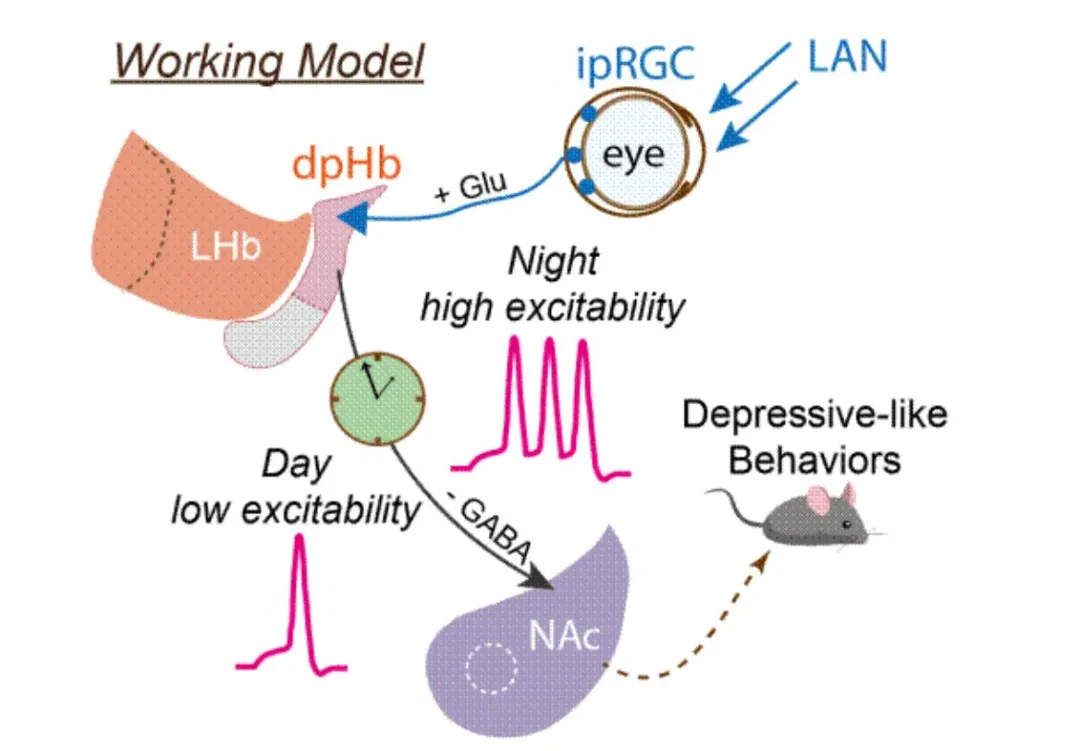
USTC Makes Progress in Research on Nighttime Light-Induced Negative Emotions
This study is the first to elaborate in detail on the circuit basis and rhythmic gating mechanisms of negative emotions induced by nighttime light. These findings can, to some extent, shed light on the mechanisms by which nighttime light interference (such as urban lighting or the use of electronic devices like mobile phones and computers) leads to negative emotions such as depression. This is of great significance for people to correctly understand the potential hazards of excessive nighttime lighting and to explore prevention and treatment methods.
Dr. An Kai from Professor Xue Tian's research group and Professor Zhao Huan from Hefei University are co-first authors, with Zhao Huan and Xue Tian as co-corresponding authors. This research was supported by the National Natural Science Foundation of China, the Ministry of Science and Technology's "973" Program, and the Chinese Academy of Sciences' Category A Strategic Priority Research Program.
China Light
The official website of the China Association of Lighting Industry and a full-media platform for the lighting sector. We provide authoritative and timely lighting information while striving to be a growth partner for businesses. From brand promotion and channel expansion to consulting, talent training and participation in standards development, we provide comprehensive professional services to help businesses improve quality and efficiency and jointly advance the high-quality development of the lighting industry.
Business Contacts
仇纯 (Ms.): 158 6155 3579
顾君 (Mr.): 137 7157 5253