
Seoul Viosys goes public in South Korea | UV LED "Violeds" technology helps prevent the spread of the novel coronavirus
Officially listed! Seoul Viosys lists on the Korean KOSDAQ
According to Korea's Pulse News, Seoul Viosys conducted its initial public offering (IPO) on the secondary KOSDAQ market in South Korea, attracting significant subscription interest, with shares officially listed for public trading on March 12.
Seoul Viosys announced that from February 26 to 27, the company attracted bids worth KRW 14.1 trillion (approximately USD 11.6 billion) from the secondary market, achieving an oversubscription rate of 942.7 times.
The report stated that Seoul Viosys issued 400,000 shares to retail investors (equivalent to 20% of its 2 million share IPO), attracting 377,081,150 bidders. Based on strong demand from institutional investors at a ratio of 1119:1 in the book-building transaction that ended on February 21, the IPO price was set at KRW 7,500, the upper limit of the expected price range.
According to available information, SEOUL VIOSYS (a subsidiary of Seoul Semiconductor) is a specialized company offering comprehensive solutions for UV LED, next-generation 3D sensor/laser light source "VCSEL", and display single-pixel "Micro Clean Pixel" technologies.
Founded in 2002, the company currently holds a significant share of the global UV LED market. It boasts a full-spectrum product portfolio ranging from ultraviolet (UV) to visible light and infrared (IR) (200nm – 1600nm), along with over 4,000 related technical Patents, securing a leading technological position in the global market.
The representative proprietary UV LED technology "Violeds" does not use harmful chemicals and relies solely on light to provide solutions for a wide range of industry sectors, including sterilization and disinfection (UVC), skin regeneration (UVB), air and water purification, insect trapping, and promoting plant growth.
Seoul Viosys UV LED "Violeds" can prevent the spread of the novel coronavirus
Not long ago, Seoul Viosys announced that with the global spread of the novel coronavirus (COVID-19), customer inquiries for its innovative UV LED technology "Violeds," which offers superior sterilization effects, have increased more than fivefold compared to the previous month.
据《紫外线杀菌辐照手册》(Ultraviolet Germicidal Irradiation Handbook[1]),单波长紫外线(UV-C)照射一分钟可杀灭冠状病毒90%以上。此外,中国试验机构对采用此项技术的空调家电产品测试后发现,气溶胶病毒颗粒减少97%。
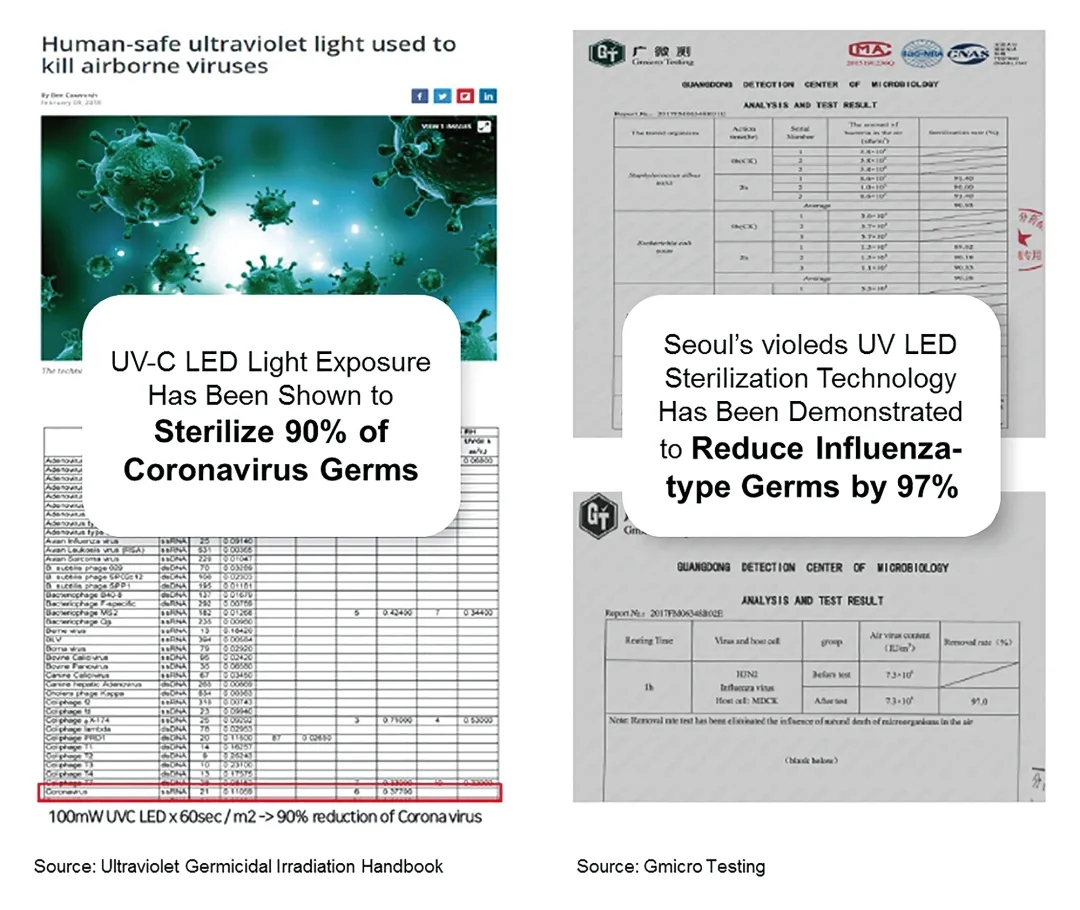
(Left) "Ultraviolet Germicidal Irradiation Handbook" (Right) Guangdong Microbiology Testing Center Certification
Until recently, many companies were conservative in adopting UV LED technology because traditional UV LEDs generally had a short service life (10,000 hours) and high costs. However, Seoul Viosys has recently increased the lifespan of its Violeds to over 50,000 hours, similar to visible light LEDs used for general lighting, and enhanced production capacity to achieve cost competitiveness. Currently, due to the coronavirus pandemic, many Chinese automotive companies are actively evaluating the feasibility of implementing in-vehicle sterilization using "Violeds" technology. Discussions on various UVC product application projects are also rapidly increasing.
Violeds UV LED technology has been used by NASA on the International Space Station for sterilization, providing astronauts with a healthy, sterile environment.
Maltani, South Korea's largest lighting company, has adopted Violeds UV LED for sterilization lighting.
RGF, the leading supplier of air purification systems in the United States, has adopted Violeds technology for its Halo-LED indoor sterilization heating and cooling air conditioning system newly released in November 2019. More information is available on YouTube.
In addition, Violeds UV LED technology is also used in water purifiers from SK Magic and Hyundai Capital.
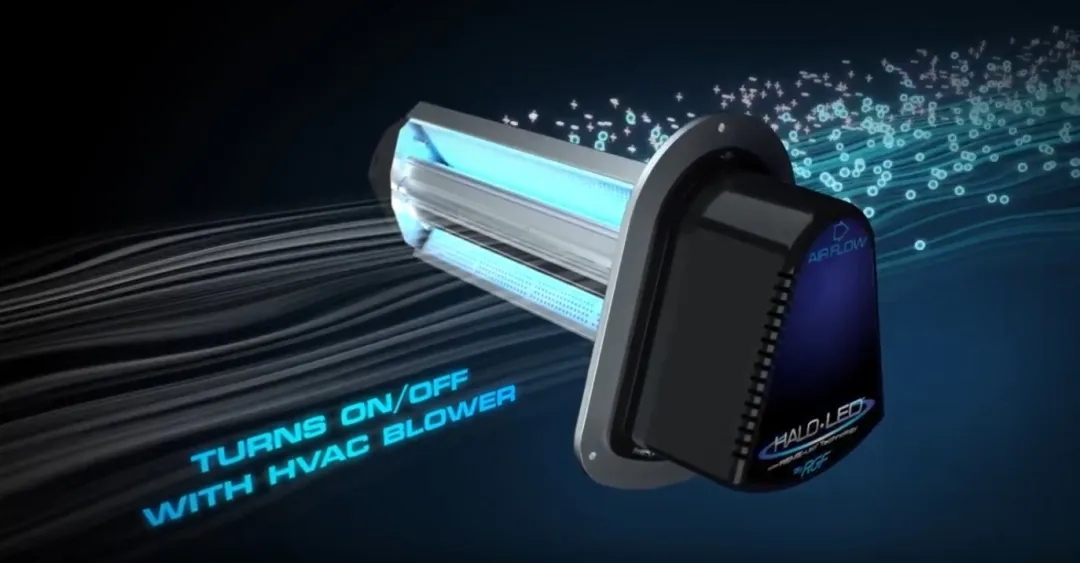
RGF air conditioning system using Seoul Viosys "Violeds" technology
"Our Violeds technology has made progress in the treatment of vitiligo and in biological research involving plants and animals. We hope to help protect human health and create a clean world as soon as possible," said Lee Jung-hoon, CEO of Seoul Semiconductor. "We aim to significantly reduce prices by extending the lifespan of UV LEDs from the current 10,000 hours to over 50,000 hours (the level of standard lighting LEDs), helping people create a safe and clean environment amid the spread of the coronavirus that threatens human health."
In addition, in 2018, Seoul Viosys acquired the professional optoelectronics company RayCan to enhance its next-generation VCSEL technology for smartphone facial recognition, automotive autonomous driving, and other applications, which has officially entered mass production. In January 2020, it launched the differentiated "Micro Clean Pixel" to replace single-pixel RGB Micro LED in the traditional display market and capture market share.
China Light
The official website of the China Association of Lighting Industry and a full-media platform for the lighting sector. We provide authoritative and timely lighting information while striving to be a growth partner for businesses. From brand promotion and channel expansion to consulting, talent training and participation in standards development, we provide comprehensive professional services to help businesses improve quality and efficiency and jointly advance the high-quality development of the lighting industry.
Business Contacts
仇纯 (Ms.): 158 6155 3579
顾君 (Mr.): 137 7157 5253